Материал: Радовель В.А. - Английский Язык
СОДЕРЖАНИЕ
1. Ознакомьтесь с терминами текста 1.
3. Просмотрите текст 1 еще раз. Ответьте на вопросы, используя информацию текста.
5. Вспомните образование и случаи употребления The Past Simple Tense.
6. Ознакомьтесь с терминами текста 2
7. Прочтите текст 2 и скажите, что такое компьютер и каковы его основные функции.
4. Прочтите, переведите и запомните следующие выраже ния:
9. Найдите в тексте 2 английские эквиваленты следующих словосочетаний:
11. Выполните письменный перевод текста 3 по вариантам.
1. Выберите вариант, который лучше всего выражает глав ную идею текста 2.
2. Вставьте необходимые слова вместо пропусков.
3. Подберите к терминам, данным в левой колонке, определения, представленные справа.
1. Ознакомьтесь с терминами текста 1.
1. Ознакомьтесь с терминами текста 1
2. Прочтите текст и скажите, о каких первых вычислительных приборах рассказывается в нем.
3. Просмотрите текст еще раз. Ответьте на вопросы, используя информацию текста.
5. Переведите следующие цепочки существительных:
6. Подберите к терминам, данным в левой колонке, опре деления, представленные справа.
10. Ответьте на вопросы, используя информацию текста.
11. Найдите в тексте английские эквиваленты следующих словосочетаний:
12. Вспомните значение новых слов и догадайтесь о зна чении их производных.
2. Прочтите текст и скажите, о каких типах компьютеров и сферах их применения вы узнали.
3. Просмотрите текст еще раз. Ответьте на вопросы, ис пользуя информацию текста.
4. Найдите в тексте английские эквиваленты следующих словосочетаний:
5. Образуйте (и переведите) имена существительные от приведенных ниже глаголов с помощью суффиксов:
6. Переведите предложения, содержащие Participle I и Participle II, в функции обстоятельства.
9. Ответьте на вопросы, используя информацию текста.
10. Найдите в тексте английские эквиваленты следующих словосочетаний:
12. Озаглавьте каждый компонент текста и составьте небольшой реферат к нему (по вариантам).
2. Согласуйте слова в левой колонке с их интерпретацией, предложенной справа.
3. Просмотрите текст еще раз. Дайте ответы на вопросы, используя информацию текста.
8. Ознакомьтесь с терминами текста 2.
3. Просмотрите текст еще раз. Ответьте на вопросы, используя информацию текста.
4. Найдите в тексте английские эквиваленты следующих словосочетаний:
6. Найдите в тексте слова, близкие по значению следующим:
7. Переведите предложения, содержащие Perfect Participle Active и Perfect Participle Passive.
8. Ознакомьтесь с терминами текста 2.
14. Выполните письменный перевод текста по вариантам.
4. Найдите в тексте английские эквиваленты следующих словосочетаний:
6. Переведите предложения, содержащие независимый причастный оборот.
14. Ознакомьтесь с терминами текста 3.
3. Ответьте на вопросы, используя информацию текста.
4. Найдите в тексте английские эквиваленты следующих словосочетаний:
12. Расшифруйте следующие аббревиатуры и переведите их.
13. Переведите безличные предложения. Обратите внима ние на их специфику.
14. Вспомните формы причастий, проанализируйте и пе реведите следующие предложения:
16. Прочтите текст и составьте письменно реферат на английском языке.
1. Вставьте необходимые слова вместо пропусков.
2. Прочтите текст и объясните, как вы понимаете термин«компьютерное программирование».
3. Просмотрите текст еще раз и ответьте на вопросы, ис пользуя информацию текста.
4. Найдите в тексте английские эквиваленты следующих словосочетаний:
6. Переведите предложения, содержащие сослагательное наклонение.
8. Прочтите текст и объясните, что представляют собой языки программирования.
13. Выполните перевод следующих текстов письменно по вариантам.
14. Прочтите тексты (по вариантам) и составьте рефераты на английском языке.
3. Определите неличные формы глагола, содержащиеся в следующих предложениях. Переведите их.
13. Прочтите текст (по вариантам) и озаглавьте его. Вы полните письменный перевод текста по вариантам.
* * *
1. It is well known that the quick development of electronics began with the invention of transistors. They replaced electronic tubes due to their numerous advantages. One of the main advantages of the transistors in comparison with the vacuum tube is absence of filament power loss. One of the principal caus-
Английский язык. Основы компьютерной грамотности 28
e s
of damages in electronic circuitry is high temperature. Theheat
causes breakdown of tubes and other circuit elements that are very
sensitive to this influence. The transistor, on the other hand,
does not heat its surroundings.
s
of damages in electronic circuitry is high temperature. Theheat
causes breakdown of tubes and other circuit elements that are very
sensitive to this influence. The transistor, on the other hand,
does not heat its surroundings.
Another advantage of the transistor is its long life. The life of the average transistor is more than ten thousand operating hours. Because of its long lifetime and raggedness, the transistor is very reliable and has much better efficiency in professional equipment.
2. As we know, transistors replaced electronic tubes due to their numerous advantages. One of the advantages of the transistor is its small dimensions. Because of their small size, the absence of heating and other properties, transistors make it possible to produce compact, small-dimensioned electronic devices which consume very little power.
In conclusion it is important to note that transistors revolutionized many fields of technology. They are successfully used for direct transformation of heat energy by means of thermal elements. They are also used to convert radiant energy into electricity with the help of photocells or solar batteries. Light sources and lasers are built on the basis of transistors. They find wide application in computers, automatic devices, aviation, communication, etc.
Notes
Filament power loss — отсутствие энергии на нити накала
TESTS 1. Вставьте необходимые слова вместо пропусков.
1. Transistors have many over vacuum tubes.
a) patterns; b) advantages; c) scales
2. They very little power.
a) consume; b) generate; c) embrace
3. An integrated circuit is a group of elements connected together by some circuit technique.
a) processing; b) assembly; c) manipulation
29 Unit 2. Development of Microelectronics
4 . The
transistor consists of a small piece of a with
. The
transistor consists of a small piece of a with
three electrods.
a) diode; b) conductor; c) semiconductor.
5. Modern began in the early 20th century with the
invention of electronic tubes.
a) miniaturization; b) electronics; c) microelectronics
6. John Fleming was the of the first two-electrode
vacuum tube.
a) generator; b) receiver; c) inventor
7. One of the transistor advantages was lower power ,
in comparison with vacuum tubes.
a) consumption; b) reception; c) transmission.
8. Microelectronics greatly extended man's intellectual
a
2. Раскройте скобки и выберите глагол в требуемом залоге: действительном или страдательном.
1. Electronic devices (help; are helped) people discover new phenomena of nature. 2. The transistor (replaced; was replaced) by vacuum tubes thanks to its numerous advantages. 3. Due to transistors all circuit functions (carried out; were carried out) inside semiconductors. 4. Electronic devices (use; are used) in scientific research. 5. Before the invention of the transistor its function (performed; was performed) by vacuum tubes. 6. The reliability of electronic systems (connect; is connected) with the number of descrete components. 7. Semiconductor integrated circuits (helped; were helped) to increase reliability of devices. 8. New types of integrated circuits (have developed; have been developed) lately.
Unit3
HISTORY OF COMPUTERS
1. Ознакомьтесь с терминами текста 1
calculating device [ksllcjiK'leitin di'vais] — вычислительное
устройство
multiple ['nultiplj — кратный
abacus ['aebakss] — счеты
slide rule ['slaid 'nil] — логарифмическая линейка
logarithm table ['Ьдэпбт 'teibl] — логарифмическая таблица
calculus pkaelkjidas] — исчисление; математический анализ
general-purpose ['4зепэгэ1 'p3:pas] — общего назначения, универсальный
to cut out the human being altogether — полностью исключить человека
to manipulate [ms'nipjuleit] — обрабатывать, преобразовывать; управлять
data processing ['deits pre'sesin] — обработка данных (информации)
tabulate the census — занести данные по переписи (населения) в таблицу
means of coding ['mi:nz sv 'koudin] — средства кодирования (шифровки)
to punch the holes ['pAntf 5э 'houlz] — пробивать отверстия
punched card ['рлШ(1 'kaid] — перфокарта
to perform [рэТэ:т] — выполнять, производить (действие); осуществлять;
unit of data ['jitnit sv 'deita] — единица информации keyboard terminals — терминал (вывод) с клавишным управлением
31 Unit 3. History of Computers
p roliferation
[pr3,hf3'reijh] —размножение,
быстрое
увеличение
roliferation
[pr3,hf3'reijh] —размножение,
быстрое
увеличение
2. Прочтите текст и скажите, о каких первых вычислительных приборах рассказывается в нем.
Text У. THE FIRST CALCULATING DEVICES
Let us take a look at the history of computers that we know today. The very first calculating device used was the ten fingers of a man's hands. This, in fact, is why today we still count in tens and multiples of tens.
Then the abacus was invented. People went on using some form of abacus well into the 16th century, and it is still being used in some parts of the world because it can be understood without knowing how to read.
During the 17th and I8lh centuries many people tried to find easy ways of calculating. J.Napier, a Scotsman, invented a mechanical way of multiplying and dividing, which is now the modern slide rale works. Henry Briggs used Napier's ideas to • produce logarithm tables which all mathematicians use today.
Calculus, another branch of mathematics, was independently invented by both Sir Isaak Newton, an Englishman, and Leibnitz, a German mathematician. The first real calculating machine appeared in 1820 as the result of several people's experiments.
In 1830 Charles Babbage, a gifted English mathematician, proposed to build a general-purpose problem-solving machine that he called "the analytical engine". This machine, which Babbage showed at the Paris Exhibition in 1855, was an attempt to cut out the human being altogether, except for providing the machine with the necessary facts about the problem to be solved. He never finished this work, but many of his ideas were the basis for building today's computers.
By the early part of the twentieth century electromechanical machines had been developed and were used for business data processing. Dr. Herman Hollerith, a young statistician from the US Census Bureau successfully tabulated the 1890 census. Hollerith invented a means of coding the data by punching holes into cards. He built one machine to punch the holes and others — to tabulate the collected data. Later Hollerith left the Census
Английский
язык. Основы компьютерной грамотности 32
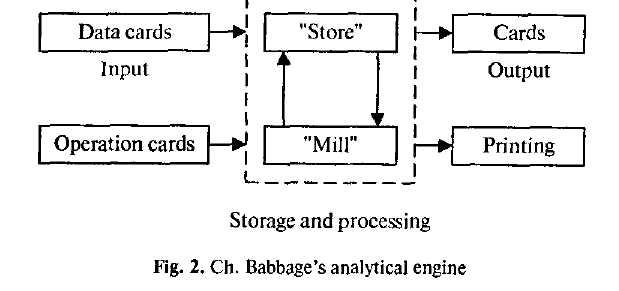
Until the middle of the twentieth century machines designed to manipulate punched card data were widely used for business data processing. These early electromechanical data processors were called unit record machines because each punched card contained a unit of data.
In the mid—1940s electronic computers were developed to perform calculations for military and scientific purposes. By the end of the 1960s commercial models of these computers were widely used for both scientific computation and business data processing. Initially these computers accepted their input data from punched cards. By the late 1970s punched cards had been almost universally replaced by keyboard terminals. Since that . time advances in science have led to the proliferation of computers throughout our society, and the past is but the prologue that gives us a glimpse of the nature.
3. Просмотрите текст еще раз. Ответьте на вопросы, используя информацию текста.
1. What was the very first calculating device? 2. What is the abacus? 3. What is the modern slide rule? 4. Who gave the ideas for producing logarithm tables? 5. How did Newton and Leibnitz contribute to the problem of calculation? 6. When did the first calculating machine appear? 7. What was the main idea of . Ch.Babbage's machine? 8. How did electromechanical machines appear and what were they used for? 9. What means of
33 Unit 3. History of Computers
c oding
the data did Hollerith devise? 10. How were those electromechanical
machines called and why? 11. What kind of computers
appeared later? 12. What new had the computers of 1970s?
oding
the data did Hollerith devise? 10. How were those electromechanical
machines called and why? 11. What kind of computers
appeared later? 12. What new had the computers of 1970s?
4. Найдите в тексте английские эквиваленты следующих словосочетаний:
Вычислительное устройство; легкий способ вычисления; поэтому (вот почему); кратное десяти; изобрести механический способ умножения и деления; логарифмическая линейка; составить таблицы логарифмов; математический анализ; изобрести независимо (друг от друга); в результате; полностью исключить человека; кроме (за исключением); обработка деловой информации; средство кодирования информации; перфокарты; пробивать отверстия; оформить собранные данные в таблицу; работать с данными на перфокарте; устройство, записывающее информацию блоками; единица информации; выполнять вычисления; для научных целей; клавишный терминал
5. Вспомните значение следующих глаголов и подберите к ним производные. Например: to calculate — calculating, calculator, calculation.
To compute, to invent, to know, to multiply, to divide, to depend, to solve, to provide, to process, to code, to punch, to collect, to design, to store, to contribute, to use, to manipulate, to assemble, to connect, to consume, to rely, to divide, to multiply, to inform, to instruct, to discover, to operate.
6. Переведите словосочетания, содержащие:
А. Причастие I— Participle I
Computers using vacuum tubes; the machine calculating mathematical problems; the computer keeping instructions in its memory; binary code storing data and instructions; the vacuum tube controlling and amplifying -electronic signals; computers performing computations in milliseconds; electronic . pulses moving at the speed of light; students coding the information by using a binary code; devices printing the information; keyboard terminals replacing vacuum tubes.
Английский язык. Основы компьютерной грамотности 34
Б .
Причастие
II— Participle II
.
Причастие
II— Participle II
The given information; the name given to the machine; the coded data; the device used in World War II; the invention named ENIAC; the machine called EDVAC; instructions kept in the memory; the engine designed for storing data; data stored in a binary code; vacuum tubes invented by J. Neumann; the general-purpose machine proposed by Ch. Babbage; the machine provided with the necessary facts.
7. Ознакомьтесь с терминами текста 2.
analog computer [э'па?1эд kam'pjuta] — аналоговый компьютер