Материал: Строительная механика и сопротивление материалов. Сафронов В.С., Ефрюш
|
|
C |
|
|
n |
2 |
n / 2, |
|||
|
|
|
|
|
||||||
|
|
2,1,n |
|
|
|
|
|
|
||
|
|
C |
|
|
n |
2 |
n 1/ 2. |
|||
|
|
|
|
|
||||||
|
|
3,1,n |
|
|
|
|
|
|
||
When k=2 we have |
|
|
|
|
|
|
|
|
|
|
C |
|
16n |
3 |
/ 3 |
10n |
2 |
14n / 3, |
|||
2,1,n |
|
|
||||||||
|
|
|
|
|
|
|
|
|
|
|
C |
|
2n |
2 |
2n, |
|
|
||||
2,1,n |
|
|
|
|||||||
|
|
|
|
|
|
|
|
|
|
|
C |
|
|
2n |
2 |
2n 2. |
|
|
|||
|
|
|
|
|||||||
3,1,n |
|
|
|
|
|
|
|
|
|
|
To obtain a generalization of the number of massesk will be required to carry out the calculations for k=1,2,...8. Generalizing these solutions using the same operators rgf_findrecurand rsolve, we obtain the final formula for the coefficients
C |
nk(2k |
2 |
4nk |
1)(k 2n) / 6, |
||||
|
||||||||
2,k ,n |
|
|
|
|
|
|
|
|
C |
kn(2n k) / 2, |
|
|
|
||||
2,k ,n |
|
|
|
|
|
|
|
|
C |
((( 1) |
k |
3)n |
2 |
2nk k |
2 |
) / 2. |
|
|
|
|
|
|||||
3,k ,n |
|
|
|
|
|
|
|
|
Thus, the dependence of the flexibilitycoefficient on the number of panels and number of nodes with mass is obtained. For even n = 2j, the expression has the form
|
|
|
(z a |
3 |
z |
c |
3 |
z h |
3 |
|
|
|
2 |
h |
2 |
EF), |
|||||||
k,n |
|
|
|
|
) / (6n |
|
|||||||||||||||||
|
1 |
|
|
|
2 |
|
|
|
3 |
|
|
|
|
|
|
|
|
|
|
|
|||
where |
|
|
|
|
|
|
|
|
|
|
|
|
|
|
|
|
|
|
|
|
|
|
|
|
z |
|
2 jk (4 j k )(1 8 jk 2k |
2 |
), |
|
|
|
|||||||||||||||
|
|
|
|
|
|
||||||||||||||||||
|
1 |
|
|
|
|
|
|
|
|
|
|
|
|
|
|
|
|
|
|
|
|
|
|
|
z |
2 |
6 jk (4 j k ), |
|
|
|
|
|
|
|
|
|
|
|
|
|
|||||||
|
|
|
|
|
|
|
|
|
|
|
|
|
|
|
|
|
|
|
|
|
|
|
|
|
z |
|
3(k |
2 |
4 jk |
|
4 j |
2 |
( 1) |
k |
12 j |
2 |
). |
||||||||||
|
3 |
|
|
|
|
|
|||||||||||||||||
|
|
|
|
|
|
|
|
|
|
|
|
|
|
|
|
|
|
|
|
|
|
|
|
Summing, according to |
|
2 |
|
||
k |
||
frequency of natural oscillations.
1/ (m |
k,n |
) |
|
|
(1), we obtain the desired lower estimate of the first
|
6h |
5 jEF / ( m( 2 j(512 j |
4 |
80 j |
2 |
7)a |
3 |
30(16 j |
2 |
1) jc |
3 |
15(1 24 j 56 j |
2 |
)h |
3 |
)) |
|
|
|
|
|
|
|
||||||||||
n |
|
|
|
|
|
|
|
|
|
|
|
|
|
|
|
|
.
A similar but more cumbersome expression holds for odd n's.
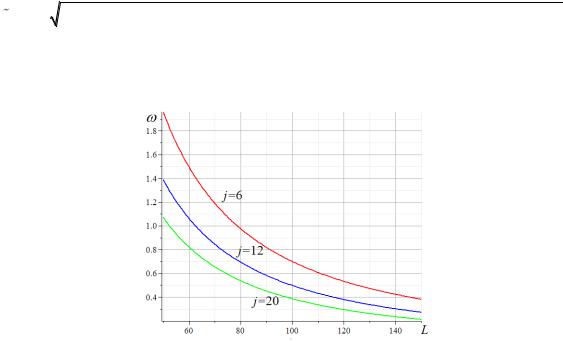
Graphs of the dependence of the oscillation frequency on the span length show that at a fixed span length, an increase in the number of panels leads to a decrease in frequency (Fig. 4, 5).
Fig. 4. Oscillation frequency depending on span length and number of panels at h=4m, a L / n L / (2 j), EF 2 104 kN, m 150 kg
10
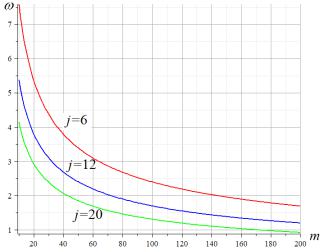
Fig. 5. Oscillation frequency depending on span length and number of panels at h=4m,
a L / n L / (2 j), L 50m, EF 2 10 |
4 |
kN |
|
In conclusion, it is stated that in comparison with solutions with one natural parameter specifying the order of the regular structure, to which we apply the induction method when deriving the general solution [18], in problems of vibration of a system with a discretely distributed mass (here - at the nodes of the lower chord) at least two natural parameters arise - the number of panels and the node number with mass. This greatly complicates the task. For example, if 10 separate solutions are required to obtain a sequence of numbers long enough to reveal its common term, then in a twoparameter problem this number increases to about 100. It should be borne in mind that symbolic transformations in computer mathematics systems require an order of magnitude more time than numerical transformations. Therefore, it is not always possible to construct an analytical dependence of dynamic characteristics on the order of a regular system.
Библиографический список
1.BachmannH. Vibration Problems in Structures: Practical Guidelines, Birkhäuser Verlag,
Basel, 1995. 234 p.
2.Алдушкин Р. В., Савин С. Ю. Исследование работы треугольных ферм при статических и динамических воздействиях // Строительство и реконструкция. 2010. №. 3-
29.С. 3-6.
3.Рыбаков Л. С., Мишустин И. В. Собственные колебания плоских регулярных упругих ферм ортогональной структуры // Механика композиционных материалов и конструкций. 1999. Т. 5. №. 2. С. 3-16.
4.Рыбаков Л. С., Мишустин И. В. Применение метода сосредоточенных масс к анализу собственных упругих колебаний одной регулярной ферменной структуры // Механика композиционных материалов и конструкций. 1999. Т. 5. №. 4. С. 51-64.
5.Мишустин И.В., Рыбаков Л. С. Колебания плоских упругих ферм ортогональной структуры //Известия Российской академии наук. Механика твердого тела. 2003. №.
2.С. 168-184.
6.Коробко В. И., Алдушкин Р. В., Бояркина О. В. Экспериментальные исследования стальных ферм с параллельными поясами на статические и динамические воздействия // Известия ОрелГТУ. Серия «Фундаментальные и прикладные проблемы техники и технологии». Орел: Орел ГТУ. 2009. №. 2/274. С. 9-12.
11
7.Vaez S. R. H., Mehanpur H., Fathali M. A. Reliability assessment of truss structures with natural frequency constraints using metaheuristic algorithms //Journal of Building Engineering. – 2019. – С. 101065.
8.Lieu Q. X., Do D. T. T., Lee J. An adaptive hybrid evolutionary firefly algorithm for shape and size optimization of truss structures with frequency constraints //Computers & Structures. – 2018. – Т. 195. – С. 99-112.
9.Pham H. A. Truss optimization with frequency constraints using enhanced differential evolution based on adaptive directional mutation and nearest neighbor comparison //Advances in Engineering Software. – 2016. – Т. 102. – С. 142-154.
10.Ахмедова Е.Р., Канатова М.И. Собственные частоты колебаний плоской балочной фермы регулярной структуры // Наука и образование в XXI веке: сборник научных трудов по материалам Международной научно-практической конференции 31 октября 2014 г. в 17 частях. Часть 11. Тамбов: ООО «Консалтинговая компания Юком», 31 октября 2014. С. 17-18.
11.Канатова М.И. Частотное уравнение и анализ колебаний плоской балочной фермы// Trends in Applied Mechanics and Mechatronics. М: Инфра-М. 2015. Т. 1. С. 31-34.
12.Kirsanov M.N., Tinkov D.V. Analysis of the natural frequencies of oscillations of a planar truss with an arbitrary number of panels // Вестник МГСУ. 2019. Т. 14. № 3 (126). С. 284-292.
13.Kirsanov M.N. Lower estimate of the fundamental frequency of natural oscillations of a truss with an arbitrary number of panels // Вестник МГСУ. 2019. Т. 14. № 7. С. 844-851.
14.Кирсанов М.Н., Тиньков Д.В. Аналитические выражения частот малых колебаний балочной фермы с произвольным числом панелей // Строительная механика и конструкции. 2019. №1(20). С. 14-20.
15.Тиньков Д.В. Аналитические решения задач о собственных частотах колебаний регулярных стержневых систем: автореф. … канд. техн. наук. – М. – 20 с.
16.Кирсанов М.Н., Тиньков Д.В. Аналитическое решение задачи о частоте колебания груза в произвольном узле балочной фермы в системе Maple // Строительство: наука и образование. 2018. - Т. 8. - №. 4. - Ст. 3.
17.Кирсанов М.Н. Формула зависимости низшей частоты колебания балочной фермы от числа панелей // Строительная механика и расчет сооружений. 2019. № 3. С. 45-49.
18.Ilyushin A.S. The formula for calculating the deflection of a compound externally statically indeterminate frame // Structural mechanics and strength of materials. 2019. Vol. 3. No. 22. pp. 29-38
Reference
1.Bachmann H. Vibration Problems in Structures: Practical Guidelines, Birkhäuser Verlag,
Basel, 1995. 234pp.
2.Aldushkin R.V., SavinS.Yu. Study of the work of triangular trusses under static and dynamic effects. Construction and Reconstruction. 2010. No. 3-29. Pp. 3-6.
3.Rybakov L.S., Mishustin I.V. Own oscillations of plane regular elastic trusses of orthogonal structure. Mechanics of composite materials and structures. 1999. Vol. 5. No. 2. p. 3- 16.
4.Rybakov L.S., Mishustin I.V. Application of the method of concentrated masses to the analysis of natural elastic oscillations of one regular truss structure. Mechanics of Composite Materials and Designs. 1999. Vol. 5. No. 4. Pp. 51-64.
5.Mishustin IV, Rybakov L. S. Oscillations of flat elastic trusses of orthogonal structure. News of the Russian Academy of Sciences. Solid mechanics. 2003. No. 2. Pp. 168-184.
12
6.Korobko V.I., Aldushkin R.V., Boyarkina OV. Experimental studies of steel trusses with parallel belts on static and dynamic effects. Izvestia Orel GTU. Series "Fundamental and applied problems of engineering and technology." Orel: Orel GTU. 2009. No. 2/274. Pp. 9- 12.
7.Vaez S. R. H., Mehanpur H., Fathali M. A. Reliability assessment of truss structures with natural frequency constraints using metaheuristic algorithms. Journal of Building Engineering. 2019. Pp. 101065.
8.Lieu Q. X., Do D. T. T., Lee J. An adaptive hybrid evolutionary firefly algorithm for shape and size optimization of truss structures with frequency constraints. Computers & Structures. 2018. 195. Pp. 99-112.
9.Pham H. A. Truss optimization with frequency constraints using enhanced differential evolution based on adaptive directional mutation and nearest neighbor comparison. Advances in Engineering Software. 2016. 102. Pp. 142-154.
10.Akhmedova E.R., Kanatova M.I. Own vibration frequencies of a flat beam truss of a regular structure/ Science and education in the 21st century: a collection of scientific papers based on the materials of the International Scientific and Practical Conference on October 31, 2014 in 17 parts. Part 11. Tambov: Consulting Company Ucom LLC, October 31, 2014. Pp. 17-18.
11.Kanatova M.I. Frequency equation and vibration analysis of a flat beam truss. Trends in Applied Mechanics and Mechatronics. M: Infra-M. 2015. V. 1. S. 31-34.
12.Kirsanov M.N. Formula zavisimosti nizshey chastoty kolebaniya balochnoy fermy ot chisla paneley // Stroitel'naya mekhanika i raschet sooruzheniy. 2019. № 3. Pp. 45-49.
13.Kirsanov M.N., Tinkov D.V. Analysis of the natural frequencies of oscillations of a planar truss with an arbitrary number of panels. Vestnik MGSU. 2019. V.14.№.3. Pp.179-187.
14.Kirsanov M.N. Lower estimate of the fundamental frequency of natural oscillations of a truss with an arbitrary number of panels. Vestnik MGSU. 2019. Т. 14. № 7. С. 844-851.
15.Kirsanov M.N., Tinkov D.V. Analytical expressions of the frequencies of small oscillations of a girder with an arbitrary number of panels. Construction mechanics and structures.
2019. №1(20). Pp. 14-20.
16.Tinkov D.V. Analytical solutions for the problem of natural frequencies in regular truss systems: synopsis … candidate of engineering sciences. – M. – 20 p.
17.Kirsanov M.N., Tinkov D.V. Analytical solution of the frequency of the load oscillation at an arbitrary girder node in the system Maple. Construction: Science and Education. 2018. – V. 8. - № 4. – Pp. 3. DOI: 10.22227/2305-5502.2018.4.3
18.Ilyushin A.S. The formula for calculating the deflection of a compound externally statically indeterminate frame// Structural mechanics and strength of materials. 2019. Vol. 3. No. 22. pp. 29-38.
13

ANALYTICAL EXPRESSIONS OF FREQUENCIES OF SMALL OSCILLATIONS OF A
BEAM TRUSS WITH AN ARBITRARY NUMBER OF PANELS
M. N. Kirsanov1, K. Buka-Vaivade2
National Research University «MPEI»1,
Russia. Moscow
Riga Technical University2,
Latvia. Riga
1Dr. Sci., Professor tel.: +7(916)592-49-52; e-mail:c216@ya.ru
2 Doctoral student tel.: +37128877852;e-mail:karina.buka-vaivade@rtu.lv
To derive an analytical estimate of the lower eigenfrequency of a plane statically determinate truss, an inertial model of a truss with masses concentrated in the nodes of its lower chordis considered. Displacements of the nodes with masses are assumed to be vertical. The deflections of the truss under the action of concentrated forces applied to the nodes with masses and calculated by the Maxwell-Mohr formula give the values of the coefficients of the truss flexibility matrix. For the evaluation according to the method of Dunkerley only requires the diagonal elements of the matrix. The required estimate formula is obtained by induction calculation of the lower bound of the first frequency for individual trusses with a consistently increasing number of panels. This makes it possible to find the dependence of the frequency of oscillations of the truss not only on its size, but also on the number of panels. The coefficients of the formula are determined from the solution of recurrent equations for elements of sequences obtained from partial solutions. Maple computer mathematics system is used in calculations and analysis.
Keywords: truss, the first frequency of oscillation, assessment of Dunkerley, induction, analytical solution,
Maple
14