Материал: Организационно-экономические и управленческие аспекты функционирования и развития социально-экономических систем в условиях инновационной экономики
5. Ward (1-2 year students of higher education, students studying STR and schoolchildren):
•takes the initiative in its own development;
•openly indicates their challenges and difficulties, demonstrates motivation to gain new experience and knowledge;
•sets personal development goals and participates in the formation of a plan for their achievement;
•agrees with the tutor and mentor goals and development plan;
•prepares for each meeting with the mentor and forms questions for discussion;
•implements the development plan and fulfills its obligations to the mentor [2].
The main directions of career guidance work are:
•creating a favorable relationship between students/students/students;
•creating optimal conditions for the realization of personal potential and development of abilities (communication, organizational, analytical);
•promotion of employment, implementation of research results in practice;
•development of General cultural and professional competen-
cies;
•formation of professionally important qualities and soft
skills [3].
Table 1 - The main aims that are planned to be achieved during the implementation of the program
For the |
For Tutors and |
For students, stu- |
University |
mentors |
dents and school |
|
|
children |
15
A systematic |
Transfer of managerial |
Skills development |
approach to |
and professional expe- |
Analyze your |
knowledge re- |
rience |
strengths |
tention |
Improving manage- |
Preparing for real, |
Development of |
ment skills |
complex manage- |
corporate cul- |
Participation in the |
ment tasks |
ture |
formation of a profes- |
|
Forming a team |
sional team |
|
of highly quali- |
Discovery of new |
|
fied and moti- |
ways to solve various |
|
vated employees |
types of management |
|
|
tasks |
|
|
|
|
When determining the directions of career guidance, the following factors were taken into account that affect the choice of an applicant's profession:
1.The presence of certain competencies in the student/student/schoolchild.
2.The presence of certain tendencies and interests of the student/student/student.
3.Knowledge of the field/profession.
4.Opinions of family and friends.
Mentor support is provided in the form of regular meetings with the applicant, in maintaining contact, advice, as well as specific guidance in training and other University activities.
This is possible when using active forms of work: training sessions, business games, group discussions.
The stages of the programme implementation "Determining the list of participants and forming groups" Groups:
•"tutor( teacher) - mentor-ward (s)",
•"tutor (teacher)-tutor(student)- ward(s)",
•"tutor(teacher) - ward (s)"
•"tutor(student)- ward(s)",
Groups are formed by mutual consent of the participants, and the ward should not be directly subordinate to the supervisor.
16
List of references
1.Sergeeva S. I., Komyshov N. S. Analysis of the development of the design method as a necessary element of the innovative educational process. Historical background/ Scientific Bulletin of the Voronezh state University of architecture and construction / Series: Innovations in construction-2016-no. 2-P. 57-60
2.Uvarova S. S., Vorotyntseva A.V., Belyaeva S. V., Rogacheva Ya. a. Development of the mentoring mechanism at the University from the point of view of the project approach. FES: Finance. Economy.. 2018. Vol. 15. No. 5. Pp. 24-29.
3.Sergeeva S. I., Komyshova L. N. Modern education: content, technology and quality in the collection: environmental, engineering and legal aspects of sustainable development abstracts. 2015. Pp. 93-94
ФГБОУ ВО «Воронежский государственный технический университет»
УДК 658.51.011.8
А.В. Мандрыкин, Ю.В. Пахомова
МЕХАНИЗМ УСТОЙЧИВОГО УПРАВЛЕНИЯ ПРЕДПРИЯТИЕМ
В настоящее время, производственная программа предприятия формируется с учетом знаний конъюнктуры рынка, которая включает производимую предприятиями продукцию (товар). Изучением продукции занимаются отделы маркетологов, которые располагают информационными данными, содержащими минимальные и доступные цены и объём производства продукции. Издержками производства, лежащими в основе ценообразования, определяются такие показатели, как объём производства продукции. Данная экономическая задача, в основе которой находится линейное программирование, решается методами последовательных приближений. Вследствие этого, можно составить модель, описывающую взаимодействие методов ценообразования и маркетинга.
17
Процессы, формирующие ценовую политику начинаются с изучения рыночных процессов среды, то есть внешней и внутренней совокупности факторов. Определение подлежащей реализации инновационной деятельности включает ценовую стратегию предприятий. Известные виды стратегий включают наступательные, предполагающие, при использовании которых применяют научнотехнические достижения, позволяющие предприятиям занимать лидирующую позицию на рынке. Их реализация включает большие затраты, поэтому, в период ограниченности средств может потребовать от предприятий выбрать другие, менее эффективные стратегии (оборонительные, имитационные и др.), требующие меньшего вложения средств.
Конъюнктура рынка, конкурентные преимущества обусловлены необходимостью выбрать ценовые стратегии (с завышенными или заниженными ценами аналогов). Выбор начального варианта и производственная программа являются необходимостью достижения минимально необходимой величины прибыли, уровню рентабельности, с которым необходимо сравнивать сумму прибыли и уровни рентабельности.
Расчёты повторяют в зависимости от результата и проводят маркетинговые исследования до получения приемлемых показателей деятельности предприятия. Если намеченная цель не может быть достигнута, то следует либо пересмотреть стратегию развития предприятия, либо довольствоваться лучшим из вариантов.
18
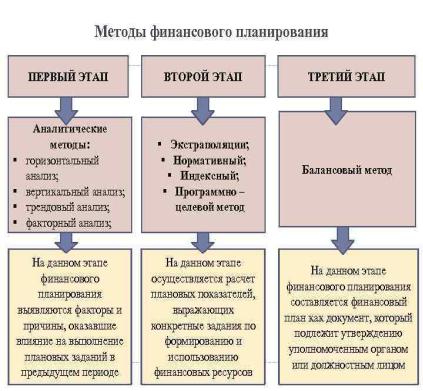
Рис. 1. Методы финансового планирования
Плановыми службами предприятия выполняются планы по улучшению финансовых показателей. Переход предприятия к системам, позволяющим функционировать на основе рыночных (коммерческих) показателей повышает ответственность предприятия, что приводит к повышению качественных характеристик финансового плана.
19