Материал: 2177
4) robot |
d) a machine controlled by means of com- |
|
puters executing pre-programmed se- |
|
quences of machine control commands |
5) material handling system |
f) mechanical handling equipment that |
|
moves materials from one location to an- |
|
other |
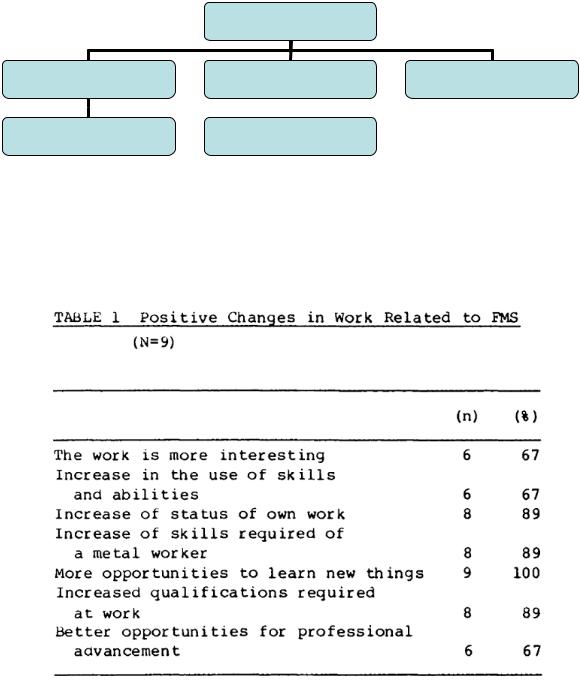
VII. Answer the questions in the chart using the information from the text.
С |
|
FMS |
|
|
What? |
What? |
|
What? |
|
||
What for? |
What for? |
What for? |
|
и |
|
|
|
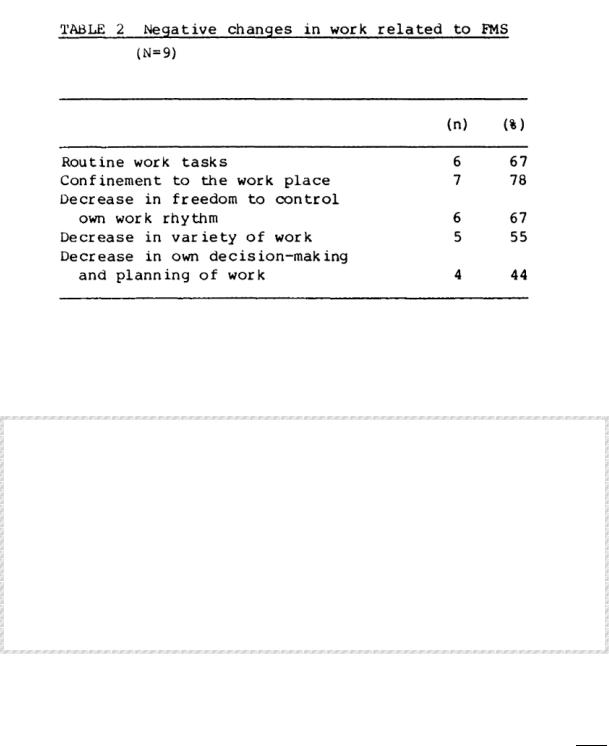
Koskinen (Department of Physiology, Institute of Occupational
б
 VIII*. Study the dataАobtained by P. Seppälä, E. Tuominen and P.
Health, Finland) in the 90s of the XX century. What conclusions can be drawn?
Д И
66
С |
|
|
|
б |
|
IX*. Work in 2 teams. Imagine you are operation managers and you |
||
needиto install FMS. Draw the layout of the FMS at your factory, label |
||
the necessary equipment, and present your ideas. |
||
|
HOME TASK 8 |
|
A. Memorize the words from Ex. I and be ready to do a dictation. |
||
B. |
|
Д |
Get ready to tell your groupmates about a Flexible |
||
Manufacturing System.АMake up five sentences as minimum. You |
||
may use drawings to help you. |
|
|
C. What skills should an engineer have to be able to work with an |
||
|
|
И |
FMS? Write them down (five as minimum) and give your arguments.
TEST YOURSELF
A Flexible Manufacturing System is the current level of automation in the field of manufacturing. The application of FMS requires 1) technical know-how.
A Flexible Manufacturing System may be defined as a system dealing with high level distributed data 2) ___ and automated material 3) ___
using computer-controlled machines, cells, industrial robots, inspection machines and so on, together with computer integrated materials 4) ___
and 5) ___ systems.
67

Here manufacturing is considered to be a 6) ___ which integrates different 7) ___ and requires a properly defined 8) ___ to create the expected 9) ___.
|
Input may be 10) ___ and/or 11) ___ which have to be processed us- |
ing various auxiliary components of the system, such as tools, fixtures and |
|
С |
|
clamping devices, sensors and their feedback data. The output may also be |
|
12) |
and/or 13) ___ which can be processed on further units (often |
called cells) of the manufacturing system.
An FMS can also be defined as a computer-controlled configuration of semi-independent work 14) ___ and a material handling 15) ___ de-
signed to efficiently 16) |
more than one kind of part number at low to |
||
medium volumes. The definition highlights the three essential physical |
|||
components of an FMS: |
|
|
|
a) standard 17) |
controlled machine tools; |
||
b) a 18) |
network to move parts and perhaps tools between ma- |
||
chinesиand fixturing stations; |
|
||
c) an overall 19) |
system that coordinates the machine tools, the |
||
parts and the workpieces. |
|
|
|
The number of 20) |
in a system typically ranges from 21) ___ to |
||
22) ___ or more.бThe 23) system may consist of carousels, conveyors, |
|||
carts, robots, automated guided vehicles, etc. |
|||
The FMS can be thought of as a distributed management information |
|||
system 24) ___ together intelligent subsystems of machining, welding, |
|||
painting, flame cutting, sheet metal manufacturing, inspection» assembly, |
|||
|
А |
||
etc. and material handling and storage processes. |
|||
Flexible manufacturing systems are regarded by many experts as be- |
|||
ing the 25) ___ way to meet the 26) |
of industry. They consider the |
||
FMS to be the 27) ___ of the automated factory, or at least the minimally |
|||
manned factory. And perhaps mostДsignificant that FMS is clearly the most |
|||
obvious manifestation of computer-integrated manufacturing on the factory |
|||
floor. |
|
How many mistakes have you done? What are they? |
|
|
И |
68

|
Lesson 9 |
|
|
|
|
|
Refresh the words in Ex. I (Lesson 8) and get ready to have a dic- |
||||
|
tation. |
|
|
|
|
|
I. Listen and repeat. Using the dictionary, write in the [træn'skripSn] |
||||
С |
|
|
|
||
|
of the words into the table below. The first word is already done for |
||||
|
you. |
|
|
|
|
|
1 |
emergence |
|
[i'mə:djns] |
появление |
|
|
и |
|
|
|
|
2 |
production facil- |
……………… |
производственное оборудо- |
|
|
|
ity |
|
|
вание; производственные |
|
|
|
|
|
мощности |
|
3 |
wide-scale |
|
……………… |
широкомасштабный, массо- |
|
|
б |
вый |
||
|
|
|
|
|
|
|
4 |
artificial |
|
……………… |
искусственный |
|
5 |
benefit |
|
……………… |
выгода; польза; прибыль |
|
6 |
uniform |
|
……………… |
ровный; равномерный; одно- |
|
|
|
|
|
родный |
|
7 |
on demand |
|
……………… |
по запросу, по требованию |
|
8 |
standalone |
|
……………… |
автономный, отдельный |
|
9 |
idle time |
|
……………… |
простой, бездействие |
|
10 |
sequence |
|
……………… |
последовательность; очерёд- |
|
|
|
|
|
Д |
|
|
|
|
|
ность |
|
11 |
reduce |
Асокращать, уменьшать |
||
|
|
……………… |
производственный цикл |
||
|
12 |
work-in-process |
……………… |
||
II. Find the words in the text and translate the word combinations
with them. И
III. Work in pairs. Think of 2 or 3 questions using the words from Ex. I. Answer the questions of your partner. Study the prompts in italics
first.
What is flexibility characterized by?
By what means can product quality be improved? How can the equipment idle time be reduced?
Does the staff have to be highly skilled?
* Find sentences in the passive voice in the text below and translate them.
69
IV. You are going to read about flexible manufacturing. Find the answers to the following questions while reading:
1. |
When did the history of FMS development start? |
|
2. |
How does an FMS affect the quality of products? |
|
С |
|
|
3. |
Why are FMS technologies implemented? |
|
|
FLEXIBLE MANUFACTURING – |
|
|
|
A GROWING INTEREST |
и |
||
|
The emergence of the flexible manufacturing system represents a |
|
significant departure from conventional manufacturing methods. An FMS
is a production facility consisting of flexible machines or work stations connected by an automated material handling system, all under the control of one or more computers.
computing machinesбhas made it possible to introduce a wide-scale automation of all branches of industry which gave rise to independent development of automation Аprocesses:
The FMS technology has a relatively brief history. The progress of
(a) Automated Data Processing (the appearance of Automated Control Systems and Computer-Aided Designing (CAD));
(b) Automation of Production Technology (the appearance of Nu- merically-Controlled Equipment, Computer-Aided Manufacturing (CAM) and Industrial Robots).
tomated lines and shops and at last Дautomated factories provided with flexible technology and computer-based artificial intelligence.
The development of FMSs began with the appearance of industrial robots, processing centres, microcomputers, computer-aided designing, etc. followed by the introduction of robotized complexes, flexible modules, au-
It seems almost certain that the main reasons for designing and implementing an FMS are the economic benefits of the system. They include first of all greater productivity which means a greater output and a lower unit cost on a smaller floor space.
И
It is possible to say that the FMS is the system where the time spent on the machine can be as high as 90% and the time spent on cutting can again be over 90%. Compare this to standalone numerically-controlled machines (NC), where the part from stock to finished item spends only 5% of its productive time on the machine tool.
70