Материал: 2177
consumer demand for the products of automation have compensated for these losses. Labour unions have argued, and many companies have adopted the policy, that workers displaced by automation should be retrained for other positions, perhaps increasing their skill levels in the process. This argument succeeds so long as the company and the economy in general are
Сgrowing at a rate fast enough to create new positions as the jobs replaced by automation are lost.
Of particular concern for many labour specialists is the impact of industrial robots on the work force, since robot installations involve a direct substitution of machines for humans, sometimes at a ratio of two to three humans per robot. The opposing argument within the United States is that robots can increase productivity in American factories, thereby making
these firms more competitive and ensuring that jobs are not lost to overseas |
||
companies. The effect of robotics on labour has been relatively minor, be- |
||
cause the number of robots in the United States is small compared with the |
||
numberиof human workers. As of the early 1990s, there were fewer than |
||
100,000 robots installed in American factories, compared with a total work |
||
force of more than 100 million persons, about 20 million of whom work in |
||
factories. |
|
|
Automationбaffects not only the number of workers in factories but |
||
also the type of work that is done. The automated factory is oriented to- |
||
ward the use of computer systems and sophisticated programmable ma- |
||
chines rather than manual labour. Greater emphasis is placed on |
||
knowledge-based work and technical skill rather than physical work. The |
||
|
А |
|
types of jobs found in modern factories include more machine mainte- |
||
nance, improved scheduling and process optimization, systems analysis, |
||
and computer programming and operation. Consequently, workers in au- |
||
tomated facilities must be technologically proficient to perform these jobs. |
||
Professional and semiprofessional Дpositions, as well as traditional labour |
||
jobs, are affected by this shift in emphasis toward factory automation. |
||
VI. Predict what will happen in |
И |
|
10 years … |
|
|
100 years …
1000 years …
due to scientific-technical progress. Write five sentences as minimum.
56
VII. Do you agree or disagree with this opinion? Why?
The new technological revolution will create tremendous societal benefits – the creation of new goods, services, markets and jobs, greater productivity, etc.
СThe traditional approach of helping workers upgrade by “up-skilling” will not necessarily reduce a worker’s susceptibility to being displaced by the new wave of automation. Workers will need to develop new skills to
will affect workers across the employment spectrum. Thus, governments need to work with stakeholders to rethink the kind of pre-employment and post-employment training institutions should offer to enable professionals to keep pace with these developments.
take on very different kinds of jobs, possibly in different industries. Presently, most governments dedicate resources towards helping low-skilled workersиsecure better jobs through training and education. Yet this shift
VIII*. Think over advantages and disadvantages of automation. Are you an optimist or pessimist? Fix your ideas in the table. Discuss the results.
|
б |
|
|
|
|
Advantages |
|
Disadvantages |
|
|
|
Д |
|
|
|
А |
|
||
IX*. A. Look at the pictures (pic. 9 - 11). What do you see? What do |
||||
you know about these things? |
|
И |
||
|
|
|
||
|
Pic. 9 |
|
Pic. 10 |
|
57
С Pic. 11
B.иRead about some automation advances, choose the one you like and advertise it to your group. Make five sentences as minimum.
Decide whose advertising is the most effective? Why?
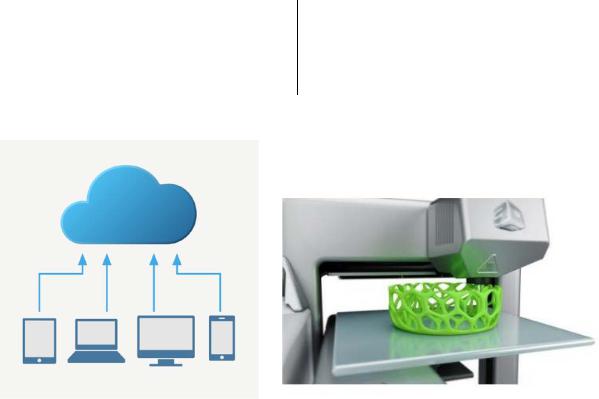
б1. Cloud storage for wireless data
One of the greatestАadvances in automation is one that stands to benefit every industry is cloud storage. Cloud storage allows you to store all data wirelessly. All data from almost every machine can be automatically uploaded, ensuring that all information is backed up over a wireless net-
work. Additionally, in case of any computer crashes, all of your data is completely safe, accessible from anyДcomputer and waiting to be recovered from the cloud.
2. Diode lasers for creating “invisible” seams
Diode lasers are adding greater efficiency in assembly processes in the automotive industry. Audi, the German car Иmanufacturer, recently implemented robot controlled 13-kW diode lasers in their Ingolstadt factory. This allowed the company to create an “invisible” weld on the car shell, providing additional structural security throughout the car. By programming these diode lasers, Audi is coupling automation with a host of other advanced processes, such as welding and bonding. As a result, the manufacturer is reducing car weight, production time, and energy costs due to regenerative braking in conveyor and lift systems.
3. 3D Printing in manufacturing for finished components
3D printing is one of the biggest recent advances in manufacturing and automation. Although the technology has been around since the 1980s, machines were previously too large and the process was too slow for wide-
58
spread adoption. Today, however, 3D printers have become so developed that these machines are used to produce finished parts. These machines now have the capability for improved accuracy and capacities for increased sizes and production runs. As a result, they are being adopted into processes throughout industries. The military, for example, conjectures that it may
Сbe able to print replacement parts in the battlefield. The advantages of automated 3D printing are many. It allows much more affordable manufacture of complex, highly customized, and efficient designs – 3D printed products can be lighter, stronger, and require less assembly. One machine can be responsible for a number of product lines, with production lines of asиmany or as few units as needed. 3D printers additionally allow for point- of-assembly or point-of-consumption printing. They present a lower barrier of entry to manufacturing, and open up a number of new supply chain or retail opportunities.
б4. Extremely small machines for nonmanufacturing
Nanomanufacturing – the manufacture of material on a molecular or even atomic level – has been recently gaining steam. It is expected to play a future role in the production of items such as high-efficiency solar cells and batteries. NanomanufacturingАis most promising for nonmanufacturing purposes such as biosystem-based medical applications. A sensor inside your body, for instance, could help your doctor monitor cancer levels. Future generations of electronics and computing devices may also heavily rely on nonmanufacturing. Д
5. 24-Hour manufacturing operations
Continuous, 24-hour manufacturing operations have come a long way in current years. Industrial robots can operate 24 hours a day, seven days a week, performing repeatable processes. The greatest advance in today’s automated 24-hour machines the increasinglyИfine precision they can achieve. These machines can now be accurate to hundredths of a second and in less space than is detectable by the human eye. The expense associated with industrial robots has also fallen as much as 50% compared with human labor since 1990. This allows manufacturers to achieve higher productivity and efficiency without additional labor costs.
6. Sensing, measurement, and process control
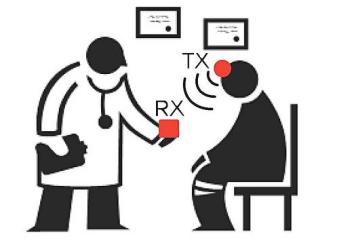
Automation has not only become more widespread in recent years, it has also become finer and more sophisticated. Industrial robots are now outfitted with additional sensing, measurement, and process control transmitters that help to guide increasingly nimble machines. These transmitters provide the information necessary to manage the operation of the factory
59

as a whole. Products can be tracked from inception all the way to the point of delivery. Sensing, measurement, and process control transmitters further make it easier and more reliable to allow machines to operate without per-
sonnel. In case anything should go wrong, such as the humidity around an |
|
automated spray system being harmful for paint, the sensor can detect the |
|
С |
|
issue and issue an alert at the moment of the incident, sending a signal to |
|
the machine operator or even to the plant manager’s cellphone. |
|
http://cnc.arnoldmachine.com/blog/6-exciting-advances-in-manufacturing- |
|
|
automation |
|
HOME TASK 7 |
A. Memorize the words from Ex. I and be ready to do a dictation. |
|
б |
|
B. Make a PowerPoint presentation (10 slides) about one of the |
|
greatestиadvances in automation. Use the Internet recourses to find |
|
more information. Remember to discuss the assessment criteria (4 – |
|
5) beforehand. |
|
C. What new automated device would you like to have at home? De- |
|
scribe it to your group paying attention to: |
|
- design, |
Д |
- size, |
А |
- material, |
|
- colour, |
|
- cost, |
И |
- place of production, |
|
- purpose, - functions,
- service life.
Be ready to discuss the results and give recommendations to the designers.
TEST YOURSELF
Over the years, the 1) ___ merits of automation have been argued by labour 2) ___, business executives, 3) ___ officials, and college professors. The biggest controversy has focused on how automation 4) ___ employment. There are other 5) ___ aspects of automation, including its effect on productivity, economic competition, education, and 6) ___ of life.
60