Материал: 2177


|
1 |
flexible |
['fleksəbl] |
гибкий |
|
|
2 |
manufacturing |
……………… |
производство |
|
|
3 |
define |
……………… |
давать определение |
|
|
4 |
deal |
……………… |
иметь дело |
|
|
5 |
flow |
……………… |
поток |
|
|
6 |
cell |
……………… |
элемент; ячейка; клетка |
|
|
7 |
handling |
……………… |
обработка |
|
|
8 |
storage |
……………… |
сохранение, хранение |
|
|
9 |
input |
……………… |
входные данные |
|
|
10 |
output |
……………… |
продукция; выпуск изделий |
|
|
11 |
auxiliary |
……………… |
вспомогательный; дополни- |
|
С |
|
тельный |
|
||
|
|
|
|
|
|
12 |
tool |
……………… |
инструмент |
|
|
13 |
fixture |
……………… |
приспособление, прибор |
|
|
14 |
clamping |
……………… |
крепление, фиксация |
|
|
|
и15 unit ……………… |
часть, элемент; отдел, отделе- |
|
||
|
|
|
|
ние; секция; модуль |
|
16 |
numerically |
……………… |
с числовым программным |
|
|
|
|
controlled |
|
управлением |
|
17 |
conveyanceб……………… |
перевозка, транспортировка |
|
||
18 |
vehicle |
……………… |
транспортное средство; те- |
|
|
|
|
|
|
лежка |
|
19 |
link |
……………… |
соединение, связь |
|
|
20 |
hardware |
……………… |
оборудование, аппаратура, ап- |
|
|
|
|
|
А |
|
|
|
|
|
|
паратное обеспечение, «желе- |
|
|
|
|
|
зо» |
|
21 |
software |
……………… |
программное обеспечение |
|
|
|
|
|
|
(ПО), компьютерные програм- |
|
|
|
|
Дмы, софт |
|
|
II. Find the words in the text and translate the word combinations |
|||||
with these words. |
|
|
|
||
III. Work in pairs. Study the prompts in italicsИ. Make up 4 sentences using the words from Ex. I and the Infinitive constructions.
Manufacturing is considered to be a system which integrates different processes.
They consider the FMS to be the future of the automated factory.
* Find sentences with the Infinitive constructions in the text below and translate them.
62
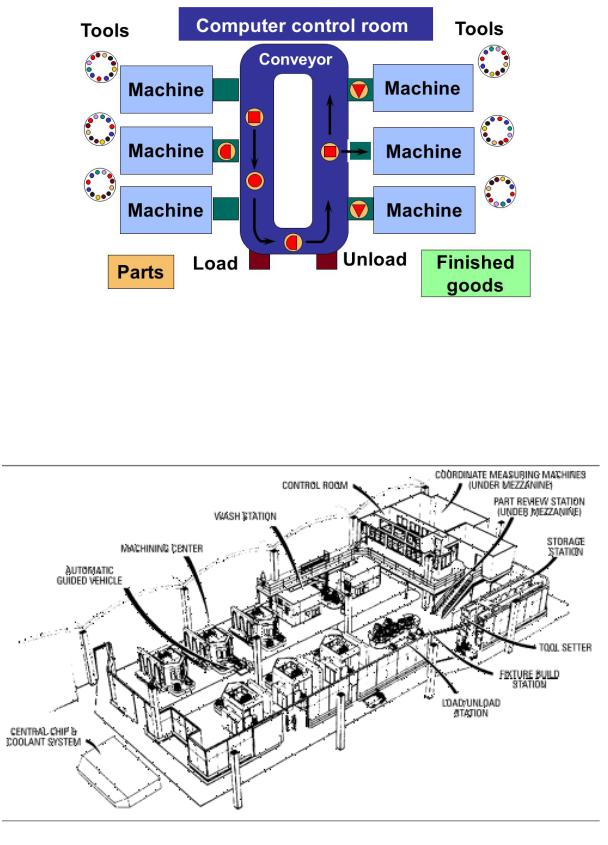
IV. Study the picture (pic. 12) and try to describe it. What units are depicted? What processes are presented?
Си бPic. 12
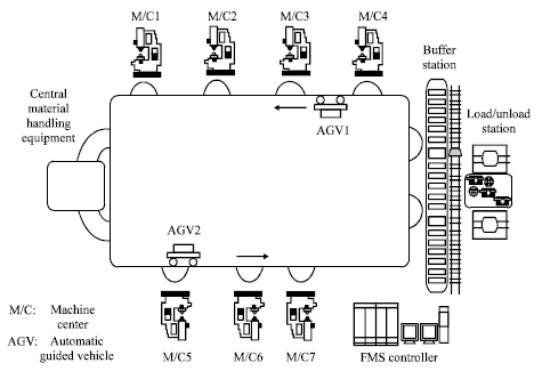
V. Look at the picturesА(pic. 13 – 14), read the information about a
Flexible Manufacturing System and find the components mentioned. Discuss the results with your partner and make corrections if
necessary. Д И
Pic. 13
63
Си бPic. 14
FLEXIBLEАMANUFACTURING SYSTEM
(FMS)
ing with high level distributed data Дprocessing and automated material flow using computer-controlled machines, cells, industrial robots, inspection machines and so on, together with computer integrated materials handling and storage systems.
A Flexible Manufacturing System (FMS) is the current level of automation in the field of manufacturing. The application of FMS requires
advanced technical know-how.
A Flexible Manufacturing System may be defined as a system deal-
И
Here manufacturing is considered to be a system which integrates different processes and requires a properly defined input to create the expected output.
Input may be raw material and/or data which have to be processed using various auxiliary components of the system, such as tools, fixtures and clamping devices, sensors and their feedback data. The output may also be data and/or material which can be processed on further units (often called cells) of the manufacturing system.
64
An FMS can also be defined as a computer-controlled configuration of semi-independent work stations and a material handling system designed to efficiently manufacture more than one kind of part number at low to medium volumes. The definition highlights the three essential physical
components of an FMS:
СThe number of machines in a system typically ranges from 2 to 20 or more. The conveyance system may consist of carousels, conveyors, carts,
a) standard numerically controlled machine (NCM) tools;
b) a conveyance network to move parts and perhaps tools between
machines and fixturing stations;
c) an overall control system that coordinates the machine tools, the
parts and the workpieces.
иThe FMS can be thought of as a distributed management information system linkingбtogether intelligent subsystems of machining, welding, painting, flame cutting, sheet metal manufacturing, inspection, assembly, etc. and material handling and storage processes.
robots, automated guided vehicles (AGV), etc.
Flexible manufacturing systems are regarded by many experts as being the best way to meetАthe demands of industry. They consider the FMS to be the future of the automated factory, or at least the minimally manned factory. And perhaps most significant that FMS is clearly the most obvious manifestation of computer-integrated manufacturing on the factory floor.
So it is possible to say that the FMS is of interest to manufacturers who produce more than one kind of part number at low to medium volumes. The FMSs provide a direct hardware/software solution to many economical and technical problems. The important aspect of these systems is
that the machine tools, conveyance and control devices combine to achieve |
|||
increased productivity and maximum machine utilization without decreas- |
|||
ing flexibility. |
Д |
||
VI. Match the words with their definitions: |
|
|
|
1) numerically controlled |
a) a portable robot that follows markers or |
|
|
machine |
wires in the floor, or uses vision, magnets, |
|
|
|
|
И |
|
|
or lasers for navigation |
|
|
2) automated guided vehi- |
b) a machine capable of carrying out a |
|
|
cles |
complex series of actions automatically |
|
|
3) conveyor system |
c) activities, equipment, and procedures |
|
|
|
related to the moving, storing, protecting |
|
|
|
and controlling of materials |
|
|
65