Материал: 2177

3rd step of development – ? |
|
|
|
|
|
|
||
4th step of development – ? |
|
|
|
|
|
|
||
5th step of development – ? |
|
|
|
|
|
|
||
6th step of development – ? |
|
|
|
|
|
|
||
7th step of development – ? |
|
|
|
|
|
|
||
С |
|
|
|
|
|
|
|
|
8th step of development – ? |
|
|
|
|
|
|
||
IX. Find the synonyms and make your own sentences with them. The |
||||||||
first one is already done for you. |
|
|
|
|
|
|||
|
magnify |
advance |
enlarge |
operate |
develop |
|
||
|
devise |
picking out |
complex |
complicated |
|
|||
|
improvement concept |
|
work |
idea |
selection |
|
||
Magnify – enlarge |
|
|
|
|
|
|
|
|
Engineersиtry to magnify the output of the enterprise. |
|
|
||||||
We should enlarge the output of our enterprise. |
|
|
|
|||||
|
|
А |
|
|
||||
X. Answer the following questions using the words from Ex. IX. |
||||||||
1. |
What machinesбcould magnify the power of human muscle? |
|||||||
2. |
What is considered to be a major advance in the development of pow- |
|||||||
ered machines? |
|
|
Д |
|||||
3. |
For the development of what items were thousands of years required? |
|||||||
4. |
Who devised the machine powered by flowing water and waterwheels? |
|||||||
5. |
What mechanism represents a rather complicated assembly? |
|||||||
6. |
What ideas were used in machine devised by Joseph-Marie Jacquard? |
|||||||
7. |
By what program was the selection of the different patterns determined? |
|||||||
|
|
|
|
|
|
И |
||
XI. Make up special questions (Active or Passive Voice) to the words in bold in the text. Answer the questions of your partner.
Example:
When were the first tools made? – They were made in prehistoric epoch.
A. Memorize the words from Ex. I and be ready to do a dictation.
B1. Rewrite the ordinal numbers in letters from Ex. VIII. Then make eight sentences using the ordinal numbers in letters and the infor-
31

mation from the text. Review grammar material if you need.
Example:
The first step of automation is represented by prehistoric man’s attempts to make tools of stone.
B2. Make a plan to the text “Automation and its history” and be ready to discuss this topic in your group. You may use Ex-s VII, VIII, X to help you to prepare a short report.
Сcthefirsttoolsmadeofstoneweremadebyprehistoricmengsimpl
C. Make the right boundaries and you will know the answers to the Ex-s VII and VIII.
emechanicaldevicesandmachinesappearedin2thousandsofyear |
||
sagoapoweredmachinesweredeveloped2,000yearsagofarathe |
||
и |
|
|
rcomplexmechanismwasdevisedabout1335dfirstautomatedm |
||
echanismsweredevelopedduringthemiddleagesbtheremarkabl |
||
edeviceoftheindustrialrevolutionweredevelopedduringthetwoб |
||
centuriesethefirstprogrammablemachinemadeabout1801was |
||
theimportantdevelopmentinthehistoryofautomationhtheprec |
||
ursorofthemoderndigitalcomputerwastheconceptdevelopeddА |
||
uring |
|
|
TEST YOURSELFД |
to |
|
The first 1)___ made of 2)___ represented prehistoric man’s 3) |
||
direct his own physical 4)___ under the control of human 5) |
. Thou- |
|
sands of years were required for the development of simple 6) |
devices |
|
and machines such as the 7)___, the 8)___, andИthe 9) , by which the power of human 10)___ could be magnified. The next extension was the development of 11)___ machines that did not require human strength to operate. Examples of these machines include 12)___, 13)___, and simple
14)___ devices. More than 2,000 years ago the Chinese developed 15)____
powered by flowing 16)___ and 17)___. The early Greeks experimented with simple reaction motors powered by 18)___. The mechanical 19)___,
32

representing a rather complex 20)___ with its own built-in power 21)___
(a weight), was developed about 1335 in Europe. Windmills, with mechanisms for automatically 22)___ the sails, were developed during the Middle Ages in Europe and the Middle East. The steam 23)___ represented a major advance in the development of powered machines and marked the beginning of the 24)___ Revolution. During the two centuries since the introduction of the 25)___ steam engine, powered engines and machines have been devised that obtain their energy from steam, electricity, and 26) , mechanical, and 27)___ sources.
Another important 28)___ in the history of automation was the Jac-
quard 29) |
, which demonstrated the concept of a 30)___ machine. |
||
С |
|
Joseph-Marie Jacquard devised an automat- |
|
About 1801 the French 31) |
|||
ic loom capable of producing complex 32)___ in textiles by controlling the |
|||
motions of many 33) |
of different coloured 34)___. The selection of the |
||
different patterns was determined by a 35)___ contained in 36)___ cards in |
|||
whichиholes were 37) . These cards were the 38)___ of the paper cards |
|||
and 39)___ that control modern automatic 40)___. The concept of 41)___ a |
|||
machine was further developed later in the 19th century when Charles |
|||
Babbage, an English 42) |
, proposed a complex, mechanical 43)“___” |
||
that could performб44) and 45) processing. Although Babbage was |
|||
never able to |
complete |
it, |
this device was the 46)____ of the modern |
47)___ computer. |
|
|
How many mistakes have you done? What are they? |
||
|
А |
|
|
|
Д |
What was new for you? Try to draw some pictures to the text to sys- |
||
tematize the information on the history of automation. Discuss the re- |
||
sult with your partner. |
И |
|
|
||
get ready to have a dicta-
I. Listen and repeat. Using the dictionary, write in the [træn'skripSn]
of the words into the table below. The first word is already done for you.
33

1 |
previously |
['pri:viəsli] |
ранее |
2 |
assembly plant |
……………… |
сборочный завод |
3 |
device |
……………… |
устройство, прибор |
4 |
endeavor |
……………… |
область деятельности |
5 |
efficiency |
……………… |
эффективность |
6 |
household thermostat |
……………… |
бытовой термостат |
7 |
punched |
……………… |
перфорированный |
8 |
flyball governor |
……………… |
центробежный регулятор |
|
|
|
последовательность |
9 |
sequence |
……………… |
непроизводственный |
10 |
nonmanufacturing |
……………… |
походить |
С |
……………… |
помощь |
|
11 |
resemble |
||
12 |
aid |
……………… |
способствовать |
13 |
facilitate |
……………… |
измерение, размеры |
14 |
dimension |
……………… |
деталь, заготовка |
15иworkpieces ……………… |
|
||
II. Scan theбtext “Automation. Part I” to find the words from Ex. I and translate the word combinationsАwith these words. The first word combination is already done for you:
previously – tasks previously done by people – задачи, ранее выполняе-
мые людьми
III. Work in pairs. Think and answerДthe question: What can be defined as Automation? Give some examples using the information from the text “Automation. Part I” and the words from Ex. I. Study the prompts in italics that can help you make your own sentences.
The sequences of operationsИare controlled auto-
matically.
The term automation is also used to describe nonmanufacturing systems.
* Choose the best definition for the word Automation in your group.
34
AUTOMATION. PART I
Automation is the system of manufacture performing certain tasks, previously done by people, by machines only. The sequences of operations are con- Сtrolled automatically. The most familiar example of a highly automated system
is an assembly plant for automobiles or other complex products.
In general usage, automation can be defined as a technology concerned with performing a process by means of programmed commands combined with automatic feedback control (control system) to ensure proper executionиof the instructions.
As a technology, automation can be applied to almost any human endeavor, from manufacturing to clerical and administrative tasks.
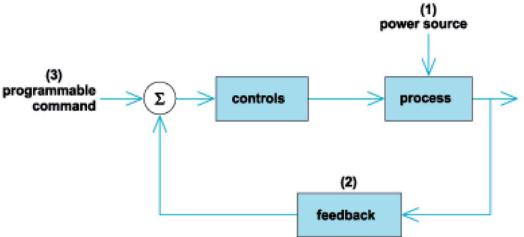
The fundamental constituents of any automated process are (1) a power source, (2) aбfeedback control mechanism, and (3) a programmable command structure (pic. 8).
ElementsАof an automated system Д
The term automation is also used to describeИnonmanufacturing systems in which automatic devices can operate independently of human control. Such devices as automatic pilots, automatic telephone equipment and automated control systems are used to perform various operations much faster and better than could be done by people.
35