Материал: 2177

a change in the muscular movements of the operator, often results in greatly increased production. This type of engineering work is called time-study engineering.
_____ A related field of engineering, human-factors engineering, also |
|
known as ergonomics, received wide attention in the late 1970s and 1980s |
|
С |
|
when the safety of nuclear reactors was questioned following serious acci- |
|
dents that were caused by operator errors, design failures, and malfunc- |
|
tioning equipment. |
|
и |
|
|
TEST YOURSELF |
Computer industry is developing so fast, that it 1)___ almost all |
|
spheres of professional life. No business now is possible without 2)___. |
||||
This is especially true about automated 3)___ of products and 4)___. Com- |
||||
|
|
б |
|
|
puter control of automated production opens new 5)___ for the 6)___ and |
||||
7) |
production of goods. Information is now 8)___, transmitted, 9)___, |
|||
and 10) |
electronically through computer 11)___ on a scale unprece- |
|||
dented in history. |
|
|
||
|
Computer engineering is a general field. It deals with both 12)___ |
|||
and 13)___ industries. |
|
|
||
|
Electronic engineering deals with the 14) |
, design, integration, and |
||
15)___ of circuits and 16) |
used in the information transmission and |
|||
processing. |
Д |
||
Engineers in the field of electric and electronic engineering are |
|||
17)____ with all aspectsАof electrical 18) . In designing communication |
|||
systems, engineers rely on various 19) |
of advanced 20) |
, such as |
|
21)___ analysis, 22)___ systems theory, linear 23) |
, differential 24)___, |
||
and 25)___ theory. |
И |
||
Engineers work on 26)___ systems which are used extensively in |
|||
27)___ manufacturing and in 28)___. |
|
|
|
Major developments in the field of communications and control have |
|||
been the replacement of 29)___ systems with 30) |
systems; 31) |
op- |
|
tics is now used instead of 32)___ cables. Digital systems offer far greater 33)___ to electrical noise.
Computer engineering is now the most rapidly growing 34)___. The electronics of computers is the design and manufacture of 35)___ systems, of central 36)___ units, and of peripheral devices. The most prospective industry now is the Very Large-Scale 37)___ (VLSI) and new computer 38)___. The field of computer 39)___ is closely related to computer 40)___; however, the task of making computers more 41)“___”, through
26

creation of 42)___ programs or development of higher level machine 43)___ or other means, is generally 44)___ as the dream of computer science.
How many mistakes have you done? What are they?
СLessonи3
What were the most difficult tasks for you? Why? Make a list of problems that prevent you from studying English for specific purposes. Analyze them and think of possible solutions.
Refresh the words in Ex. I (Lesson 2) and get ready to have a dictation.
I. Listen and repeat. Using the dictionary, write in the [trxn'skripSn] of the words into the table below. The first word is already done for
you. |
б |
|
||||
|
|
|
||||
1 |
tool |
[tu:l] |
инструмент; приспособление |
|||
|
2 |
attempts |
|
……………… |
попытки |
|
|
3 |
intelligence |
|
……………… |
интеллект |
|
|
4 |
require |
|
……………… |
требовать |
|
|
5 |
device |
|
А……………… устройство |
|
|
|
6 |
lever |
|
……………… |
рычаг |
|
|
7 |
pulley |
|
……………… шкив, блок; ворот |
|
|
|
8 |
magnify |
|
……………… |
увеличивать |
|
|
9 |
trip-hammer |
|
……………… |
падающий молот |
|
|
10 |
devise |
|
Д |
|
|
|
|
……………… |
изобретать; разрабатывать |
|
||
|
11 |
Jacquard loom |
|
……………… |
жаккардовый ткацкий станок |
|
|
12 |
ancestor |
|
……………… |
прототип, прообраз |
|
|
13 |
punch |
|
……………… |
пробивать, перфорировать |
|
|
14 |
precursor |
|
……………… |
предшественник |
|
|
|
|
|
|
И |
|
II. Find the words above in the text “Automation and its history” and translate the word combinations with these words. The first word combination is already done for you:
tool –
the first tools made of stone – первые инструменты, сделанные из камня
27
III. Work in pairs. Think of 2 or 3 questions using the words from Ex. I. Answer the questions of your partner. Study the prompts in italics showing how to ask special questions in the passive voice.
С |
When was the mechanical clock developed? |
|
What is powered by flowing water? |
||
|
||
|
What machines are powered by steam? |
|
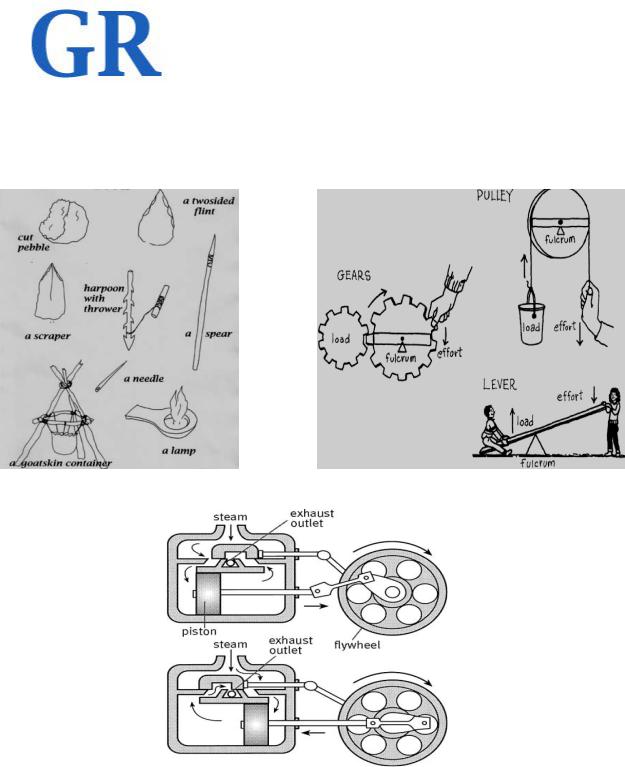
IV. Look at the pictures (pic. 5 – 7). What processes do they represent? |
||
и |
||
Make up 3 questions (What? How? Why?) and let your partner an- |
||
swer them. |
|
|
б |
||
|
А |
|
Pic. 5 |
Д |
|
Pic. 6 |
||
|
И |
|
Pic. 7
28
V. Read the title of the text below and guess what the text will be about? Share your ideas with your groupmates.
VI. You are to read the text and define whose ideas were closer to the text content.
СAUTOMATION AND ITS HISTORY
The first tools made of stone represented prehistoric man’s attempts toиdirect his own physical strength under the control of human intelligence. Thousands of years were required for the development of simple mechan-
ical devices and machines such as the wheel, the lever, and the pulley, by which the power of human muscle could be magnified. The next extension
windmills, andбsimple steam-driven devices. More than 2,000 years ago the Chinese developed trip-hammers powered by flowing water and waterwheels. The early АGreeks experimented with simple reaction motors powered by steam. The mechanical clock, representing a rather complex assembly with its own built-in power source (a weight), was developed about 1335 in Europe. Windmills, with mechanisms for automatically
was the development of powered machines that did not require human strength to operate. Examples of these machines include waterwheels,
turning the sails, were developed during the Middle Ages in Europe and the Middle East. The steam engine represented a major advance in the development of powered machines and marked the beginning of the Industrial Revolution. During the two centuries since the introduction of the Watt steam engine, powered engines and machines have been devised that
|
И |
obtain their energy from steam, electricity, and chemical, mechanical, and |
|
nuclear sources. |
Д |
Another important development in the history of automation was the Jacquard loom, which demonstrated the concept of a programmable machine. About 1801 the French inventor Joseph-Marie Jacquard devised an automatic loom capable of producing complex patterns in textiles by controlling the motions of many shuttles of different coloured threads. The selection of the different patterns was determined by a program contained in steel cards in which holes were punched. These cards were the ancestors of the paper cards and tapes that control modern automatic machines. The concept of programming a machine was further developed later in the 19th century when Charles Babbage, an English mathematician, proposed a
29
complex, mechanical “analytical engine” that could perform arithmetic and data processing. Although Babbage was never able to complete it, this device was the precursor of the modern digital computer.
VII. Do you remember the steps of automation development? Fill in the gaps with the prompts from the chart below. The first one is al-
ready done for you. |
|
|
|
|
A. Powered machines were developed 2,000 years ago. |
||||
B. The remarkable device of the Industrial Revolution were developed dur- |
||||
ing … . |
|
|
|
|
C. The first tools made of stone were made by ... men. |
||||
С |
|
|
|
|
D. First automated mechanisms were developed during … . |
||||
E. The first programmable machine made … was the important develop- |
||||
ment in the history of automation . |
|
|
||
F. A rather complex mechanism was devised … . |
||||
G.иSimple mechanical devices and machines appeared in … . |
||||
H. The precursor of the modern digital computer was the concept devel- |
||||
oped during … . |
|
|
|
|
бthe Middle |
|
|
||
2,000 years |
Ages |
the 19th |
||
|
||||
ago |
|
|
century |
|
about 1801 |
А |
|||
|
Automation |
|
the two |
|
|
|
development |
|
centuries |
|
|
|
||
thousands |
Д |
|||
|
about 1335 |
|||
of years ago |
Prehistoric |
И |
||
|
|
|||
|
|
|
||
VIII. Rearrange the sentences from Ex. VII in the right order according to the dates of development. Then look through the text and check your answers. The first one is already done for you.
1st step of development – C.
2nd step of development – ?
30