Материал: Экономика англоязычных стран и России. методическая разработка по развитию навыков чтения и устной речи для студентов 2-го курса. Лукина Л.В
Investment in Britain manufacturing, measured as a proportion of manufacturing output, is comparable with the level of investment in other major developed market economies. Manufacturing investment was about £ 5.800 million, directed chiefly towards engineering, shipbuilding and metal goods; chemicals; food, drink and tobacco; and vehicle manufacture.
4. Finance and banking
Public sector finance comprises the transactions of central government, local authorities and the public corporations. The major sources of central government revenue on current account are taxes on income and capital which yielded 41 per cent of revenue in 1978-1979 (£ 22.882 million); taxes on expenditure which yielded 33 per cent of revenue (£ 18.694 million); and national insurance contributions paid by employers and employees which yielded 16 per cent of revenue (£ 9.152 million).
For local authorities revenue derives mainly from Government grants, loans and "rates", local tax based on the valuation of property; in 1978-79 rates yielded £5.996 million. A large part of the public corporations' borrowing requirement is met by the central government but, in recent years, they have also borrowed directly themselves in foreign currencies.
Taxes on income comprise income tax and corporation tax. Taxes on individual incomes are progressive in that larger incomes bear a proportionately higher rate of tax. In general, income tax is charged on all income which has its origin in Britain and on all income arising abroad of people resident in Britain. Companies pay corporation tax at a single rate on all their profits, whether distributed or not; investment and other allowances reduce the tax burden considerably. Taxes on capital comprise capital gains tax, capital transfer tax and development land tax.
Expenditure taxes are largely excise duties on, for example, oil, tobacco and alcohol and a value added tax (VAT) levied on a wide range of goods and services. In the June 1979 Budget there was a shift from taxation on earnings to taxation on spending. Public expenditure in 1978-79, excluding the contingency reserve and debt interest, amounted to £ 63.000 million, of which 71 per cent was undertaken
by central government, 27 per cent by local authorities and the rest represented the capital expenditure of public corporations other than the nationalised industries.
The social services programme (education, the national health service, social security and personal welfare) accounted for nearly 51 per cent of the total programmes and defence expenditure for about 11 per cent.
The Bank of England is Britain's central bank. Its main functions are: to advise on the formulation of, and to execute, monetary and foreign exchange policy; to manage the domestic currency and - as agent for the Government - the foreign exchange reserves; and to supervise the banking system within Britain. The Bank acts as banker to the Government and commercial banks in Britain and to overseas central banks and international monetary institutions. Monetary policy is implemented by the Bank primarily through the money markets and the markets in British government gild-edged securities.
The principal deposit banks are the six London clearing banks; three Scottish clearing banks and two Northern Ireland banks. The Post Office National Girobank provides a low-cost current account banking and money transfer service; it is operated through most post offices in Britain.
Apart from banks and finance houses, the latter specialising in instalment credit for individuals and companies, the main groups of financial institutions are building societies which take deposits from the public and make loans to people who want to buy houses or flats, pension and life insurance funds, and investment trusts.
In addition there are various markets: the Stock Exchange, second only to the New York Stock Exchange in the value of securities quoted and their turnover; the commodity markets; the gold market; and the Baltic Exchange (for shipping and aviation) and Lloyd's (for insurance), both pre-eminent in their own fields.
5. Housing and social security
Planning. One of the achievements of recent British planning has been the establishment of 32 new towns designed to relieve overcrowding in the large cities and to provide fresh opportunities for employment. Attention is now being focused on the regeneration of decaying inner-city areas. Buildings and whole areas of special architectural or historic interest are protected by law.
Housing. More than two British families in every five live in a home built since 1945. Over half of all dwellings are owned by their occupiers and nearly a third are rented from private landlords, and a small number from non-profit making housing associations. Houses are much more common than flats - the ratio is roughly four to one. The building of new houses is financed by both public and private sectors. Private building is almost entirely for sale to owner occupiers, while public authorities, who have provided houses mainly for renting, are now encouraged to sell to tenants who want to buy. Loans for house purchase are available from various sources and tax concessions are granted to borrowers. There are also rent rebate schemes and a system of rent allowances to help poorer tenants.
Although problems remain, housing conditions have vastly improved in the past three decades. There are slightly more dwellings than households, although shortages remain in some areas and the houses available are not always of the type in demand. Emphasis is placed on improving the older existing dwellings and their environment. Public grants are paid towards the cost of improving older homes.
Social Security. The social security system is designed to secure a basic standard of living for people in financial need. It provides three kinds of help: benefits which are paid in return for contributions to the national insurance scheme; non-contributory benefits paid to certain groups of people regardless of income; and benefits (which are also non-contributory) designed to bring the incomes of people with limited means up to a guaranteed weekly level.
Choose any country that you are interested in and tell us about the economic situation of the country.
UNIT V
TEXTS FOR ADDITIONAL READING
FK. Marx, 1867
V. Lenin, 1917
J. S. Mill, 1848
amily Tree of Economics
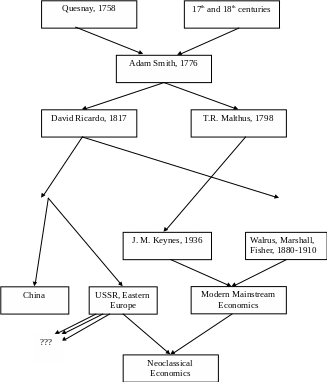
Text 1
THE FIRST MODERN ECONOMISTS
The Mercantilists
Between the 16th and 18th centuries, the major countries of Europe believed in the economic theory of mercantilism. Mercantilists argued that nations should behave as if they were merchants competing with one another for profit. Accordingly, governments should support industry by enacting laws designed to keep labour and other production costs low, and exports (sales to foreign countries) high. In this way the nation could achieve what was called a favourable balance of trade.
«Favourable balance of trade» described a situation in which exports exceeded imports. The excess, which was like profits to a merchant, would result in an increase in the nation's supply of gold or silver. And, as most people agreed in those days, the true measure of a nation's wealth was its hoard of gold or silver.
To achieve favourable trade balances, the major European powers sought to acquire colonies. Colonies, it was thought, could provide the «mother country» with cheap labour, raw materials and a market for its manufactured goods. In an effort to attain these goals in their American colonies, the British, for example, enacted the Navigation Acts.
The Navigation Acts protected British industry by prohibiting the colonies from producing certain goods like hats, woolen products and wrought iron. The laws also listed certain «enumerated articles» (mostly raw materials) which could not be sold to buyers in countries other than England. Resentment towards the Navigation Acts was so great that they are regarded as one of the principal causes of the Revolutionary War.
Today there are people who still argue that our country should promote a «favourable balance of trade, » that the federal government should do what it can to restrict imports and promote exports. For that reason, they are often described as neo-mercantilists or «new» mercantilists.
The Physiocrats
For one group of 18th-century French philosophers and economists, the suggestion that nations should go out of their way to protect business and industry made no sense at all. These were the physiocrats. The physiocrats argued that the products of agriculture and other natural resources were the true source of wealth. Since these were God-given, it made little sense for government to go out of its way to help business and industry increase profits. For similar reasons, they opposed government efforts to promote a «favourable balance of trade. » In other words, since real wealth came from the land, it followed that the wisest thing government could do would be to keep its hands off business and let nature take its course. This idea was expressed in the slogan «laissez faire, » (let people do as they choose).
Interestingly, the 200-year-old argument between those favouring regulation of the economy and those supporting laissez faire is still with us. Whether the problem involves individuals (like those living in poverty and unemployment) or institutions (such as a rising tide of business or bank failures), there are those who find the solution in government intervention, and others who favor «laissez faire,» letting natural economic forces take their course.
Text 2
Adam smith and the wealth of nations
Seventeen seventy-six, the year that we associate with the signing of the Declaration of Independence, also marked the publication in England of one of the most influential books of our time, «The Wealth of Nations» written by Adam Smith, it earned the author the title «the father of economics. »
Smith objected to the principal economic beliefs of his day. He differed with the physiocrats who argued that the land was the only source of wealth. He also disagreed with the mercantilists who measured the wealth of a nation by its money supply, and who called for government regulation of the economy in order to promote a «favourable balance of trade. »
In Smith's view, a nation's wealth was dependent upon production, not agriculture alone. How much it produced, he believed, depended upon how well it combined labour and the other factors of production. The more efficient the combination, the greater the output and the greater the nation's wealth.
The heart of Smith's economic philosophy was his belief that the economy would work best if left to function on its own without government regulation. In those circumstances, self-interest would lead business firms to produce only those products that consumers wanted, and to produce them at the lowest possible cost. They would do this, not as a means of benefiting society, but in an effort to outperform their competitors and gain the greatest profit. But all this self-interest would benefit society as a whole by providing it with more and better goods and services, at the lowest prices. To explain why all society benefits when the economy is free of regulation, Smith used the metaphor of the «invisible hand»:
«Every individual is continually exerting himself to find the most advantageous employment for whatever capital he can command. It is his own advantage, and not that of society, which he has in mind, . .but he is in this, as in many other cases, led by an invisible hand to promote an end which was no part of his intention, for the pursuit of his own advantage necessarily leads him to prefer that employment which is most advantageous to society. »
The «invisible hand» was Smith's name for the economic forces that we today would call supply and demand, or the marketplace. He sharply disagreed with the mercantilists who, in their quest for a «favourable balance of trade,» called for regulation of the economy.
Instead, Smith agreed with the physiocrats and their policy of «laissez-faire,» letting individuals and businesses function without interference from government regulation or private monopolies. In that way, the «invisible hand» would be free to guide the economy and maximize production.
The Wealth of Nations goes on to describe the principal elements of the economic system. In a famous section, Smith turned to the pin industry to demonstrate how the division of labour and the use of machinery increased output.
«One man draws out the wire, other straights it, a third cuts it, a fourth points it, a fifth grinds it at the top for receiving the head; to make the head requires two or three distinct operations...»
Although modern technology has improved the methods by which pins are produced, the principles pertaining to the division of labour remain unchanged.
Similarly, other sections dealing with the factors of production, money and international trade are as meaningful today as when they were first written.
Text 3