Материал: chapter V
5.3.2 Electromechanical recording
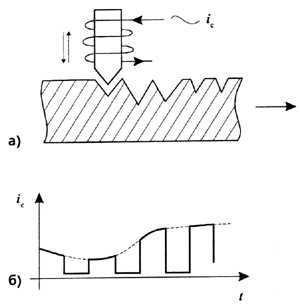
This is one of the first, but still used methods for automated production of print forms. To create the relief of print and blank elements on the plate material, an electromagnetic recorder is used there with a stylus as the core of its solenoid (see Figure 5.9). The image signal current flowing through the coil controls the stylus reciprocating motion and, thus, the degree of its immersion in the material. Moving the latter relative to the cutting head provides a flatbed or drum-type scanning system.
Figure 5.9 There are not only the depth but also the size of the printing elements is varied in electronic engraving (a); the image signal current chopped by the pulses of screen frequency to obtain a plate with a dot structure
In the simplest version, the image consists of grooves of variable width, i.e. has a linear screen structure (see Fig. 2.1, b). If the signal current is mixed with pulses, the amplitude of which provides a periodic complete extraction of the stylus, the halftone dot image is obtained. In the 60s and 70s, engraving was widely used not only for relief and gravure printing, but also for lithography, where halftone transparencies were obtained by removing a layer of paint with a stylus from the surface of transparent plastic. For this purpose, special materials were later developed that had an etching effect for the subsequent manual tone and color correction [5.10]. The most popular electronic engraving machine was Vario Klischograph K181 of Hell. The color-separated clichés were obtained in it in a wide range of screen rulings with smooth scaling of both transparent and opaque originals. For line work plates, the scan density reached 18 lines/mm. The machine was a unique fusion of the technology achievements of that time in the field of electronics, precision mechanics and optics, pneumatics and hydraulics, automation and industrial design. Its analogues were produced in Japan and United States, and in the late 60-ies similar machine was made in USSR [5.11]. However, by that time the progress in the prepress was not in favor of engraving illustrative forms and now it is preserved only for gravure printing. There it’s justified by relative complexity and high cost of the traditional indirect (using photo reproduction stage) method of preparing printing cylinders. However, in relief and offset printing the engraving was replaced by this seemingly less progressive, indirect way. Direct production of forms, however, had always been of great interest and remained relevant. Now it is implemented in the computer-to -plate concept [5.12]. In this regard, it is interesting to understand the reasons for its departure from wide practice in the early 70's. One of them was the low productivity of engraving. The cutting frequency did not exceed 2 kHz due to the inertia of the recorder and was more than an order of magnitude inferior to the speed of recording halftone dots in the alternative film output of that time. In the relief printing, the indirect films using method was to some extent justified by the availability of a stable and well-normalized so-called single-process of etching clichés [5.8]. The second and probably more important reason was that the engraved illustrative and text forms had to be further assembled both in the page and in the entire print sheet format. In letterpress printing, for example, the manual page stripping was greatly facilitated with illustrations and text presenting on film. The same was one of the reasons for the transition to an indirect method of obtaining text forms, i.e. replacing the "hot" set with a phototypesetting.
|
5.3.3 Gravure cylinders preparation
The problem of increase of productivity was solved in HelioKlischograph K200/201 (R. Hell) by the parallel use of eight or more recording heads, each of which engraves the respective page of an edition. The relief of the obtained form, in contrast to the form of classical gravure printing, is characterized not only by the variable depth of the printing elements, but, due to the specifics of the engraving process (see Fig. 5.9 a), also by their area variation, i.e. corresponds to the form of a gravure autotype [5.13].
The method of gravure printing is initially characterized by a relatively low geometric accuracy of fine detail reproduction due to the relatively large size of the printed elements and the presence of partitions between them, serving as a support for the squeegee (“doctor blade”), removing excess ink from the cylinder before it comes into contact with paper. For this reason, the typefaces of relatively simple design are used here.
Traditionally, a special input module was used in the cylinder engraving system, the optical heads of which produced signals of negative opaque original pasted up layouts with text and color-separated halftones.
To eliminate their time-consuming manual preparation in the late 70-ies there was designed the first digital system for color text-illustrative pages layout - HDP (Helio Data Processing) [1.17]. For input and functional transformation of images was used the input section of a scanner, and the text files came from a phototypesetter. Layout and sophisticated retouching in accordance with the editorial instructions was carried out on a computer workstation having the means of interactive graphic dialogue and the ability to simulate a page on its monitor.
5.3.4 Laser engraving
Initially focused on the digital layout, the system “Lasergravure” was later developed by Crosfield Electronics. Its technology included thermal, under the influence of video-modulated radiation of a powerful laser, ablation of epoxy resin filling the pre-etched cylinder cells. To increase the number of printed copies, the cylinder surface could then be subjected to metallization.
Laser engraving means not mechanical, but thermal effect of laser radiation on the copy material. Obtaining by this method of relief metal forms for letterpress or gravure is low productive and inefficient in relation to the achieved quality. Despite a number of attempts [5.14], it has not found practical application. Therefore the use of laser for direct print forms production is, as a rule, associated with the development of special technologies, including materials and copying layers. The latter can belong to the category of silverless or, using silver salts, be close in sensitivity to phototechnical films. In this case, some output devices are universal, capable of producing both transparencies and print forms.
Indicative in this sense is the schemes variety of use the laser facsimile apparatus LogEscan and silverless LaserMask technology in New York Times in the mid 80s for continuous production cycle of this more than hundred pages daily edition.
The pasted-up original pages were transmitted by means of this equipment by cable to the relief printing department located in the ground floor of the same building. Here, in the receiver, the laser beam modulated by the transmitted signal transferred a layer of dye from the transparent substrate of the LaserMask material to the paper producing the positive copy to be returned to the layout section upstairs, where it was used to prepare the pages of the next (day, evening) editions. The remaining layer of dye on the substrate formed a transparent negative image suitable for copying to a letterpress cliché. The signal of the same transmitter was simultaneously transmitted by ultra short wave to the offset print shop located a few kilometers away in New Jersey, where a copy was recorded directly on the litho plate in a similar receiver.
In various versions of the "computer - offset plate" technology, the final result of the exposure by laser or other radiation source onto the plate material is to obtain an intermediate image in the form of a set of ink receiving (oleophilic) and repelling (oleophobic) elements. This, mainly thermal, effect is used either to remove one of the plate layers or selectively change the physical properties of its surface.
In the technology of "computer - relief form of flexography" is widely used two-stage process. At the first stage, alternative to the manufacture of halftone transparencies, the laser radiation burns the mask on the auxiliary protecting coating. Due to the subsequent selective (through the mask) irradiation of the photopolymer with un-modulated ultraviolet, the relief of the printing and blank elements is more pronounced than in the traditional exposure through the film negative. The absence of the need for such negative also makes it possible to produce seamless, sleeve photopolymer forms of web flexographic printing [5.15].
5.3.5 Digital printing
The result of the computer publishing system operation is a numerical image of the page or multi-page print sheet. This information is sufficient to properly reproduce illustrations, text, elements of graphic design, their placement in the page, etc.2 With the subsequent stages being strictly normalized, the possibility of full automation of the whole printing process in the concept computer –to - print or the so-called "digital printing" is created. The input of such systems receives a flow of publication data while the output almost simultaneously and without the use of any intermediate manual operations provides prints, and in some cases, folded and bind print products.
"Digital" presses of DI (direct imaging) type differ in that they include the entire above-mentioned CtP system of, bypassing the mechanicals, the plates manufacture, as well as the means of their automatic installation and removal [5.16].
In the majority of digital presses there is no plate in its usual meaning, despite existence in some cases of an intermediate image carrying surface. The latter objectively fixes the received data individually for an each print and then comes into contact with a paper, ink, toner, offset blanket…. Such a light-sensitive surface of optical photoconductor has, for example, the cylinder in the most common digital printing systems with electro photographic (with dry or liquid toner) principle of image registration [5.17].
In devices with thermal transfer of the dye from the tape, its thermal sublimation or non-impact printing of the ink jet type, intermediate images are excluded at all, and the numerical data received at the input is imaged only on the print substrate [5.18].
In general, as defined by [5.19], a digital press is a device that:
- is able to accept digital data from computer (mainly in the PostScript format);
- is equipped with a raster processor (RIP or driver) that converts a PostScript file to a bitmap;
- registers the bitmap on a substrate with the use of a particular physical process.
However, such a set of features also meet the usual, office printer and digital color proof device. Therefore, it is also important to see how this machine is an alternative to traditional printing in terms of performance, efficiency and other parameters.
Most appropriate in technical and economic terms, the runs of various digital presses were initially in the range of 50 - 5000 prints and the format had rarely exceeded A3. Simpler versions of such machines combined several conventional laser printers.
The current digital presses are mostly designed to take into account the specifics of the "computer-to-print" concept and the optimal use of its advantages [5.20]. Ongoing is the research and development of novel methods and, for example, a continuous tone printing elcography –the deposition of pigment on a substrate from the electrolyte under the image signal control [5.21]. A systematic analysis of the digital printing structure and trends was given in the end -1990s in [5.22].
The specific advantages of digital printing are characterized by such concepts as personalization, "just-in-time" and "print-on-demand". This implies the following features that are not available in traditional technologies:
- getting each copy of the publication and any of its pages with the desired individual differences from others;
- making corrections and additions at the last moment and, in particular, remotely over the network, the peripheral device of which is essentially a digital press;
- print to the exact appointed (up to minutes) date with reduction of problems associated with warehousing and forwarding of print matter;
- print the runs in parts, including single copies, at different times and places, which significant reduce the mailing expenditures.
The last of these features marks the trend of transition in the new media from the usual practice of “print - distribute" to the principle of “distribute - print".
The feasibility of using digital printing in each case is determined by the ratio of these advantages and disadvantages. In comparison with the traditional offset, for digital printing machines of various types, such disadvantages were initially expressed in the following:
- 3 to 10 times less performance, which among other things was limited by the speed of raster processors;
- limited format (A3, A4);
- limited choice of papers;
- the high cost of monopoly supply of consumables (color toners, for example, were many times more expensive than offset inks);
- limited outside the triad, the choice of colors;
- relatively low print quality;
- high investment.
In addition to the awareness in illustration printing specific, the system operator was required to be able to handle PostScript files, at least for their display on the screen due to lack of proofs.
Being decisive for some, especially small-run, types of printed products, the advantages of digital technology seemed to be in little demand in the future in other fields, such as the production of labels and packaging. However, over time, and here the emphasis has shifted significantly in favor of digital printing. With the improvements its scope is steadily expanding not only for print packaging, but also in the manufacturing of a wide variety of industrial items, such as electronics.