Материал: Homework_1_(Electrostatics)_What_to_do
21
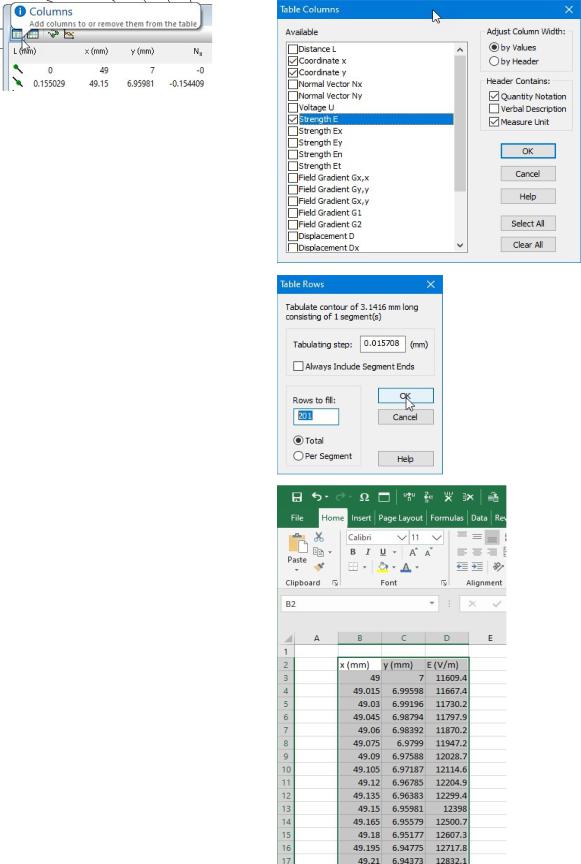
Click the Columns button and left only three columns to show: x, y, and E
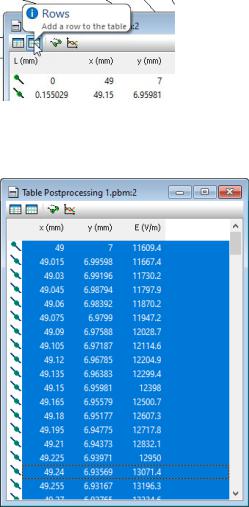
Then click the Rows button and ask to tabulate the contour with 200 segments (201 points)
In the table select all rows and column captions by pressing Ctrl+A keys (Select All Rows command) and drag the contents of the table to your favorite table processor, e.g. Excel
Now you can sort the table by the E value from largest to smallest values, and the first row in your table will contain the maximal field value along with the point coordinates. Put it to your report together with corresponding mesh spacing value on the rounded capacitor corner. Repeat this with decreased values of the mesh spacing until you reach the convergency with accuracy <1%.
22
2.9.EXTRACT LOCAL FIELD VALUES
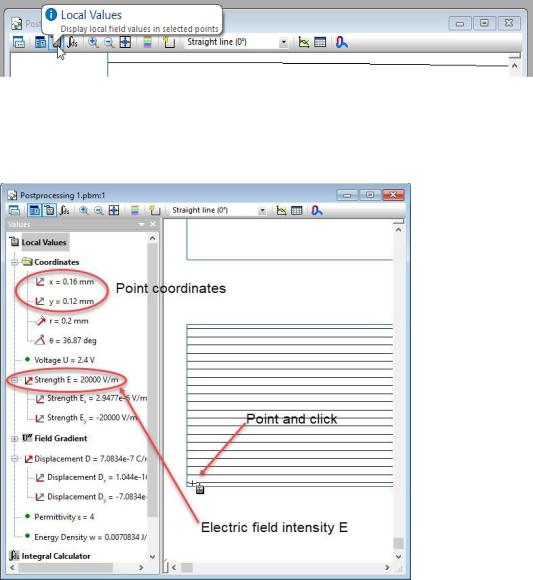
Besides various field pictures you can extract from the solution a value of different physical quantities, both local and integral. The Local field quantities describe the field in a given point. Locals include: electric field E (magnitude and components), electric displacement D, potential U and some others.
To extract a local value, click the Local Values button on the postprocessor’s toolbar
,
And then click the point you want to know field values in the field picture window.
To extract integral quantities, you first have to define the domain of integration. QuickField can calculate integrals:
23

1. over a line L, for example, potential difference U = E dl
L
2. over a surface S, for example, electric flux q = D ds
L
3. over a volume V, for example energy of electric field W = 1 D E dv
2 V
In all cases the domain of integration is given by a plane contour that can be open or closed.
•An open contour defines a line and a side surface,
•A closed contour defines a line and two surfaces – a side surface and a cross-section surface in the model plane, as well as a volume inside the closed surface.
2.10.CALCULATE THE CAPACITANCE
The capacitance can be calculated in the following ways:
1.Using the definition, as a ratio of the charge to the voltage difference: Cq = qU
2.By electric field energy: Cw = 2UW2
In both cases we have to calculate an integral value:
•the electric charge as q = D ds
L
• the total electric field energy in the model: W = 1 D E dv
2 V
One of the ways to calculate the electric charge of a capacitor plate is to use the Gauss theorem. The charge is calculated as an electric flux other any closed surface surrounding the conductor. For numerical reasons to achieve better accuracy is recommended to draw the contour far enough from the region where the field changes quickly, e.g. as shown in the picture below:
24
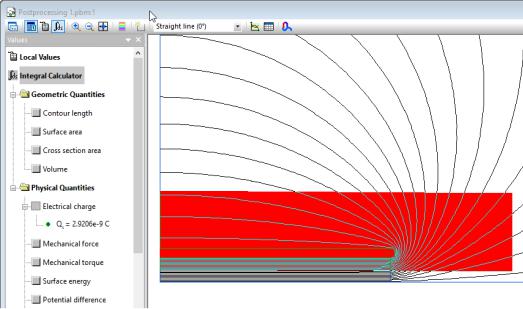
The domain of integration for the electric field energy is the total volume of the model. To define such domain, one must enter the contour defining mode (click the Add to Contour button on the postprocessor toolbar), and then click all the model blocks one by one.
QuickField also provide a tool simplifying the capacitance calculation – the Capacitance wizard.
25