Материал: 411
You must ensure that all reported offenses are quickly and thoroughly investigated. You may conduct the preliminary inquiry yourself or direct someone else to do so. In serious or complex criminal cases, you should seek the help of law enforcement personnel. When collecting information that may prove or disprove allegations of misconduct, investigators should ask three primary questions:
Was an offense committed?
Was the suspect involved in the offense?
What is the character and military record of the suspect?
Investigators must always remain impartial. A one-sided investigation may result in an injustice to the accused and an embarrassment to the command.
Preliminary investigations are usually informal, consisting of interviews with witnesses and reviews of police reports. Investigations must provide a thorough, factual foundation for determining what happened and what should be done. Preliminary investigations should not be confused with UCMJ, Article 32 investigations, which require sworn charges. Nor should they be confused with the procedures for administrative investigations addressed in AR 15-6.
Once a preliminary investigation is complete, you must do one of the following:
Take no action.
Take nonpunitive disciplinary action.
Impose nonjudicial punishment under UCMJ, Article 15.
Prefer court-martial charges against the accused and forward them up the chain of command with a recommendation for appropriate action.
STATEMENTS OF SUSPECTS AND WITNESSES
Investigations may be complicated or simple. Not all cases will require formal statements; in simple cases, you may find sufficient facts without written statements. You must investigate the circumstances of alleged crimes and examine the facts relevant to the case. You should ensure that all witnesses and suspects are interviewed. Interviews should be fair and prompt. Before questioning, you must advise suspects of their rights under UCMJ, Article 31, and of their right to counsel.
A confession or admission by a suspect without a proper rights warning will not be admissible in a court-martial. A court, however, may still convict an accused because of other evidence of guilt that is admissible. Failure to warn does not mean automatic acquittal; it means that the admission may not be presented to a court-martial.

After receiving the warning, a suspect may waive the right to remain silent and the right to consult a lawyer. He must waive these rights freely, knowingly, and intelligently. If a suspect indicates that he wishes to consult a lawyer, he should not be questioned until a lawyer is made available. The installation Trial Defense Service office will provide a military lawyer. If the suspect indicates that he does not wish to answer questions, no questions should be asked. If he waives his rights, he may then be questioned about the offense.
In any case, your manner should not lead suspects to believe they are being threatened. Neither should it play down the importance of the warning. If you do either of these, a court-martial may determine that the suspect's agreement to answer questions was in response to coercion or improper inducement. The judge would then find the statement not admissible in the trial. You may decide not to question a suspect if other adequate evidence is available.
Rights Warning Statement
You need not give a rights warning to witnesses who are not suspects. During the questioning, you may, however, begin to suspect that a witness was involved in an offense. The witness may appear to have been an accomplice or an accessory to the crime. You should then stop the questioning, inform the witness of the offense of which you now suspect him, and warn him of his rights as previously described. DA Form 3881 provides a convenient format to apprise individuals of their rights, and you should complete it before questioning a suspect.
Written Statement
A sworn statement is the best way to record accurately and completely information obtained in an investigation. UCMJ, Article 136, authorizes investigating officers to administer oaths in conjunction with sworn statements taken in the course of a preliminary investigation.
No special form is required; however, the investigating officer may use DA Form 2823 for a witness's statement. He should use the language of the witness or suspect throughout the statement, even if the language is vulgar. Doing so ensures that the statement is the witness's and not the composition of the investigating officer. The statement may be narrative, questions and answers, or both.
The following is an appropriate oath for administering and completing the sworn statement:

Do you swear that the statements you have made are the truth, the whole truth, and nothing but the truth?
The witness should sign his name, and the officer administering the oath must then sign his own name.
You should request sworn statements primarily from persons who have direct, personal knowledge of the facts. For example, if Sergeant A provided the information to the witness, you should try to get a sworn statement from Sergeant A. Opinions and conclusions without supporting facts, however, reduce the reliability of sworn statements. You should try to get the facts on which opinions are based and encourage witnesses to provide facts rather than opinions. In each case, the witness should sign the written statement and initial it at the beginning and at the end of each page, at each erasure and correction, and at the places otherwise indicated on DA Form 2823. The initials are to avoid any question of tampering.
Oral Statement
When a suspect waives his rights under Article 31 and his right to counsel but refuses to make a written statement, you should record his remarks. Oral statements may be admissible in a trial by court-martial. A suspect may make a statement about his part in an offense to a person not investigating the case, or he may blurt it out to you before he receives the rights warning. The information he provides may be admissible in a trial by court-martial as well.
LAWFUL SEARCHES AND SEIZURES
You may lawfully seize soldiers' property in their units after a legal search, inspection, or inventory. An unlawful search may violate a soldier's rights and result in seized items being inadmissible in a court-martial.
Searches
PROBABLE CAUSE TO SEARCH
You may direct a search of any person or property in a place under your control only if you have probable cause. You may authorize searches in your company areas, but only post commanders may authorize searches or apprehensions in government quarters. (See MCM, 302, Military Rule of Evidence and MCM, R.C.M. 315.) Probable cause to search requires both of the following:
You have a reasonable belief that evidence of the crime is on the person or at the place you plan to search.
The information and its source are reliable.
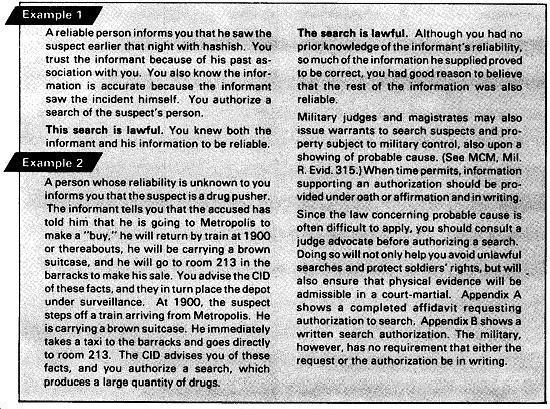
You must have more than a suspicion, but you need not have absolute proof. In other words, probable cause lies between suspicion and knowledge. You must conclude on the basis of information presented to you that the contraband or evidence of a crime is at that time likely to be in the possession of the suspect or on the premises to be searched. Your determination that probable cause exists must be reasonable and based on facts. It may not be based solely on others' conclusions. A CID agent's, first sergeant's, or informant's awareness of sufficient facts to provide probable cause is unimportant unless the commander who orders or authorizes the search receives those facts. That commander must believe the person furnishing the information and the information are reliable before probable cause can exist.
The following examples are situations in which you would have probable cause to search.
NO PROBABLE CAUSE TO SEARCH
The following paragraphs address searches that do not require probable cause to be lawful.
Searches incident to lawful apprehension. A soldier may be searched when and where he is legally apprehended. (See Apprehensions) Such a search is to discover weapons and prevent destruction of evidence. The search is limited to the soldier's person and the area within his immediate control. For example, the area within his
immediate control might include an open wall locker within reach, but it might not include the entire room. However, a complete search of the passenger compartment of an automobile is permissible, even if the apprehended soldier has been removed from the vehicle and cannot return to it.
Searches of government property. A search of government property does not require probable cause unless the person to whom the property is assigned or issued has a reasonable expectation of privacy. Generally, a person does not have a reasonable expectation of privacy in regard to government property that is not issued for personal use. (See MCM, Mil. R. Evid. 314(d).)
Searches by consent. Probable cause is not necessary when a person freely consents to the search. Because consent is a waiver of the Constitutional right of freedom from unreasonable searches, the government must be able to produce clear and convincing evidence that the consent was voluntary and not a submission to authority. You should have a witness to a soldier's consent to a search. If the consent becomes an issue at a trial, the witness can verify its nature. If the search then uncovers evidence of criminal conduct, the evidence will be admissible at a trial. (See MCM, Mil. R. Evid. 314(e).)
To establish voluntary consent, the suspect should be informed of both of the following:
The legal right to withhold consent.
The fact that any evidence found during the search can be used against the suspect. The following examples are situations lacking probable cause to search.