Материал: 1989
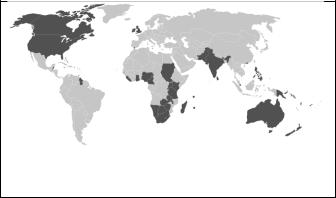
30. Read the text to find out if the statements above were true or false. Compare the received information with your answers given before. Then read the article in more depth.
ENGLISH IS A WORLD LANGUAGE
Today, when English is one of the major languages in the world, it requires an effort of the imagination to realize that this is relatively recent thing – that in Shakespeare’s time, for example, only a few million people spoke English, and the language was not thought to be very important by the other nations of Europe, and was unknown to the rest of the world.
English has become a world language because of its establishment as a mother tongue outside England, in all the continents of the world. This exporting of English began in the seventeenth century, with the first settlements in North America.
Above all, it is the great growth of population in the United States, assisted by massive immigration in the nineteenth and twentieth centuries, that has given the English language its present standing in the world. It is widely spoken on six continents, and is the official language, or one of the official languages, in 55 countries.
People who speak English fall into one of three groups: those who have learned it as their native language; those who have learned it as a second language in a society that is mainly bilingual; and those who are forced to use it for a practical purpose – administrative, professional or educational. One person in seven of the world’s entire population belongs to one of these three groups. English is the language of politics and diplomacy, science and technology, business and trade, sport and pop music. 80% of all information in the world’s computers is in English, 75% of the world’s mail and 60% of the world’s telephone calls are made in English, more than 60% of all scientific journals are written in English.
The following are a few of the many reasons why English is so widely spoken.
English is the official language in many of Britain’s former colonies, such as America, Australia and New Zealand.
The economic power of Britain in the 18th and 19th centuries, and of the US in the 20th century, helped to make English the language of world trade.
Entertainment has helped to spread the use of English, because of the worldwide popularity of English-language films, TV programmes and pop music.
Unofficially, English has become the international language of travel and tourism, technology and computers, business, medicine and so on.
Officially, it is the international language of air traffic control and shipping. Also, in countries with several tribal or ethnic groups speaking different languages, English has often been chosen as the official language of government, as in Nigeria, India and Papua New Guinea.
Now let us dwell upon the basic characteristics of English.
Old English, like modern German, French, Russian and Greek, had many inflections to show singular and plural, tense, person, etc., but over the centuries words have been simplified. Verbs now have very few inflections, and adjectives do not change according to the noun. Some modern English words still inflect, but much less so than in other European languages. The English verb “to ride” inflects into five forms (ride, rides, riding, rode, ridden) whereas the equivalent German verb has sixteen forms. The trend towards simplicity of forms is considered to be a strength of English.
Another strength is a flexibility of function of individual words. Without inflections, the same word can operate as many different parts of speech. Look at these uses of the word “round”:
There was a round table, (adjective) He bought a round of drinks, (noun) He turned round, (adverb)
He ran round the field, (preposition)
The car tried to round the bend too quickly (verb).
Openness of vocabulary involves the free admissions of words from other languages and the easy creation of compounds and derivatives. Most world languages have contributed some words to English at some time, and the process is now being reversed. Purists of the French, Russian, and Japanese languages are resisting the arrival of English in their vocabulary.
These features have made English what it is today, an effective medium of international communication. English has achieved this in spite of the difficulties caused by written English, which is not systematically phonetic.
Geographically, English is the most widespread language on Earth, second only to Mandarin Chinese in the number of people who speak it. It is the language of business, technology, sport, and aviation. This will no doubt continue, although the proposition that all other languages will die out is absurd.
31. Explain the meaning of the following word-combinations from the text:
mother tongue, former colonies, economic power, worldwide popularity, air traffic control, tribal or ethnic groups.
Make your own sentences using these word-combinations.
32.Here are the answers to some questions. Work out the questions.
1)A few million.
2)Because it is the mother tongue of many countries outside England.
3)In the seventeenth century.
4)75%.
5)60%.
6)Yes, it had a lot of inflections.
7)Simplicity of form, flexibility, and openness of vocabulary.
8)Mandarin Chinese.
33.Answer the following questions and explain your point of
view:
1) Does the text come from …
-a brochure for an English language school?
-a preface to a book on modern language teaching?
-a dictionary?
-an encyclopaedia?
2)Why does the author of the text say that it is because of the United States that English is a world language?
3)Which of the three groups of English speakers do you belong to? What is your reason for learning?
4)What words are there in your language that have been borrowed from other languages?
34. Read the text and then do the task after it.
People have long been interested in having one language that could be spoken throughout the world. Such a language would help to increase cultural and economic ties and simplify communication between people. Through the years, at least 600 universal languages have been proposed,
including Esperanto. About 10 million people have learned Esperanto since its creation in 1887, but English, according to specialists, has better chances to become a global language.
Divide into several groups. Each group/student will represent (native) speakers of different languages. Following languages should be represented: English, Spanish, Esperanto, Italian, French, German, Chinese. Choose a name according to your supposed nationality. You are to prove that your language has a good chance to become an international language. Try to give at least three arguments for your language. One person will be an interviewer and should conduct the discussion, introduce people.
35. Discuss the following paragraph with your partner and express your opinion:
Of course, not all newspapers and TV programmes report events objectively, but serious journalists and TV reporters try to be fair and provide us with reliable information. It is true that the world today is full of dramatic events and most news seems to be bad news. But people aren’t interested in ordinary events. That is why there are so many programmes and articles about natural disasters, plane crashes, wars, murders and robberies. Good news doesn’t usually make headlines. Bad news does.
36.Look through the following text and answer the questions:
1)What is the main idea of the article?
2)What is meant by the term “relativistic ethic”?
3)What does the author consider to be real liberalism and real conservatism of mass media?
THE MASS MEDIA AND POLITICS:
AN ANALYSIS OF INFLUENCE
Pay no attention to that man behind the curtain!
The Wizard of Oz
Freedom of the press is guaranteed only to those who own one.
A.J. Liebling
All of the American broadcast media and most of the print media as well, are owned primarily by wealthy individuals. Direct ties to the biggest of big businesses are almost unbelievably extensive, and, we believe, these ties cannot help but seriously bias and compromise news coverage.
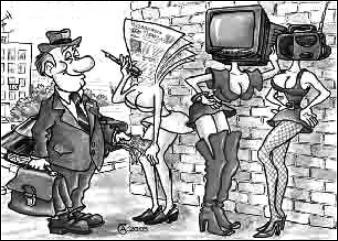
Moreover, the media empires are, first and foremost, profit-making corporations that conduct themselves like other corporations when it comes to corrupting American politics. That is, the parent corporations make socalled “campaign contributions” and also act against the public interest in other ways. As big winners in the corruption game, they show no signs of serious interest in political reform.
Allegations of political bias in the media are common, although there is considerable controversy concerning the nature of this bias: neither liberals nor conservatives are pleased. Conservatives allege that the media exhibit a liberal bias. On the other hand, liberals allege that the media exhibit a pro-corporate, plutocratic bias. However, we believe such charges rely on a faulty and simplistic analysis of the American political and economic spectrum. The truth is that the apparent liberalism of some of the mass media is primarily cultural, and rarely economic. In effect, and like most other American institutions, the mass media advance the economic interests of the wealthy few at the cost of the interests, and values, of the majority; and the self-indulgent, empire-building interests of the wealthy few are not those of either liberals or cultural conservatives.
At the heart of media pseudoliberalism is a shallow but highly serviceable relativistic ethic. We say “serviceable” because the fundamental corporate ethical premise, “if it’s profitable it’s good,” is fully compatible. This form of “liberalism” nicely advances the corporate profit agenda. The media is being
entirely logical when it also manifests pro-corporate, economic “conservatism.” Though the names and the products are different, the underlying ethos is not.
Against this, some have objected that the media often attack corporations. It’s true, certainly, that this or that individual corporation may be subjected to media criticism, sometimes even harsh criticism – but it is obvious that the sort of fundamental reforms needed to bring about real change are never mentioned.
37. Make rendering of the text “The Mass Media and Politics: An Analysis of Influence”.