Материал: 1989
3)Mass media form public opinion.
4)Mass media build up public images of political figures.
5)People use mass media for various purposes.
19.Sum up and enrich your knowledge of mass media:
1)Interview your relatives and friends what kinds of the mass media they usually/seldom use. Compare the answers of the people of different age. Make up a story on the topic “Mass media in our life”.
2)Prepare a talk for a foreign audience on mass media in your country. Give this talk in class and answer the questions that may follow.
20.Say which of the existing mass media was the first to appear, prove your point of view.
21.Read the text and try to determine the main stages of mass media development:
HISTORY OF MASS MEDIA
Types of drama in numerous cultures were probably the first mass media, going back into the Ancient World. The first dated printed book known is the “Diamond Sutra”, printed in China in 868 AD, although it is clear that books were printed earlier. Movable clay type was invented in 1041 in China. However, due to the slow spread of literacy to the masses in China, and the relatively high cost of paper there, the earliest printed massmedium was probably European popular prints from about 1400. Although
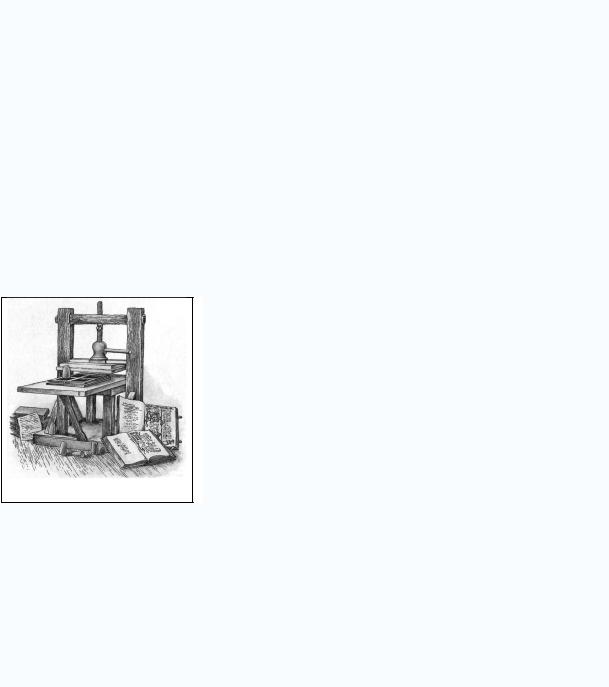
these were produced in huge numbers, very few early examples survive, and even most known to be printed before about 1600 have not survived. Johannes Gutenberg printed the first book on a printing press with movable type in 1453. This invention transformed the way the world received printed materials, although books remained too expensive really to be called a mass-medium for
 at least a century after that. Newspapers developed around from 1612, with the first example in English in 1620; but they took until the nineteenth century to reach a mass-audience directly.
During the 20th century, the growth of mass media was driven by technology that allowed the massive duplication of material. Physical duplication technologies such as printing, record pressing and film duplication allowed the duplication of books, newspapers and movies at low prices to huge audiences. Radio and television allowed the electronic

duplication of information for the first time. Mass media had the economics of linear replication: a single work could make money proportional to the number of copies sold, and as volumes went up, units costs went down, increasing profit margins further. Vast fortunes were made in mass media. In a democratic society, independent media serve to educate the public about issues regarding
government and corporate organizations. Some consider the concentration of media ownership to be a serious threat to democracy.
22. Find out which of these events were mentioned in the text:
Popular prints appeared in Europe.
Auguste and Louis Lumiere invented cinematograph. First newspaper in English was published in Amsterdam.
Philo T. Farnsworth created the first electronic television system. Johannes Gutenberh used his printing press to print the Bible. Tunable radio was invented.
Put them in the chronological order.
23.Say what happened in the following years:
868, 1041, 1453, 1612, 1620.
24.Look through these passages paying attention what influenced the development of mass media in the 20th century in America:
The 1900s
At the dawn of the new century, the media consisted mainly of newspapers and various periodicals. News, entertainment and advertising were packaged into one paper, and not divided into special sections. Newspapers and magazines were limited to local and regional news as there were no extensive communication systems like we have today.
The 1910s
Newspapers and magazines dominated the media in the second decade of the 20th century. Due to World War 1, the public looked for news they could trust in these sources. The war changed the relationship between the press, the public and the government. Military censorship was necessary for national security, leading to debates over the press concealing facts.
The 1920s
Radio dominated the Twenties, with roughly 3 million Americans owning radios by 1923. The appeal of the spoken word attracted audiences and advertisers, while publishers were forced to improve upon its image to retain profits. Television, capable of wireless transmission of moving pictures, was first demonstrated in 1926, combining sight and sound to rival radio.
The 1930s
In 1929, The Great Depression started with the collapse of the American stock market. At the lowest point in 1933, 16 million people, or one third of the United States working population were unemployed. Many advertisers switched to radio from newspapers, spending US$60 million in radio commercials. Radio infiltrated all aspects of American life, filling it with music, news, entertainment and advertisements.
The 1940s
Radio became the dominant form of media during and after World War II, as could provide war information much faster than newspapers, and people desired current news of the war situation and of their relatives fighting overseas. Radio was also more economical, as it was a one-time investment of a radio set. Newspapers still supplied daily information and advertising, and large media groups continued to grow throughout the 1940s.
The 1950s
Television dominated the media industry in 1950. There were 3.1 million television sets in American homes, and over 100 television stations operating in 38 states across the USA. Apart from being known as “The Golden Age of Television”, the Fifties were also remembered as the Cold War, when fear of nuclear destruction and takeover by the Communist was strong. Cinema, radio and print media were to compete with television that seemed to give the best of both worlds: pictures and sound. With the advent of television in the 1950s, print media, radio and film were forced to rethink their approaches towards news and entertainment.
The 1960s
The 1960s were a time of political, social and cultural change. Americans were confronted with cult movements, the Vietnam war, civil rights issues, student protests, all covered by national news organizations, and more immediately television. Television's effect on politics, public perception and advertising continued to grow. Since 1962, with the communications satellites space news reports from around the world could be transmitted directly to a broadcast center, giving television unique power to communicate major world events real-time.
The 1970s
In the 1970s, reporters took stronger roles in uncovering news. They revealed corruption in the government that lead all the way to the president. The Pentagon Papers started a legal battle between the powers of the government to protect its secrets and the press' freedom to publish information for the public good.
The 1980s
There was explosive growth of the media in the 1980s, especially television. With rising costs of materials and labour, and with competition from 24-hour cable television news, many newspapers disappeared, leaving many towns with only one print voice to service them. Satellite television reported events across the world. Cable news and cable television also rose in popularity, competing with network television.
The 1990s
With the Internet going public, electronic publishing and chat rooms sprang up, allowing individuals to express their opinions to a large audience. With minimal technical know-how, anyone could air his or her comments and views without the huge expense of traditional publishing. Still, advertising searched for new ways to use new media to promote their products.
25.Answer the following questions:
1)What discoveries were mentioned in the text?
2)What events took place during the 20th century?
3)Which mass medium dominated in each decade?
4)What kinds of information formed the main contents of mass media in each decade?
26.Integrate the information about the development of mass
media:
1)Sum up all the information and make a conclusion what factors determined the evolution of mass media during the 20th century.
2)Analyse what factors influenced the development of Russian mass media and compare your conclusions with ones based on the information about American mass media.
27.Express your opinion if it is necessary to know a foreign language to be an effective media consumer. Read the following passage and decide, whether you agree or not with it.
There are many reasons for people to learn foreign languages. One of the main reasons is the need to communicate orally or in writing with other people who use this language. You may communicate with them over the Internet or mail if they are far away. When you listen to tapes, radio, watch videos and read a book or newspaper in a foreign language it also means that you communicate. It is because you understand not only the words but thoughts and ideas of other people and you are ready to express your own thoughts in reply.
28.Read some facts about the English language.
1)English is a working language of the Internet service.
2)80% of all information in the world’s computers is in English.
3)More than 60% of the world’s radio stations broadcast in English.
4)More than 60% of all scientific journals are written in English.
5)The greatest number of press production is published in English as well.
Say which of these facts were unknown for you before.
29. Discuss the following statements with your partner. Say if you consider them to be true or false. Explain your point of view.
1)English was already an important world language four hundred years ago.
2)It is mainly because of the United States that English has become a world language.
3)One person out of seven in the world speaks perfect English.
4)There are few inflections in modern English.
5)In English, many verbs can be used as nouns.
6)English has borrowed words from many other languages.
7)In the future, all other languages will probably die out.