Материал: 1964
What kind of transport do you prefer to take? Why?
Is it necessary to construct the metro in our city? Why?
What are the advantages and disadvantages of the metro construction?
Being in Russia
41.What proverbs about travelling do you know? How would you say them in Russian? Can you explain them?
E.g. Travel broadens the mind means that you can learn a lot about the world and its people by travelling. If you travel and visit new places, you get to know other people’s habits, customs, culture, etc, therefore you expend your knowledge.
42.In pairs discuss the following:
1.In what region of Russia can you visit the Hermitage Museum or enjoy a ballet performance?
2.In what region can you swim in crystal clear waters and sunbathe on sandy beaches? You can also see eucalyptus.
3.In what region of Russia can you visit Pushkin’s museum or walk along the streets?
4.In what region of Russia can you enjoy magnificent scenery, snow-capped mountains and huge lakes?
5.In what region of Russia you can see the beautiful natural scenery and admire the interesting architecture?
6.In what region of Russia can you try the local cuisine, bread kvass and meat dumplings and buy handmade souvenirs?
7.In what region of Russia can you see animals in their natural environment? You can also visit natural sites and traditional villages?
8.What places would you like to visit? Why?
43.Search one of the regions of Russia in the library/on the Internet and make a poster to display it in the classroom.
44.Write a short article about one of the most interesting natural areas in your country for your school magazine. Write about:
- it’s location;
-size;
-historical details;
-what you can do/see there;
-recommendation.
45. It must be very easy for you to tell a foreigner about your country. Fill in the table below.
Name origin: |
|
Total area: |
16, 995, 800 sq km |
Population: |
|
Official languages: |
|
Ethnic groups: |
|
Motto: |
|
National anthem: |
|
Capital: |
|
Largest city: |
|
Government: |
|
Head of state: |
|
Longest river: |
|
Highest mountain: |
|
Currency: |
|
46. Look at the pictures (Pic. 13 – 21). What nationalities are the people? What makes it easy for you to identify them? Use the words from the box to describe the pictures:
bowler hat; beer; bunch of green birch twigs; Russian bath; to cross legs; bottles; glasses; pint; newspaper; relaxation; tradition; to admire; friends; to spend time outdoors; to go out; cafes; reading in the tube.
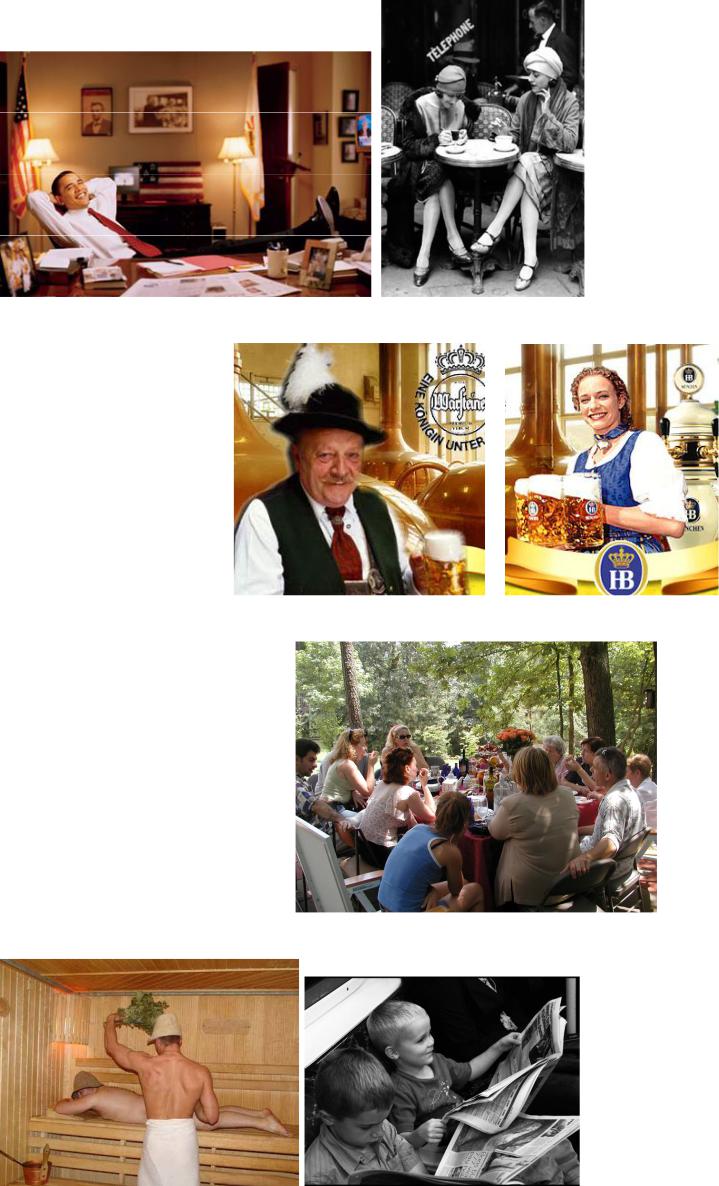
Pic. 13 |
Pic. 14 |
Pic. 15 |
Pic. 16 |
Pic. 17
Pic. 18 |
Pic. 19 |
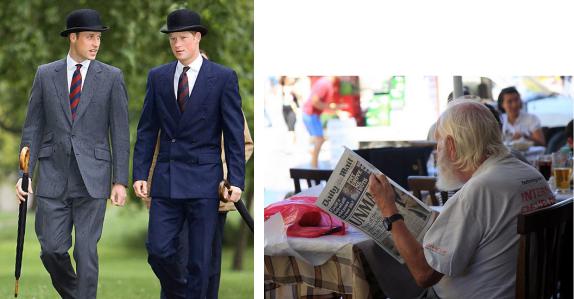
Pic. 20 |
Pic. 21 |
47.What is the stereotype Russian man/woman? Do you believe in stereotypes? What do you think are the stereotypes for other nationalities?
48.Which adjectives in the box do you think go with nationalities below (use your dictionary to check new words)?
dangerous; strong; weak; generous; determinated; of cool judgment; energetic; fast; sociable; rich; sophisticated; wealthy; rude; boring; reserved; modern; busy; cosmopolitan; hard-working; easy-going; punctual; friendly; reserved; emotional; lazy; out-going; hospitable; formal; casual; enthusiastic; quiet; tolerant; talkative; well-dressed; funloving; respectful; humourous; serious; nationalistic; romantic; funny; stingy, jealous.
Nationalities |
Characteristics |
American |
|
Ukrainian |
|
Russian |
|
French |
|
British |
|
Caucasian |
|
Kazakh |
|
German |
|
49. In pairs, discuss the following questions.
1.Do you get many foreign tourists in your country?
2.What do they come to see? What do they come to do?
3.What are the most popular towns for them to visit?
4.What are the most popular places?
5.Which countries do the tourists come from?
50.Look at the title of the text (Ex. 52). It is a proverb. Try to explain it. Does it have an equivalent in Russian?
51.Match the words with their definitions and find them in the text.
appropriate |
a fixed idea or image that many people have of a |
|
particular type of person or thing, but which is often |
|
not true in reality; |
dormitory (dorm) |
a large important city (often the capital city of a |
|
country or region); |
metropolis |
a room for several people to sleep in, especially in |
|
school or other institution; |
stereotype |
a small but interesting piece of news; |
semester |
one of the two periods that the school or college |
|
year is divided into; |
tidbit |
suitable, acceptable or correct for the particular |
|
situation; |
52. Read the text quickly to find out:
1.Who is the author of the text?
2.What does she do?
3.What forced her to write the article?
4.Why did the students travel to Moscow?
5.What is the author’s general idea of the tidbits selection?
When in Rome do as the Romans do
The author, Olga Zatsepina, PH.D, is an Associate Professor at Lomonosov Moscow State University (Faculty of Foreign Languages) and has been teaching an intercultural communication course "Cultural Diversity of the Modern World" for Russian and American students for the last 9 years at different institutions of Moscow and New York. (www.culturelinks.net).
“My students agreed to let me publish ideas and statements they made for the sake of future Americans who will come to study in Russia. I express my gratitude and appreciation of these students who were able to understand and love Russia, especially: Michael Johnson, Rachel Purkett, Nick Butler, Jane Janosky, Latta Anthony, Melissa Mc Crimmon, Stephanie Curbo, Wade Stormer, and many others who were my students in Moscow at the Grint Institute”.
We have all heard that “When in Rome do as the Romans do”. That advice is equally appropriate when visiting the Russian Federation so it is important to know a little about what the do's and don'ts that Russians will expect of you. This paper describes some of them. In it, I draw on more than a decade of continuous travel between the US and Russia and the suggestions I make are illustrated and confirmed by the many American and Russian students I have been privileged to have in my classes.
Of particular interest to anyone who plans to go to Russia would be some ideas of American students whom I taught at the Grint Center of Education in Moscow. These were students majoring in International Affairs, Russian Literature or the Russian Language, who came to Moscow from different US universities. They were much more prepared to come to Russia to live for a semester of study abroad at the Grint Center than regular American tourists who visit Russia for several days or read major American newspapers dealing with Foreign affairs. They lived with host families or at the dormitories of Moscow Linguistic University at different times during 2000-2002.
While comparing Russia and the US during the course, the students, well prepared, studied a lot and not only from books. Having an opportunity to be "in the field," they could experience Russian life (not only in Moscow) and make their own observations which inevitably led them to develop their own stereotypes. Although students traveled to different places during a semester, their main port to Russia was Moscow, and, just as every American knows that New York is not all America, Moscow is not all Russia. Traveling to Moscow requires determination, flexibility, an open mind, and plenty of patience. The capital of Russia is not as safe as it was back in the days of the Soviets but, a trip to Moscow presents not more risk than traveling in a major city in the US; there are many things to learn in this world class metropolis.
During the course, I asked my students to write recommendation letters to those American students who would be coming to Russia after them. All of the students' ideas are interesting and for this article I have selected items that I could put in the context of "what to do and not to do if you go to study in Moscow". These are just tidbits of information that my American students, having lived in Russia for some time, think that other students should know in advance. I hope you find them valuable.
Note that when traveling abroad you should naturally check with the government's periodically posted advisements concerning Russia in general. However, that simply cannot tell a student everything that he or she needs to know.
53. Match the words with their definitions and find them in the text below.
ATM |
a machine in/outside a bank, etc., from which you |
|
can get money from your bank account using a |
|
special plastic card; |
beat around |
the a person who steals money, etc. from other peoples |
bush |
pockets, especially in crowded places; |
cash |
a stamp or mark put in your passport by officials of |
|
a foreign country that gives you permission to enter, |
|
pass through or leave their country; |
emergency |
a sudden serious and dangerous event or situation |
|
which needs immediate action to deal with it; |
pickpocket |
money in the form of coins or notes/bills; |
vague |
not clear in a person’s mind, not having or giving |
|
enough information or details about something; |
visa |
to talk about something for a long time without |
|
coming to the main point; |