Материал: 1964
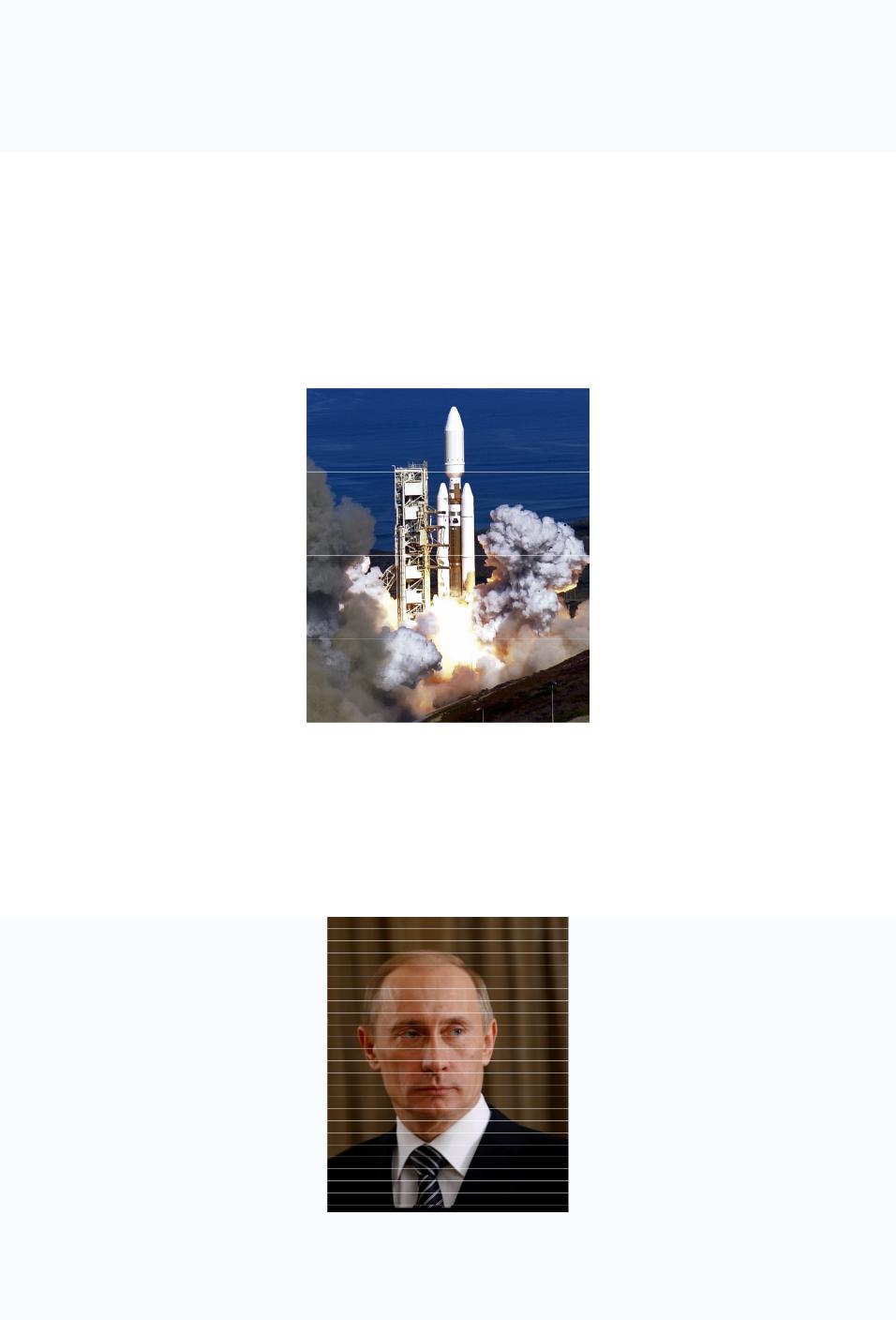
timber account for more than 80% of Russian exports abroad. Since 2003, however, exports of natural resources started decreasing in economic importance as the internal market strengthened considerably. Despite higher energy prices, oil and gas only contribute to 5.7% of Russia's GDP and the government predicts this will drop to 3.7% by 2011. The state-run gas monopoly Gazprom is the world’s largest producer and exporter, and supplies a growing share of Europe’s needs. Russia is also considered well ahead of most other resource-rich countries in its economic development, with a long tradition of education, science, and industry. The country has more higher education graduates than any other country in Europe.
The federal budget has run surpluses since 2001 and ended 2007 with a surplus of 6% of GDP. Over the past several years, Russia has used oil revenues from its Stabilization Fund of the Russian Federation to prepay all Sovietera sovereign debt to Paris Club creditors and the IMF. Oil export earnings have allowed Russia to increase its foreign reserves from $12 billion in 1999 to $597.3 billion on 1 August 2008, the third largest reserves in the world. The country has also been able to substantially reduce its formerly massive foreign debt.
The economic development of the country though has been uneven geographically with the Moscow region contributing a disproportionately high amount of the country's GDP. Much of Russia, especially indigenous and rural communities in Siberia, lags significantly behind. Nevertheless, the middle class has grown from just 8 million persons in 2000 to 55 million persons in 2006. Russia is home to the largest number of billionaires in the world after the United States, gaining 50 billionaires in 2007 for a total of 110.
Pic. 8
Over the last five years, fixed capital investments have averaged real gains greater than 10% per year and personal incomes have achieved real gains more than 12% per year. During this time, poverty has declined steadily and the middle class has continued to expand. Russia has also improved its international financial position since the 1998 financial crisis. A principal factor in Russia's growth has been the combination of strong growth in productivity, real wages, and consumption. The upward trend continued in the first quarter of 2008, driven largely by rising food costs. Infrastructure, ageing and inadequate after years of being neglected, is considered to be a bottleneck to economic growth. The government has said $1 trillion will be invested in infrastructure by 2020.
Pic. 9
During Putin's eight years in office, industry grew by 75%, investments increased by 125%, and agricultural production and construction increased as well. Real incomes more than doubled and the average salary increased eightfold from $80 to $640. The volume of consumer credit between 2000–2006 increased 45 times, and during that

same time period, the middle class grew from 8 million to 55 million, an increase of 7 times. The number of people living below the poverty line also decreased from 30% in 2000 to 14% in 2008.
Arms sales have increased to the point where Russia is the first in the world in sale of weapons, the IT industry has recorded a record year of growth concentrating on high end niches like algorithm design and microelectronics; Russia is now the world's third biggest destination for outsourcing software behind India and China. The space launch industry is now the world's second largest behind Arian Space of Europe and nuclear power plant companies are going from strength to strength, selling plants to China and India, and recently signed a joint venture with Toshiba to develop cutting edge power plants. Russia is experiencing a regrowth of Electronics. Among Russia's biggest television sets producers is Rolsen.
The large majority of Russia's exports are made up by raw materials and fertilizers, although exports as a whole accounted for only 8.7% of the GDP in 2007, compared to 20% in 2000.
The mineral-packed Ural Mountains and the vast oil, gas, coal, and timber reserves of Siberia and the Russian Far East make Russia rich in natural resources. However, most such resources are located in remote and climatically unfavorable areas that are difficult to develop and far from Russian ports. Oil and gas exports continue to be the main source of hard currency. Russia is a leading producer and exporter of minerals, gold, and all major fuels. The Russian fishing industry is the world's fourth-largest, behind Japan, the United States, and China. Natural resources, especially energy, dominate Russian exports. Ninety percent of Russian exports to the United States are minerals or other raw materials.
Russia comprises roughly three-quarters of the territory of the former Soviet Union but has relatively little area suited for agriculture because of its arid climate and inconsistent rainfall. Northern areas concentrate mainly on livestock, and the southern parts and western Siberia produce grain. Restructuring of former state farms has been an extremely slow process. The new land code passed by the Duma in 2002 should speed restructuring and attract new domestic investment to Russian agriculture. Private farms and garden plots of individuals account for over one-half of all agricultural production.
23. Match the beginnings of the sentences (1-8) with their endings (a-h).
1.Since the turn of the century, rising oil prices, increased foreign investment, higher domestic consumption and …
2.Growth was primarily driven by non-traded services and goods for the ...
3.Oil, natural gas, metals, and timber account for …
4.Russia has also improved its international financial position since …
5.A principal factor in Russia's growth has been the combination of …
6.Arms sales have increased to the point where …
7.However, most such resources are located in remote and climatically unfavorable areas that are …
8.The new land code passed by the Duma in 2002 should speed restructuring and …
a)more than 80% of Russian exports abroad.
b)greater political stability have bolstered economic growth in Russia.
c)strong growth in productivity, real wages, and consumption.
d)difficult to develop and far from Russian ports.
e)domestic market, as opposed to oil or mineral extraction and exports.
f)the 1998 financial crisis.
g)Russia is first in the world in sale of weapons.
h)attract new domestic investment to Russian agriculture.
24.Discuss with your partner if the modern economic situation in Russia is on the rise. Prove your ideas with the facts from the text you have read.
25.Read the text in Ex. 22 again and draw up its plan.
26.Tell about the development of Russia’s economy using your own plan.
27.Make the correct word boundaries. Give the main idea of the text you have got after correction.
It is interesting to know that …
EXPECTINGTHEAREATOBECOMEMOREACCESSIBLEASCLIMATECHANGEMELTSARCTICICEANDBELI EVINGTHEAREACONTAINSLARGERESERVS OFUNTAPPEDOILANDNATURALGASONAUGUST22007RUSSIANEXPLORERSINSUBMERSIBLESPLANTEDTHE RUSSIANFLAGONTHEARCTICSEABEDSTAKINGACLAIMTOENERGYSOURCESRIGHTUPTOTHENORTHPOLE REACTIONTOTHEEVENTWASMIXEDPRESIDENVLADIMIRPUTINCONGRATULATEDTHEEXPLORERSFORTH EOUTSTANDINGSCIENTIFICPROJECTWHILECANADIANOFFICIALSSTATEDTHEEXPEDITIONWASJUS APUBLI SHOW
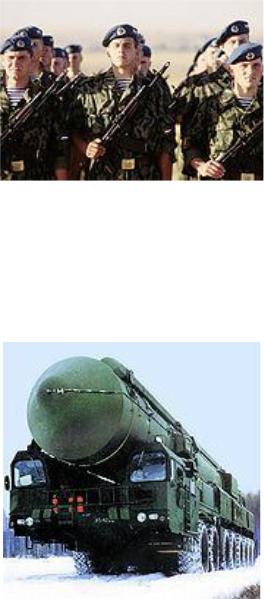
Do you think it was only a show? What advantages will Russia get from this event? Give the examples.
28. Read the supplementary information about foreign relations and military of our country. Before reading the text find the meaning of the following words and expressions in the dictionary.
|
albeit; |
|
implement; |
|
assets; |
|
international treaty; |
|
assume; |
|
joint collaboration; |
|
conscription term; |
|
maintain relations; |
|
defense industry; |
|
procurement; |
|
draft; |
|
production facilities; |
|
embassy; |
|
proliferation; |
|
equal partners; |
|
stockpile; |
|
fleet; |
|
volatile. |
foreign policy;
Foreign relations and military
The Russian Federation has a permanent seat on the UN Security Council, membership in other international organizations, the rights and obligations under international treaties and property and debts. Russia has a multifaceted foreign policy. It maintains diplomatic relations with 178 countries and has 140 embassies. Russia's foreign policy is determined by the President and implemented by the Ministry of Foreign Affairs.
As one of five permanent members of the UN Security Council, Russia plays a major role in maintaining international peace and security, and plays a major role in resolving international conflicts by participating in the Quartet on the Middle East, the Six-party talks with North Korea, promoting the resolution of the Kosovo conflict and resolving nuclear proliferation issues. Russia is a member of the Group of Eight (G8) industrialized nations, the Council of Europe, OSCE and APEC. Russia usually takes a leading role in regional organizations such as the CIS, EurAsEC, CSTO, and the SCO. Former President Vladimir Putin had advocated a strategic partnership with close integration in various dimensions including establishment of four common spaces between Russia and the EU. Since the collapse of the Soviet Union, Russia has developed a friendlier, albeit volatile relationship with NATO. The NATO-Russia Council was established in 2002 to work together as equal partners to pursue opportunities for joint collaboration.
Pic. 10
Russia assumed control of Soviet assets abroad and most of the Soviet Union's production facilities and defense industries. The Russian military is divided into the Ground Forces, Navy, and Air Force. There are also three independent arms of service: Strategic Rocket Forces, Military Space Forces, and the Airborne Troops. In 2006, the military had 1.037 million personnel on active duty.
Pic. 11
Russia has the largest stockpile of nuclear weapons in the world. It has the second largest fleet of ballistic missile submarines and is the only country apart from the U.S. with a modern strategic bomber force. The country has a large and fully indigenous arms industry, producing all of its own military equipment. Russia is the world's top
supplier of weapons accounting for around 30% of worldwide weapons sales and exporting weapons to about 80 countries. Following the Soviet practice, it is mandatory for all male citizens aged 18–27 to be drafted for two years' Armed Forces service. But there are still various problems associated with this, such as dedovschina (institutionalised hazing). This explains why the armed forces have reduced the conscription term from 18 months to 12 since 2008, and are planning to increase the proportion of contract servicemen to 70% of the armed forces by 2010. Defense expenditure has quadrupled over the past six years. Official government military spends $40 billion for 2008 and makes Russia the eighth largest country in the world. But it is important to note that various sources, including US intelligence, and the International Institute for Strategic Studies, have estimated Russia’s military expenditures to be considerably higher. Currently, the military is undergoing a major equipment upgrade with about $200 billion on procurement of military equipment between 2006 and 2015.
29. Look at the following abbreviations from the text. What do they stand for?
OSCE; APEC; CIS; UN; EU; NATO; ICBM; U.S.
30. What is the English for:
ОБСЕ, Организация по безопасности и сотрудничеству в Европе
АТЭС, Азиатско-тихоокеанское экономическое сотрудничество
СНГ, Содружество Независимых Государств
ООН, Организация Объединённых Наций
ЕС, Европейский союз
НАТО, Североатлантический союз
МБР, межконтинентальная баллистическая ракета
США, Соединенные штаты Америки
31. Match the facts from the text “Foreign relations and military” with the following figures.
1.037; 30; 26; 2008; 70; 2010; 200; 2015; 18-27; 40.
32.In pairs. Ask and answer your own questions using information from the text (Ex. 28).
33.Work in group. Discuss the perspectives of Russian economic development. Use all information you have learnt from the previous texts and exercises.
34.Draw a plan of the text in Ex. 28.
35.Write an essay on the topic (not less than 200 words) without looking back at the text. You may use your plan.
36.What do you know about our region economy? What industries do you consider to be the most important? Brainstorm ideas.
Regional economy (Omsk)
37.Use the Internet to find the information about one of the Omsk industrial enterprises. Imagine you are talking to a foreigner; tell him/her about it. You may use the following words:
to be situated; products; to produce; industry; to belong to; to develop; environment restrictions; to satisfy; to work; enterprise; to want; the future plans etc.
38.Read the text about the development of Omsk Metro. Give its summary. Compare with your partner’s. Omsk Metro (Omsky metropoliten) is currently under construction in Omsk, Russia. After long delays, the first
section is scheduled to open in 2010, which will make it Siberia's second metropolitan underground railway system after the Novosibirsk Metro system that was opened in the mid 1980s.
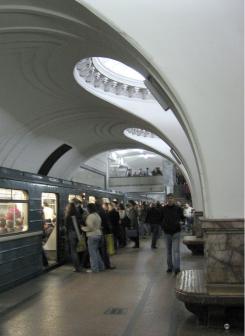
Central planners in Moscow first identified Omsk as a metro-eligible city during the 1960s, due to its length along the Irtysh River and its relatively narrow streets. But after the plan was approved and financed, the planners decided to build an express tram instead, and the money allocated to Omsk was given to Chelyabinsk. In 1979, a Gosplan commission rejected a plan to build an express tram system since it was predicted to be unable to handle projected passenger flows without severely discomforting riders. In 1986, metro plans were revisited and financing began, along with the demolition of residential buildings to make way for tracks and a yard.
Construction began in 1992 between the stations Tupolevskaya (Russian: Туполевская) and Rabochaya (Russian: Рабочая ~ Workers' Station). The initial plans involved opening the section between the stations Marshala Zhukova and Rabochaya on the right bank of the Irtysh River to connect downtown to the manufacturing district, and then later to connect the line to the opposite bank of the Irtysh. Due to poor financial circumstances, by 2003 just the section between Tupolevskaya and Rabochaya was completed (with no intermediate stations). At this time the plans changed and the authorities decided to connect the two banks of the Irtsh with a metro bridge, going between one station on the right bank and three on the left bank. The combined metro (lower level) and motor-vehicle (upper level) bridge was built and opened to vehicular traffic in 2005.
Pic. 12
The current phase of construction involves four stations:
Biblioteka Imeni Pushkina (Библиотека имени Пушкина ~ Pushkin Library)
Zarechnaya (Заречная ~ Over the River)
Kristall (Кристалл)
Sobornaya (Соборная ~ Cathedral Station)
This section is 6.1 km in length. The average speed is expected to be 36 km/h and travel time along the entire route
is expected to be 10 minutes 12 seconds. Daily ridership is projected at 190,000 passengers and yearly ridership at 69 million.
Stations
All of the stations will be shallow.
Biblioteka Imeni Pushkina was planned as Krasny Put' (Красный Путь ~ Red Way).
Kristall was planned as Bulvar Arkhitektorov (Бульвар Архитекторов ~ Boulevard of the Architects)
Sobornaya was planned as Avtovokzal (Автовокзал ~ Bus Terminal).
Future development
Plans call for the line to be extended on the right bank of the Irtysh to Rabochaya station (the section between Tupolevskaya and Rabochaya is partially complete). The first line is planned to have 11 stations and a total length of 13.6 km, with an additional metro bridge over the Om River, by 2015 or 2016 (the latter date is the 300th anniversary of Omsk). When the line is complete, it is expected to have a daily ridership of 330,000 passengers.
Construction of the second line will start after 2015. It will go on the right bank of the Irtysh, mostly parallel to the river. Transfer to the first line will be available at Biblioteka Imeni Pushkina. This line is expected to have twenty stations. At the same time, the first line is planned to be extended on the left bank by four stations.
The third line will not be built until the distant future. If built, it will likely be on both banks of the Irtysh, like the first line.
November 11, 2008 http://wikipedia.ru/
39.Use the Internet or some other resources to find the information about the current phase of construction. Prepare a short presentation.
40.Work with a partner. Discuss the following questions: