|
Levels/Rates
|
High
|
Average
|
Low
|
|
Linguistic
competence
|
0
(0%)
|
3
(20%)
|
12
(80%)
|
|
Activity
|
1
(7%)
|
8
(53%)
|
6
(40%)
|
|
Preparedness
|
3
(20%)
|
7
(47%)
|
5
(33%)
|
to the analysis of the facts which we have
obtained during the primary stage, we can make the following conclusions:
) initial level of learning motivation of pupils
is low and requires to be increased;
) making a conclusion of teachers’ answers, we
can notice that among the factors that can change the attitude of pupils to
English lessons there are requirement of usage on modern computer technologies
in order to increase pupils' interest. That means our experiment has a suitable
field of implementation;
) efficiency of pupils' knowledge is not
characterized by high rates and it leads to non-attendances of lessons of English
because of fear to get a bad mark or be ridiculed by classmates. Consequently,
the effectiveness of knowledge is entirely related to the motivation of pupils.
2.3 Usage of design method with the help of Power Point
Theoretical basis of project development of complex of English
lessons on the theme «What a wonderful world!»
After primary stage of the experiment we have
conducted formative stage, during which we use special projects, made with the
help of computer profram Microsoft Power Point. This project is used only for
the experimental group of 8 «А». In the control group, lessons are conducted,
using only traditional methods of teaching.
The theme of the project: «What a
wonderful world!». This theme is closely linked with the theme of the unit «The
world around us» (textbook T.D Kuznetsova and P. Kozlov for the 8 th grade).
Type of project: innovative
with elements of research and creative activity. The practical result of the
project has to be presentation of pupils on the theme «Global education as a
way to Earth's safe». We suppose that outcome of their works will show results
of our research, because, first of all, such task is connected with independent
research of pupils, it shows how effective our methods are and also identify
major environmental, economic and social problems in modern world.
The aim of the project: to test the
effectiveness of method of projects, using the program Microsoft Power Point in
the process of teaching English., we should prove that:
) projects enhance the level of language
knowledge;
) usage of innovative computer technology
provides increased level of internal motivation of pupils to learn
English.orientation of the project: cognitive.
Duration of experiment: 5 weeks (10
lessons)
Age: 8-th form (14-15
years).the experiment is taken place: school №23, Kostanay.
Equipment and materials: computer,
projector, Internet resource containing information data, illustrative
material, computer software - Microsoft Power Point, Paint is used to prepare
materials for lessons, the organization of work in the classroom, textbook on
English by T.D. Kuznetsova and P. Kozlov for the 8-th grade.
The list of lessons which are included
into the project:
Lesson 1 - I’m a citizen of the world. Sequences
of Tenses.2 - Future in the Past (grammatical and lexical theme).3 - The world
around you.4 - My planet is my home.5 - The Environment and you. Negative
adjective prefixes.6 - The Earth in danger.7 - I’m an environment-educated
person. Real condition.8 - Subjunctive Mood. Type 1. Many wonderful things to
see - belong to you, belong to me.9 - Subjunctive Mood Type 2-nd and 3 rd type.
The threatening word «Industrialization».10 - Defence of projects.
The model independent projects of pupils: the project
is based on the material on the topic «Ecology» and focused on the expansion
and enrichment of knowledge on this topic through the use of reference
materials. It can be made with the help of computer presentation, or just with
traditional materials for projects.
Content and implementation of project «What a wonderful world!»
As we have already mentioned, our project
consists of 10 lessons according to technology of the usage of method of
projects during the process of teaching English.lessons, we use such programs
as Microsoft Power Point, Paint, Exсel and Word.
Microsoft Power Point is used for
demonstration of grammar material (Future in the Past, Sequence of Tenses,
Negative adjective prefixes, Subjunctive Mood of 1-st and 2-nd type). Also,
with the help of this program we make different types such as:
· Dialogue with
the screen. The main concept of such work consists in the process when pupils
give answers on questions, which are shown on the screen, using lexical and
grammatical structures which are in the questions.
· Dialogue with
prepared answer. The computer by itself offers a multiple choice of answers and
the task of pupils to choose right one.
· Exercises on
filling gasps. Computer offers a text or a set of sentences with gasps. Pupils
should fill gasps, using tips which are given in the form of Russian words.
Pupils need just to translate them in English and use these words in the
correct forms. Or, another activity can be offered. For example, there are
prepared word and word combinations in English and the task is to fill gasps
with them correctly.
· Exercises for
control or self-control. Computer offers some words for translation; it offers
to correlate 2 lists of words (in Russian and in English), to find their
equivalent pairs in the both languages; computer offers to correlate 2 lists of
words in order to suit synonyms and antonyms; or it gives a list of English
words and definitions them which should be connected [34; 19].
Microsoft Excel allows to
make tables and cards for individual filling by pupils or for control of their
knowledge.
Microsoft Word is used for many purposes.
As a rule, for making cards and illustrative materials.we use
Internet-recourses for search of interesting information which touches theme of
our project.should be noticed that we don’t use a computer during the whole
lesson. It takes only 20-25 minutes.lesson includes the following stages:
1. Introduction.
2. The development of phonetic skills
of pupils.
. Checking of home task.
. Revision of material studied
before, training new material etc. (depends on type of the lesson).
. Home task.
Now, let us to observe the content of our project
in details.
Lesson 1
The theme: I’m a citizen of the world. Sequences
of Tenses.structure:
· Introduction.
The lesson begins with a brief introduction. We
greet all pupils and tell them about project. In addition we give some main
notion which touch theme of the project, describe briefly the structure of our
lessons etc. Then, we come to the theme of 1-st lesson. The theme of the lesson
is shown on the 1-st slide.
· The
development of phonetic skills of pupils.
In order to continue our work we proceed to
another stage. We ask questions about the weather in order to activate speech
of pupils. Also it gives us information about linguistic competence and
activity level of pupil.
· Checking of
home task.
Before we come up to new grammatical and lexical
material we need to check pupils’ home task in order to estimate the level of
their preparedness.
· Actualization
of knowledge.
First of all we begin to speak about our country,
about travelling, Pupils share their ideas about their position in life, about
their aims, about their dreams. Pictures which touch this theme appeared on the
screen to stimulate speech of pupils. Then we proceed to the quotation of
Socrates and after words «He said that he was a citizen not of Athens or
Greece, but of the world, we come to grammatical theme «Sequences of tenses».
The title of this theme is shown on the screen. We explain that sequence is the
order in which things or events follow one another and if the main clause
(sentence) is in the Past simple the verb on the Subordinate Clause will be in
one of the Past Sentences. Some examples are shown on the screen of a computer.
Then we make a conclusion that if we want to tell somebody about the
conversation with another person, we should use the sequences of tenses. Slide
with keywords appears on the screen:
he said,
she thinks,
I hoped,
They will know, etc
She says, he is cute.work with illustrative
theoretical material of presentation, we offer some pupils to make exercises
according to new theme. They are given, as well, in the form of slides which
provide some tips.this activity, we begin to work with exercises from the
textbook., pupils are offered reflection which help them to summarize new
grammatical material and use it
· Home task
We give pupils a test which includes the same
type of exercises which were shown in presentation during the lesson. Also,
it’s required to be able to explain why they have chosen this or that
variant.the beginning of the project we lead a table of achievements, which
will hang in the class, where all successful results will be shown. On the last
lesson of defense of projects, all points will be sum up and pupils with high
achievement will be awarded with special kits of «Global education» which were sent
from the United States of America.
Activity of teacher during the lesson:
· Organization
of introduction into the complex of lessons, setting educational tasks,
purposes;
· Entering new
grammatical material Sequence of Tenses;
· Organization
of discussion «I’m a citizen of the world»;
· Motivation of
pupils with the help of table of achievements; explanation project’s purposes;
· Recording of
the results of lesson in the table of achievements.
Activity of pupils during the lesson:
· Acquaintance
with new grammatical theme, and recording its summary to the exercise-book;
· Work with
exercises from the presentation and textbook;
· Participation
in the discussion «I’m a citizen of the world».
Results of the lesson:
· pupils got
acquainted with new grammatical structures;
· they activated
their vocabulary during the discussion and other speech activities;
· pupils used
their new knowledge during the work with exercises.
Lesson 2
The theme: Future in the Past (grammatical and
lexical theme).structure:
· Introduction.
In the beginning of the lesson there is a brief
introduction of goals ant the tasks which should be solved during this lesson.
Small talk about weather etc. And then come to the theme of the lesson which is
shown on the 1-st slide of our presentation.
· The
development of phonetic skills of pupils.
In order to continue our work we proceed to the
next stage. According to the fact that the main theme of our project is ecology
we offer to start the lesson with short poem which is also shown on the screen.
It’s very suitable for all pupils, since it suits both groups: those, who have
aural memory prevail and those who get information more freely with the help of
visual memory.
· Checking of
home task.
Before we come up to new grammatical and lexical
material we need to check pupils’ home task in order to estimate the level of
their preparedness. They were given test, which included tasks of the same type
as had been given on previous lesson. Correct answers are shown on the screen
in the form of colorful sad and merry faces. Results of all pupils are entered
in list of achievements.
· Actualization
of previous material.
After checking of home task, we offer the
following type of activity. Pupils are given a situation that they met their
friend Charlie yesterday and he told you something about himself and their task
is to tell their common friend about him using sequence of tenses. The picture
of Charlie and all his phrases are given on the screen in order to give an
opportunity for every pupil to imagine this situation Here are some of these
phrases:
1. My father
isn’t very well.
2. Sharon and
Paul are getting married next month.
3. Margaret has a
baby.
4. I don’t know
what Fred is doing.
5. I saw Helen at
a party in June and she seemed fine.
6. I haven’t seen
Diane recently etc.
· Introduction of new material
We explain not only Present Times transfer into
Past Times in the Sequence of Tenses, but also Future Tenses gets its «past»
form - would. This rule and all its examples are shown on the slide of
presentation. Then, we address to the textbook in order to make exercises on
this theme. When pupils finish them, we offer to look at the theme of the
lesson from the other side (not in grammatical, but in lexical way). It means
that we begin to discuss the problems of ecology and negative consequences
which we might face in the future. In order to concentrate pupils’ attention on
this theme, slides with suitable pictures appear on the screen.
· Home task
For home task we offer a dialogue which is given
in the textbook. The task of pupils is to transform that conversation into
connected sentences using sequences of tenses. And also we give the poem which
was read during the process of development of phonetic skills of pupils and for
learning it by heart.
Activity of teacher during the lesson:
· Introduction
and explanation of new grammatical material with the help of visual methods;
· Revision of
grammatical material Sequence of Tenses, which was studied during the previous
lesson;
· Organization
of role play «Charlie’s friends»;
· Motivation of
pupils with the help of table of achievements;
· Recording of
the results of lesson in the table of achievements.
Activity of pupils during the lesson:
· Acquaintance
with new grammatical theme, and recording its summary to the exercise-book;
· Revision of
previous grammatical material;
· Participation
in the role play «Charlie’s friends»;
· Work with
exercises from the textbook;
· Development of
skills of pronunciation.
Results of the lesson:
· pupils got
acquainted with new grammatical structures;
· they activated
their vocabulary during the discussion and other speech activities;
· pupils used
their new knowledge of grammatical structure during the work with exercises and
during the role play.
Lesson 3
The theme: My home is my planet.structure:
· Introduction.
The lesson begins with a brief introduction. We
say that we will discuss many important problems which are connected with the
topic of the lesson. Some words about how dangerous the ecological situation of
our Earth is etc. Also we announce goals and tasks in order to give a notion of
content of the lesson.
· The
development of phonetic skills of pupils.
This stage of lesson connects with the checking
of home task since for development of phonetic skills of pupils we use a poem,
which was given for learning by heart. We turn on the slide of presentation
which contains this poem and start with reading of in line by line. Then we
turn off the slide and ask some pupils to read this poem by heart.
· Checking of
home task.
According to the fact that one half of home task
is already worked, we just check exercise in the form of dialogue.
· Introduction
of new lexical material.
First of all we give definition to the word
«ecology», tell that this word came from the Greek «oikos» which means «home».
This idea of «home» includes the whole planet of ours; it’s population, the
nature, animals, birds, fish, all other living beings and even the atmosphere
around our planet [35; 13]. During our telling we show new words on this theme.
Each word is accompanied with illustrations. After that we show the slide with
statement for discussion:
1. House is made
by men, home is made by women.
2. East or West,
home is best!
3. Our planet is
our Home!
4. There exist
concrete kids in a concrete house.
5. What is the
main difference between the words «house» and «home»?discussion we give the
information about the original meaning of the word «home» in English and many
other Indo-European languages, that it has meaning of «safe dwelling place» and
it doesn’t matter what home is: a village, a room or even the world. All this
information is shown on the screen with illustrations.
· Home task
At home pupils have to learn new words by heart
and also they should be able to explain these words in English. In addition we
give a text for reading and translation from the textbook.
Activity of teacher during the lesson:
· organization
of introduction into the complex of lessons, setting educational tasks,
purposes;
· entering new
lexical material on theme «Ecology»;
· organization
of discussion with the help of statements on the theme of notions of «Home» and
«House»;
· Recording of
the results of lesson in the table of achievements.
Activity of pupils during the lesson:
· acquaintance
with new lexical material, and recording it to the exercise-book;
· work with
exercises;
· participation
in the discussion on statements on notions of «Home» and «House».
Results of the lesson:
· pupils got
acquainted with new words on theme «Ecology»;
· they activated
their vocabulary during the discussion and other speech activities;
· pupils used
their new knowledge during the work with exercises.
Lesson 4
The theme: The world around you.structure:
· Introduction.
The lesson begins with a brief introduction. We
greet all pupils and tell them about project. In addition we give some main
notion which touch theme of the project, describe briefly the structure of our
lessons etc. Then, we come to the theme of 1-st lesson. The theme of the lesson
is shown on the 1-st slide. We continue to speak on the topic «Ecology». We
tell that many years ago people lived in great harmony with nature because
industry was not much developed. Today the situation is quite different.
Nowadays industrially developed states can’t ignore the problem of
environmental protection. Pictures of negative results of industry and beauty
of nature appear on the screen.
· The
development of phonetic skills of pupils.
In order to continue our work we proceed to
another stage. We offer pupils to discuss some statements which are given on
the slide, their task is to agree or disagree with them.
. We want our planet to be clean.
. It’s nice to see dirty seas.
. People must care about the Earth.
. Kids must leave cans in the park.
. It’s nice to care about rivers and forests.
. It’s healthy to drink dirty water.
· Checking of
home task.
Making a conclusion we say that there are a lot
of problems connected with ecology. And then we check the text which was given
for translation as a home task, since it includes much information on the theme
of the lesson. We check the level of understanding of pupils and show the most
important sentences on the slide which are given for translation.
· Revision of
previous material.
First of all we revise new words. For this
purpose we use illustrations on the slide and some exercises from presentation.
According to the fact that our purpose isn’t to check knowledge of every pupil,
we try to involve all pupils to this process. And then pupils are offered to
answer some questions, using as much new lexical units as possible.
. What do you think when you say the words «The
world around us»?
. Do you agree with the statement that water is a
source of life?
. Why do many people think that there is little
water on the Earth?
. Do you think that with every year the problem
of water is becoming more and more important ant difficult?
. What does a lot of harm to environment?
. Do you agree that the Earth is in danger?
· Home task
By the 4-th lesson pupils have studied enough
material and that’s why we advise to be ready for test and word dictation on
the next lesson. We remind the pupils that scores for activity on the lessons
and mark of such works influence greatly on results in the end of the project.
We offer a list of themes of material which should be revised for test and word
dictation. All points are shown on the slide.
Activity of teacher during the lesson:
· organization
of introduction into the complex of lessons, setting educational tasks,
purposes;
· revising
lexical material;
· development of
speech activity of pupils;
· recording of
the results of lesson in the table of achievements.
Activity of pupils during the lesson:
· self-control
of knowledge on the theme «The world around you»;
· development of
their skills of pronunciation;
· participation
in the discussions.
Results of the lesson:
· pupils checked
themselves with the help of exercises of presentation;
· they activated
their vocabulary during the discussion and other speech activities.
Lesson 5
The theme: The Environment and you. Negative
adjective prefixes.structure:
· Introduction.
The lesson begins with a brief introduction. We
greet all pupils, tell about goals and tasks. The structure of the lesson is
shown on the slide in order to draw attention of pupils to the main stages of
the lesson. It contributes to concentration of attention of pupils. They have a
notion of what they should do and they don’t do outside matters.
· The
development of phonetic skills of pupils.
During this stage, we don’t stop to talk about
ecology and environment problems. That’s why we give one more poem which
contains this theme:along feeling free.the earth here with me.I love her, she
loves me.hug the Earth, the Earth hugs me.poem is also shown on the screen. As
we have already mentioned it’s very suitable for all pupils, since it suits both
groups: those, who have aural memory prevail and those who get information more
freely with the help of visual memory.
· Checking of
home task.
In stead of home task, on the previous lesson we
asked pupils to be ready for test and word dictation. According to the fact
that we can’t give all pupils the same variant, we can’t use Microsoft Power
Point on this stage of the lesson, since we need printed material which
contains different on content, but the same on difficulty level material. For
the word dictation, it’s conducted wh the help of illustration, shown on the
screen.
· Introduction
of new grammatical material.
At this lesson we enter new grammatical material
which touches prefixes. All material appear on the screen where it’s shown that
there are two main difficulties in the use of prefixes. The first is choosing
between the prefixes that are similar in meaning, spelling and pronunciation.
The second difficulty is where to use a hyphen between the prefix and the root
of the word. At this lesson we discuss prefixes with meaning «not», prefixes
«un», «in», «im», «ir» and «il».prefixes and their examples are given on the
slide for rewriting them to exercise-books. After work with these words, we
offer to fill gasps in the exercise which is places on the slide of
presentation.
. Don't go into my bedroom. It's really_________.
. I can't do maths. For me, it's an
_______subject.
. I don't ________fish. I just prefer meat.
. It's very ________ to ask someone how much they
earn.
. When we arrived at the hotel, we________our
suitcases.
. I was for________ two years. Then I got a job
in an office.
. Perhaps I’m mistaken, but I think learning
languages is stupid. I________. I think it's a good idea.
. The thief stole my bag, ran into the crowd
and_____ I never saw him again.
. You should know: cannabis is an_______ drug in
many countries. Be careful!
. You gave her more money than me! That's
________!
Words: pack, possible, agree,
tidy, fair, like, appear, employed, legal, polite.
· Home task.
For revision of new grammatical material we give
exercises on negative adjective prefixes from the textbook.
Activity of teacher during the lesson:
· entering new
grammatical material «Negative adjective prefixes»;
· holding of
test and word dictation;
· recording of
the results of lesson in the table of achievements.
Activity of pupils during the lesson:
· acquaintance
with new grammatical theme, and recording its summary to the exercise-book;
· execution of
test and word dictation;
· work with
exercises from the presentation.
Results of the lesson:
· pupils got
acquainted with new grammatical structures;
· they activated
their vocabulary during the discussion and other speech activities;
· pupils used
their new knowledge during the work with exercises.
Lesson 6
The theme: The Earth in danger.structure:
· Introduction.
This lesson is one of the conclusion lessons and
that’s why the main concept of it is exchanging of opinions about ecological
problems. Pupils have to answer if they are friends of the Planet and how they
are going to protect it, how to prevent pollution, what urgent and necessary
measures to undertake etc. The lesson begins with a brief introduction of goals
and tasks.
· The development
of phonetic skills of pupils.
In order to continue our work we proceed to
another stage. For development of phonetic skills of pupils we use two poems
which we have learnt before. Thanks to the fact that Microsoft Power Point is
able to save as many slides as possible, we don’t need to make remember every
word, since both of these poems are in the presentation.
Before we come up to new grammatical and lexical
material we need to check pupils’ home task in order to estimate the level of
their preparedness. They were given exercises from the textbook. Correct
answers are shown on the screen in the form of colorful sad and merry faces.
Results of all pupils are entered in list of achievements.
· Brainstorming.
In order to activate pupils’ knowledge, we
address to this type of activity. Pupils are offered to name ideas which come
up to their minds when they hear the word «nature». All ideas are fixed on the
slide and shown on the screen of projector.
· Development of
skills of dialogue
For this activity all class is divided into
pairs. We offer a role situation, the main purpose of which is to find out what
people should do to keep fit.
Student A: Say to your friend that
you had an ecology class yesterday and you discussed what people should do to
keep life on our planet.
Student B: You are interested in
the topic and ask your friend about this information and tell him (her) what
know about this problem.
· Home task.
According to the fact that this lesson is some
kind of conclusion lesson, we offer to make a composition on the theme «I’m the
friend of my Planet».
Activity of teacher during the lesson:
· organization
of introduction into the structure of lesson, identification of its goals and
tasks;
· entering such
activity as brainstorming for stimulating of cognitive activity;
· organization
of a role situation which helps to develop skills of dialogue;
· recording of
the results of lesson in the table of achievements.
Activity of pupils during the lesson:
· revision of
lexical material on the theme «Ecology»;
· work in pairs;
· participation
in the brainstorming.
Results of the lesson:
· pupils
memorized all material on the theme «Ecology»;
· they activated
their vocabulary during the discussion and brainstorming;
· majority of
pupils were very active.
Lesson 7
The theme: I’m an environment-educated person.
Real condition.structure:
· Introduction.
The lesson begins with a brief introduction of
goals and tasks. The structure of the lesson is shown on the slide in order to
draw attention of pupils to the main stages of the lesson. It contributes to
concentration of attention of pupils. It’s very important, since this lesson is
a lesson if introduction of new material. That’s, it’s advisable for pupils to
have a notion of what they should do and they don’t do outside matters and will
be able to understand new material better.
· The
development of phonetic skills of pupils.
In order to continue our work we proceed to
another stage. We ask questions which touch previous theme «Ecology» in order
to activate speech of pupils. Also it gives us information about linguistic
competence and activity level of pupils.
· Checking of
home task.
Consists only in taking exercise-books with
compositions.
· Introduction
of new grammatical theme.
We begin explanation of new grammatical theme
with the phrase about the weather: «What nasty weather we are having today! If
the weather is bad tomorrow, I won’t go to the country». We say this in order
to attract attention to the grammatical stricture of this statement. It’s built
with the help of Real condition, that is the theme of the lesson. This phrase
appears on the screen and its structure is underlined by red colour in order to
draw attention. We explain that, the first part of this sentence is started
with «if» and in the 2-nd part we use the verb «will». Such kind of sentences
is called Real condition.
F.e If I work hard I’ll
pass all my exams.’ll buy a new dress if she has enough money.
All explanations and examples are accompanied
with illustrationstraining new grammatical material pupils are offered to fill
gasps in the sentences on theme «Ecology».
If we protect environment we’ll live longer.’ll
live longer, if we protect environment.
· Home task
In order to practice new grammatical material, we
offer to make exercise from the textbook and make up 5 own sentences using
structures of Real condition.
Activity of teacher during the lesson:
· explanation of
the theory on theme Real condition with the help of Microsoft Power Point;
· organization
of pupils’ work;
· recording of
the results of lesson in the table of achievements.
Activity of pupils during the lesson:
· acquaintance
with new grammatical theme Real condition with the help of Microsoft Power
Point;
· making
exercises which include new grammatical structures
Results of the lesson:
· pupils got
acquainted with new grammatical material;
· they know how
to use it in their speech;
· pupils use new
structures while speaking on theme «Ecology».
Lesson 8
The theme: Subjunctive Mood. Type 1. Many
wonderful things to see - belong to you, belong to me.structure:
· Introduction.
The lesson begins with a brief introduction. The
theme of the lesson is shown on the 1-st slide of presentation. So, pupils have
notion of content of the lesson. There they are able to see the main
definitions and structures that concentrate pupils’ attention. According to the
fact, that this lesson is a continuation of previous one, majority of notions
are clear for pupils.
· The
development of phonetic skills of pupils.
In stead of ordinary activity, we immediately
come to new grammatical structures. Pupils, one by one, makes sentences which
include structures of Real condition.
· Checking of
home task.
Before we continue we need to check pupils’ home
task in order to estimate the level of their preparedness. They were given
exercise on Real condition. All correct answers are shown on the screen in the
form of colorful sad and merry faces. Results of all pupils are entered in list
of achievements.
· Actualization
of speech.
In order to practice grammar structures, pupils
are offered to answer the following questions, which are shown on the screen:
. What will we do if they forecast a rainstorm on
Sunday?
. What will we do if they forecast a bright, warm
day?
. What will you do if the grove near your village
is piled with rubbish?
. What will you do if the river nearby is in a
mess?
. What will you do if the schoolyard is full of
bits of glass, paper and plastic?, we offer activity for the whole class.
Pupils should imagine the situation that the granny of one of their friend is
going to Scotland and she can’t decide how it will be more convenient to get
there. Children need to help her and make sentences using Subjunctive Mood of
1-st type. And after that, class is divided into 2 groups. The 1-st group makes
up a dialog between a travel agent and that lovely old woman and the 2-nd group
makes sentences about what things this woman needs depending on different ways
of traveling.
· Home task.
Consists in making exercises on Subjunctive Mood
of the 1-st type from the textbook.
Activity of teacher during the lesson:
· organization
of introduction into the complex of lessons, setting educational tasks,
purposes;
· organization
of such type of activity, that allow widely to use new grammatical structures;
· recording of
the results of lesson in the table of achievements.
Activity of pupils during the lesson:
· revision of
grammatical theme, studied on the previous lesson;
· work with
exercises from the presentation and textbook;
· participation
in role plays.
Results of the lesson:
· pupils revised
grammatical structures Subjunctive Mood of the 1-st type;
· they activated
their vocabulary during the role situation and other speech activities;
· pupils used
their new knowledge during the work with exercises.
Lesson 9
The theme: Subjunctive Mood Type 2-nd and 3 rd
type. The threatening word «Industrialization».structure:
· Introduction.
The lesson begins with a brief introduction. It’s
the last lesson before defence of projects, and it makes it very important. We
remind pupils that they have the last chance to get scores.
· The
development of phonetic skills of pupils.
In order to continue our work we proceed to
another stage. We ask questions what they know about industrialization. This
activity is conducted in order to activate speech of pupils. Also it gives us
information about linguistic competence and activity level of pupils.
· Checking of
home task.
Before we come up to new grammatical material we
need to check pupils’ home task in order to estimate the level of their
preparedness.
· Introduction
of new grammatical theme.
During the previous 2 lesson we were dealing with
the 1-st type of Subjunctive Mood. At this lesson we need to finish its rest
types. Both of them are shown on the screen with underlined grammatical
structures and examples. Both these types are unreal. But the 2-nd type refers
to present. It’s like a wish or a dream, and the 3-rd type is unreal because
it’s connected with the past and it means that we can change nothing.
f.e. Dan likes fast cars
but he hasn’t got one. He doesn’t have enough money.he had the money, he would
buy fast car.
· Training of
new knowledge.
For this purpose pupils are offered exercise from
presentation which include different types of tasks.
· Home task.
Be prepared for defence of projects
Activity of teacher during the lesson:
· organization
of checking of home task into the complex of lessons, setting educational
tasks, purposes;
· explanation of
new material referred to the 2-nd and the 3-rd types of Subjunctive Mood, using
Microsoft Power Point;
· organization
of pupils’ work: fulfillment of exercises;
· organization
of home task. Division of pupils for creating project on theme «Ecology»;
· Recording of
the results of lesson in the table of achievements.
Activity of pupils during the lesson:
· acquaintance
with new grammatical theme, and recording its summary to the exercise-book;
· work with
exercises from the presentation and textbook.
Results of the lesson:
· pupils know
how to make conditional sentences;
· they activated
their vocabulary during the discussion and other speech activities;
· pupils used
their new knowledge during the work with exercises.
Lesson 10
The theme: Defence of projects.lesson is a
so-called result of our research. For preparation, pupils were given 2 weeks,
although they knew about this task in the beginning of our experiment. That
goes without saying, that projects of pupils were consisted of several stages
which should be mentioned here.
I. The stage of preparation includes the
following:
А. Expressions for presentation
1. Today I'm
going to talk about…
2. As you can see
in this photo…
3. Well, first
I'd like to talk about…
4. What about the
history of…?
5. Right, now let's
look at…
6. Another area
of great interest…
7. So what is the
future of…
8. To sum up,…
9. That's all.
Thank you.
B. Strategies for monologue
First, make sure you understand the subject and
have collected enough information.
To prepare, choose the most interesting
information. Then write notes about what you want to say. Do not write out your
presentation.
Find visual aids to help you: slides, photos,
diagrams, etc.
Practise giving your presentation to yourself. Go
through it again just before you give it.
If you get very nervous beforehand, breathe in
and out deeply a few times.
At the start, state clearly what you are going to
talk about.
If you make a mistake or forget something.
C. Volume of the project (30 sentences).
D. Slides of presentation Microsoft Power
Point (it’s not obligatory)
II. The stage of research work includes:
. Work with informative recourses.
. Observation, analysis and systematization of
material.of search method allows to create all conditions for independent work
of pupils. During this process their creative activity rises. Implementation of
such projects make pupils to think, analyze, pay attention even to trifles.
During the search of necessary information different types of activity are used
such as: reading, writing, speaking. Also, here we can speak about improvement
of skills of computer usage, while decorating chosen material.
III. Final stage is a stage of public
presentation.
1. Public presentation.
. Exchange of views.of people suppose, that it’s
the most important ant interesting stage of work. Here, pupils can show the
following ability: an ability to appear before an audience, overcome one’s
shyness [36; 20].
Activity of teacher during the lesson:
· organization
of discussion and commenting of classmates’ works;
· sizing up of
project.
Activity of pupils during the lesson:
· presentation
of projects;
· commenting of
classmates’ works;
· reflection.
Results of the lesson:
· implementation
of projects, using studied lexical and grammatical units;
· making
conclusions on the project «What a wonderful world!».
2.4 Revelation of results and their interpretation
the end of our experiment we came to the
following results: majority of pupils demonstrated high interest in project and
it favoured the rise of motivation during the process of learning English.
Pupils maintained discipline, were active during the lessons and made all tasks
almost without any difficulties. It favoured the high concentration of
attention, activization of speech and cognitive activities.defence of projects
in the aggregate results of each lesson allow to underline the following:
method of projects, based on modern computer technologies, is an effective
innovation mean which provides:
· considerable
rise of level of speaking as one of the main types of speech activity;
· rise of level
of pupils’ motivation;
· increasing of
pupils’ mentality., we can say, that the project «What a wonderful world»
influenced greatly on ability of pupils to speak, it helped to enrich their
vocabulary, developed their skills of speaking and intercultural
competence.talking to pupils, we discovered them to be very enthusiastic about
the integration of computer technology into the classroom experience; some even
requested that we design more such projects in which they could participate.to
our research, we came to the conclusion that all presentations, which were made
by us, can be divided into 2 types; informative (as a rule, they wear
culturological character, for example «Place where I live - place that I love»)
and educational which introduce grammatical structures (presentations on
Sequence of Tenses, Subjunctive Mood).we tried to generalize our experience of
making of presentations. During our research we faced some challenges which
weren’t connected directly the process of teaching, but influenced on it
indirectly. They touch organizational, technical and supporting sides of the
process of teaching English.
· firstly, all
presentations should be united by the same communicative situation;
· they should
take into account the same level of difficulty (equal tasks);
· presentations
should include and texts, and pictures;
· the background
should be the same for all slides and wear «calm» character;
· characters and
objects, which are used in the presentations, should belong to the same style;
· all
presentations should include effects of the same type;
· each
presentation should have rather simple navigation and be easy to use;
· replacement of
slides should be done by click;
· amount of
slides in «grammatical» presentation shouldn’t be more than 10.the final stage
of the project, we asked pupil to make their own project on theme «Ecology». In
general, we were very pleased with the results: many pupils spoke English
freely even without notes. Most pupils went beyond discussing the mere content
of their chosen themes, and even brought in supplemental materials.pupils, of
course, were less inventive, but even these presentations were engaging and
well-prepared; in addition, each student wrote new vocabulary items of
importance on the board and explained them to the class, thus ensuring the
other pupils’ comprehension of his report.suppose that such wonderful results
were reached because in the beginning of the experiment we understood that it
was necessary to involve all pupils, giving each of them those tasks which met
a demand of their level of knowledge.of our research proved that when we’re
speaking about drawing attention and interest to learning English, we can’t
just rely on the content of studied material. If pupils are not interested in
the process of learning, even the most factful material just brings only
contemplative interest to the process of learning and it wouldn’t be
effective.the end of our experiment, we conducted repeat polls and conversations
with the pupils of control and experimental group in order to see or not to see
effectiveness of our work. Let us to remember that we had 2 main goals during
our research: to raise motivation of pupils and to raise efficiency of pupils’
knowledge. Results are given in diagrams 3, 4 and 5:
3 Motivation of learning English (control group
8)
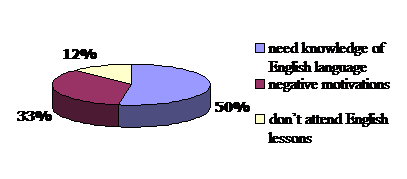
Diagram 4 Motivation of learning English
(experimental group)
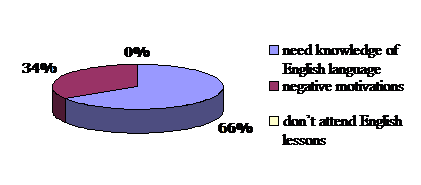
we can see, in the control group the level
of motivation stayed the same. We predict such result since the period of
experiment was only 5 weeks and it’s rather difficult to speak about any
changes without involving something new. But on the other hand 5 weeks were
enough for noticing great results in an experimental group. They are shown in
the diagram 5 below
Diagram 5 Changes in motivation of
learning English (experimental group)
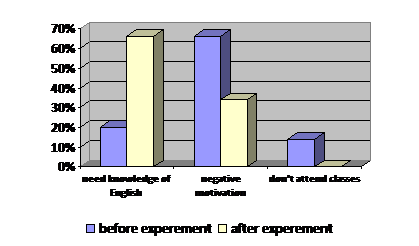
The most important achievement is that
after our project all pupils attend English lessons, although in the beginning
of our experiment there were 2 pupils who missed lessons systematically. It
proves efficiency of our work and shows that non-traditional methods,
especially when they are connected with modern computer technologies are able
to draw attention of even those, who weren’t interested in the process of
learning at all.now let us to address to results of effectiveness of
teaching.was estimated by us according to 3 indicators: linguistic competence,
activity in communication process and during the whole lesson and preparedness
with home task.experiment, we analyzed the work of pupils according to these
indicators again. Results are shown in the table 3 and table 4
Table 3. Control group
|
Levels/Rates
|
High
|
Average
|
Low
|
|
Linguistic
competence
|
0
(0%)
|
5
(42%)
|
7
(58%)
|
|
Activity
|
1
(6%)
|
5
(42%)
|
6
(50%)
|
|
Preparedness
|
0
(0%)
|
5
(42%)
|
7
(58%)
|
Table 4. Experimental group
|
Levels/Rates
|
High
|
Average
|
Low
|
|
Linguistic
competence
|
1
(7%)
|
8
(53%)
|
6
(40%)
|
|
Activity
|
4
(27%)
|
7
(46%)
|
4
(27%)
|
|
Preparedness
|
7
(46%)
|
6
(40%)
|
2
(14%)
|
, as we can see, the only change in the control
group is that one of the pupils who had high level of activity moved to average
level of activity. The rest indicators stayed the same., we observe increase of
average level of linguistic competence in experimental group on 33%. Here can
be also noticed decrease of low level, on 40%.of activity also show positive
results. For example, its high level increased on 20%.of preparedness give the
following dynamics: almost half of the group shows high level of it. It’s a
very positive result since in comparison with the beginning of our research we
saw that 34% of pupils had low level of preparedness. By the end of research,
this figure has fallen down to 14%., we can affirm that in the experimental
group we observe positive dynamics of increasing of efficiency of teaching in
comparison with control group that is a result of the usage computer program
Microsoft Power Point during the lessons of English.of our research give us an
opportunity to suppose, that usage of the method of project together with this
program influenced positively on the quality of formed skills., results of
practical part of our research can be admitted as a confirmation of hypothesis,
which we have suggested before since we’ve got the proof of efficiency of the
usage of this technology in practice.
Conclusion
So, we can say that thanks to our research which
touches the problem of the usage of computer technologies during the process of
teaching English, we came to the conclusion the ability of teachers to organize
lessons and correctly choose one of the means of modern computer technologies
leads to a large efficiency of the educational process.computer plays an
increasing role in modern education. The use of computers in teaching and
overtime work is an effective way to improve motivation and individualization of
instruction. Integration of usual lesson with a computer allows the teacher to
shift part of their work on the computer, while the learning process becomes
more interesting and intense. The computer does not replace the teacher, but
only complements it. The use of computer technology makes the lesson more
exciting and allows to make an informed choice for best traininganalyzing
theoretical scientific and methodological literature which deals with this
problem, we made a conclusion that the usage of method of projects in the
aggregate with innovational technologies can be correlated with main tasks of
modern education.a great number of computer technologies, which are so widely
spread nowadays, we have chosen usage of computer program Microsoft Power Point,
since we have made the hypothesis that it’s the most suitable technology for
the process of teaching English, because it’s rather effective, easy to use and
it’s based on the method of projects which gets only positive opinions. Also we
suggested that it would affect upon process of teaching in the best way and we
were not mistaken.experience of our research has shown that even those
students, who during the standard lesson felt hesitant or didn’t want to
participate in educational process, were pleased to do the same work if
computer programs were used. Their interest of learning English has increased,
the percent of home task which were made right became much more higher than in
comparison with beginning of integration this complex of lessons in practice.proves
the importance of the usage this computer program by teacher of foreign
languages.and teachers do not represent two opposing sides, they work together,
side by side, moving towards achieving the common goal of getting knowledge.
You can also use computer graphics capabilities. This is particularly important
when for entering new vocabulary, as well as the image on the monitor allows
you to associate words in a foreign language directly from the action, rather
than with words in their native language.all mentioned above it follows that
the results of the usage of such computer program as Microsoft Power Point are
individualization of teaching, raise of motivation of pupils during the process
of learning English, gain feedback pupil-teacher, facilitating the collection
of statistics, identification of gaps in knowledge and differentiation of
instruction., the usage of computer technology Microsoft Power Point reveals
new opportunities for learning English and allows to switch to a new level of
quality in teaching., which we have got after our experiment show that usage of
Microsoft Power Point helps to integrate new methods of teaching English and
creates all conditions for work in teams. Thanks to this experience, pupils are
involved in the world of forms and knowledge. It explains the importance of
projects which require abilities to analyze knowledge, interpret them, and
results of their own work. The usage of Microsoft Power Point, taking into
account its «strong» and «weak» sides, can breathe new life into traditional
plans of lessons. However, the usage of Microsoft Power Point can increase
motivation of pupils only if a teacher knows how to use its recourses in
accordance with plan of teaching., urgency of our research, its theoretical
significance and practical importance in the modern educational process
contributed to solution of tasks, which we formulated in the beginning of our
research.
. We gave description of some computer
technologies which can be used during the process of teaching English. Also we
made theoretical substantiation of method of projects and its psychological and
pedagogical bases in the process of teaching foreign languages
. We worked out and tested the complex of
lessons, using Microsoft Power Point. Also we analyzed our experience of the
usage of this program during the process of teaching English. The object of our
analysis was a project which included lessons on theme «What a wonderful
world!», which was held for 8-th form of school №23, Kostanay. Results of our
research showed advantages of this technology over traditional methods of
teaching English such as:
· cultural
development of pupils;
· lessons become
more interesting, and pass smoothly;
· there is no
need to waste time on making illustrations, materials, schemes. All is given on
the screen and it draws even more attention than just ordinary printed cards
and tables. Besides, presentations are more esthetic and beautiful than just
ordinary pictures, since not all teachers have a talent of artist;
· authority of a
teacher rises when he uses modern technologies. It means that he keeps abreast
of the times and this fact inspires respect of pupils.conclusion we can say
that usage of computer technologies is very effective, it increases level of
knowledge of material and also it rises motivation of pupils., we consider that
we have reached the purpose of our research and proved our hypothesis in
practice.project which was worked out by us and its didactic application in the
form of presentation can be used by teachers for increasing the quality of
teaching English; for working out other project with the usage of computer
technologies; for assessing the quality of computer technology of education.
Bibliography
1. Куклина С.С. Коллективная учебная деятельность в группе на завершающих
этапах овладения иноязычным общением // Иностр. языки в школе. 2000 №6. - с. 51
2. Львова О.В. Системный подход к интегрированию ИКТ в
преподавание иностранного языка /Информационно-коммуникационные технологии в
преподавании иностранных языков: тезисы докладов II Международной
научно-практической конференции 7-8 июня 2006 г. Москва, 2006. - с. 86
3. Синенко В.Я. Педагогическое проектирование как способ
повышения качества образования // Сибирский учитель, 2004 №1 - с. 65
4. Мартьянова Т.М. Использование проектных заданий на уроках
английского языка // ИЯШ, 1999 №4 - c. 47
5. Обухов А.С. Исследовательская деятельность как возможный путь
вхождения подростка в пространство культуры // Школьные технологии. 2001 №5. -
с. 54
6. Витлин Ж.Л. Эволюция методов обучения иностранному языку в XX
веке / Ж.Л. Витлин // Иностр. языки в школе. - 2001. - №2. - c. 23-29.
7. Ляховицкий М.В., Кошман И.М. Технические средства в обучении
иностранным языкам. - М.: 1981 г. Полат Е.С. Метод проектов на уроках
иностранного языка / Иностранные языки в школе - №2 2000 г. - с. 47
8. Салтовская Г.Н. Лингводидактический подход к проектной
методике в младших классах. Пятигорск, 1997 - с. 213
9. Туркина Н.В. Работа над проектом при обучении английскому
языку // ИЯШ, 2002, №3 - с. 18
10. Новые педагогические и информационные технологии в системе
образования: Учеб. пособие для студентов пед. вузов и системы повышен.
квалифицир. пед. кадров / Е.С. Полат, М.Ю. Бухаркина,
М.В. Моисеева, А.Е. Петров. - М.: Академия,
2000. - с. 13, 67
11. Pope C., & Golub J.
(2000). Preparing tomorrow's English language arts teachers today: Principles
and practices for infusing technology. Contemporary Issues in Technology and
Teacher Education. citejournal.org/vol1/iss1/currentissues/english/article1.htm
12. http://www.citejournal.org/vol2/iss4/english/article2.cfm
13. Калугина В.Н. Использование
информационных технологий на ранних этапах изучения иностранных языков. Материалы ХIII
Международной конференции, Троицк, 2002, с. 34-35
14. http://www.mediainfo.com/emedia/
15. http://cnn.com/worid
16. http://www.abcnews.go.com/index.html
17. http://www.bbc.co.uk/worldservice
18. http://www.washtimes.com/
19. http://www.nytimes.com/
20. http://wwwl.fiikui-med.ac.ip/kuzuryu/
21. listserv.cunvvm.cunv.eduor
22. http://www.stolaf.edu/
network/iecc
23. http://edvista.com/clairc/linc.html.
24. Мишина Г.С. Из опыта работы с международными e-mail проектами
/ Г.С. Мишина // Иностр. языки в школе. - 2000. - №4. -
с.
54-57
25. Соловова Е.М. Подготовка учителя иностранного языка с учетом
современных тенденций обновления содержания образования / Е.М. Соловова //
Иностр. языки в школе. - 2001. - №4. - с. 8-11
26. Полат Е.С. Метод проектов на уроках
иностранного языка //
Иностранные языки в школе. 2000. №2. с. 31-36
27. Полат Е.С. Новые педагогические и информационные технологии в
системе образования, 2000 с. 67
28. Бим И.Л. Личностно-ориентированный подход - основная
стратегия обновления школы / И.Л. Бим // Иностр. языки в школе. - 2002. - №2. -
с. 11-15.
29. Зимняя И.А., Сахарова Т.Е. Проектная методика обучения
английскому языку / И.А. Зимняя, Т.Е. Сахарова // Иностр. языки в школе. -
1991. - №3. - с. 9-15
30. Калугина В.Н. Использование информационных технологий на
ранних этапах изучения иностранных языков. Материалы ХIII Международной
конференции, Троицк, 2002, с. 34
31. Васильев В. Проектно-исследователькая технология: развитие
мотивации /В. Васильев // Народное образование. - 2000. - №9. - с. 177-180
32. Теплова Н.А. Метод проектов как реализация
личностно-ориентированного подхода в обучении иностранным языкам //
Преподавание английского языка: новые подходы. 2006. №1.
с.
45-46
33. Солдатов А.В. Особенности использования метода проектов в
преподавании английского языка // Иностранец. 2008. №6. с. 48-52
34. Нехорошева А.В. Из опыта работы по проектной методике / А.В.
Нехорошева // Иностр. языки в школе. - 2002. - №1. - с. 18-21
35. Вайсбурд М.Л., Толстиков С.Н. Обучение реальному общению по
экологической тематике на английском языке в условиях международного
экологического проекта / М.Л. Вайсбурд, С.Н. Толстиков // Иностр. языки в
школе. - 2002. - №5. - с. 11-16
36. Мартьянова Т.М. Использование проектных заданий на уроках
английского языка / Т.М. Мартьянова // Иностр. языки в школе. - 1999. - №4. -
с. 19-21