Дипломная (вкр): Intensification of learning a foreign language using computer technology
· Simplicity of installation.
· Saving of expense because of absence of hardware component.
· It’s rather simple to use, that’s why we concentrate our attention on teaching of pupils since it’s not necessary to study the system of this program.
· Simplicity of
usage.than 6000 schools and institutions all over the world use advantages of
the complex HiClass., we can see that usage of multimedia software and interactive
technologies really enriches the content of a lesson, speeds up its temp and,
that goes without saying, arouses the interest in learning language.
1.4 Usage of Internet recourses in the process of teaching English
All these innovations became a great discovery in the sphere of computer technologies, but one of the most revolutionary achievements of last decades, which influenced considerably on educational process all over the world, is creation of Internet. Usage of cyberspace for teaching purposes is absolutely new trend of didactics and methodology. These changes touch all areas of teaching process: from choice of means and style of work to change of requirements of knowledge’s level.main purpose of learning foreign language in high school is formation of communicative ability, all other aims are put into effect during the process of carrying out that mean purpose.approach implies teaching communication and formation ability to cross-cultural interaction and it’s a base of Internet. It doesn’t have any sense without communication, because Internet is an international society, which lives only by electronic communication of millions of people. When we enter Internet on the lesson of foreign language, we create a model of real communication.provides true language environment, and pupils find themselves in real true-to-life situations. They are involved in solution of important and interesting tasks, pupils are taught spontaneously and it helps them to create unusual statements which differ from clichés.of usage Internet-recourses are enormous. Global net creates all conditions for getting any necessary information: country-specific material, news of youth’s life, articles from newspapers and magazines and others.’s possible to solve a lot of didactic tasks during the lessons of English with the help of Internet: to form skills of reading, using materials of Internet; to improve skills of writing; enrich vocabulary of pupils; to form steady motivation to learning foreign languages.can take part in testing, quizzes, competitions which can be found in Internet. Also they can communicate with pupils of the same age from other countries and participate in charts and video conferences., computer is loyal to variety of pupils’ answers: it doesn’t accompany their work with eulogistic comments or criticism and this fact creates favorable psychological atmosphere on a lesson.we should remember mastering of communicative ability is impossible without practice of communication, and usage of Internet-recourses on the lesson of foreign language is irreplaceable in this sense: virtual environment of Internet allows to go out of boards of time and place, giving users an ability of authentic communication with real interlocutors. However, we shouldn’t forget, that Internet is just educational supplement and in order to reach better results we should integrate it correctly in the process of lesson.can be very helpful for other purposes of teaching too. For example, let us observe use of Internet in auding.site of company Lucent Technologies and its department Bell Labs allow listening to pronunciation of any phrase in foreign language. Here can be found speech synthesizer, which turns printed text into sound. It means, that we can post-synch any phrase from the textbook or any other teaching material. On-line textbooks are most suitable for these purposes. Also all data can be saved and there will be no need to use Internet in order to listen to the extract again.is a perfect mean of getting information from all over the world and besides, we always will receive the latest news about what is going on. Thereby, with the help of Internet we can turn a classroom into news agency and pupils into reporters of first-class. Such way of activity during the lesson of foreign language suits pupils of senior school, since in includes the great volume of reading and art of interpretation, fluent speaking.all significant newspapers have their own web pages. In order to find out where and what newspapers exist, there is site MEDIA LINKS [14; 1] which contains links to a great number of editions.a mean of knowledge’s acquirement, on-line newspaper is a irreplaceable «helper». It allows to be absorbed in the thick of things, and it takes place in current situation. Also it’s a great opportunity to see what is going on from different points of view. The most valuable link is «send us feedback», which carries out interaction of readers with publishers. Also, pupils can pass an opinion concerning what they read and have a talk with the author of the article. They can do it thanks to the section «Today’s columnists».World News [15; 1],News [16; 1],World Service [17; 1],Washington Times [18; 1],New York Times [19; 1].links, mentioned above, have very similar and quite convenient structure for users. Titles and number of columns can vary, it depends on edition, however, all of them touch main spheres of our life.the work of groups, which consist of 2-3 pupils, can be offered. A teacher can do it in order they learn how to analyze an article which tell us about all sides of our life: news, sport, weather, culture… The main advantage of such mean consists in the fact, that all pupils are involved in the process of learning foreign languages. And at the same time it solves the problem of different knowledge’s level. Pupils, who know English well, can analyze more difficult articles and reports about weather or something of cultural life can be task who those, who know foreign language less.this case we improve not only just skills of reading and speaking, we also enrich the vocabulary of our pupils and improve their motivation to work with materials in foreign language and not to be afraid of difficulties which can be met.the main advantage of such work is the fact that pupils have an access to information at first hand. They don’t deal with printed matter of week or even more ago. They are involved in the thick of things and influence on them.is one more purpose of teaching foreign language, which we didn’t mention before. It’s writing. We might think that Internet can’t solve this task, but it would be just not true.
Internet can be and must be used not only passively but actively also. Pupils can try themselves not only in the role of consumers of information but also they can provide it. For example, site THE YOUNG VOICES OF THE WORLD [20; 1]. It’s an open forum which presents something like publishing house where everybody may publish his works which will be become public, pass his opinion etc. All works are provided with e-mail of their «creators» in order feedback can be possible.authors mark great opportunities of Internet, especially its possibility to create bilingual internet pages. It can provide optimal results of Internet’s integration in the educational process for both sides who participate in this «creation», for example, pupils who study English in Kazakhstan and pupils who study Kazakh or Russian in the USA or England. Here are some possible themes for such cooperation: review of books, articles, TV-programs, quotations, proverbs, anecdotes, receipts, sport, culture and customs, school etc., pupils find it interesting to create their own internet pages.
Also communication in virtual reality is carried out by use of E-mail, which can be used on the lessons of foreign language. For example we can offer to find pen-friends all over the world. It’s an universal solution, because it’s possible to do in any age and having any level of foreign language knowledge. Such communication isn’t only training writing. With the help of letters, pupils can learn culture of the country. Besides, it should be mentioned, that E-mail has a lot of advantages over ordinary letters: it’s quicker, more convenient and cheaper.isn’t any problem to find pen-friends in Internet. We could do it with the help of following instruction:
· We can send a request to TESL-L [21; 1].
· We can use list-server for international connection - Intercultural E-Mail Classroom Connections [22; 1], which offer exchange of letters for realization of joint projects, discussion of problems etc.
· Also we can visit home page for ESL/L1NC [23; 1] It offers help and instructions which touch use of E-mail, free access, it helps to find pen-friends and gives opportunities to take part in pair or group projects [24; 56].of E-mail projects is that they make communication in English possible and also, pupils can have a talk with real partners. It’s very important for pupils to know that these texts are designed not for a teacher, but for them and their partners. They give rather good opportunities to discuss actual problems or share interesting information. It leads to more responsible attitude to learning English. Vocabulary of pupils includes more and more words, their linguistic competence improves and surely, pupils have motivation during the process of teaching.order to get better results, let us pay attention to some problems, which can be faced during such way of teaching., who already use E-mail on the lessons of foreign languages, are not satisfied with content of exchange of letters, with its profundity. For the first time, pupils are very interested in communication with their friends from all over the world, but this interest goes away quite quickly and pupils find themselves in awkward situation because they don’t know what to write further. In order to prevent this problem and disappointment of pupils, it’s necessary to connect this activity with process of teaching. For example, we can offer to ask their pen-friend some questions which touch one theme, and then to make a report, based on their letters.all letters are answered that leads to deep disappointment. In order to prevent this problem, we can recommend having several pen-friends simultaneously.’ve mentioned above that in order to improve effectiveness of E-mail use, this process should be purposeful and the set of task may include the following formulates:
· Insert an advertisement that you’re looking for friends in different sites which deal with such search.
· Right down information about yourself.
· Send several messages (for example 2-3 a week).
· In order to get an answer, put questions which are interesting for you.
· Get not less then 3 answers
· Give the
detailed report about what you did, what new information you got. Include all
letters and answers into your report.
1.5
Forms of work with computer tutorials during English lessons
Let us consider one more mean which is also referred to the newest technologies, used in the process of teaching foreign language.main types of work which can be used during lessons of English are divided into 2 groups: usage of educational computer programs on CD and creation of programs by a teacher and their further usage during lessons of explanation of material or control of pupils’ knowledge.pupils learn English in the form of play - is one of the best principals of educational system. Diversity of multimedia games favours expantion of vocabulary, familiarizes with grammar of English, teaches to understand speech of native speakers and write correctly.opportunities allow to listen to speech in English adapting it to own level of every pupil. Also, possibility to change speed of auding allows to cut phrases into words. Thanks to it, pupils can suit pronunciation and writing of English words. Usage of microphone and automatic control of pronunciation allow to correct phonetic skills.program has its own tasks, and willing to solve these tasks creates positive pupils’ motivation. It’s also very important, that learning is possible without any influence from the side.order to work with the whole class, we should use computer programs which are based on cooperation of all pupils during the process of teaching. Teacher just rules a process, using a keyboard and presenting material on the screen, and pupils discuss this material and make all necessary tasks. Also, pupils can be divided into groups., there are a great number of multimedia programs, such as interactive courses «Tell me more», «English: a way to perfection», «Professor Higgins. English without accent», different encyclopedias for children (for example - «Encyclopedia Britannica») etc. They’re designed for improving skills of reading, writing, auding, speaking. Also they are rather good helpers for explanation and revision of new grammatical material since such programs include a lot of interesting exercises. They can be used on different stages of teaching process because you can find there tasks of different levels of sophistication. Let us stop on some of these programs.the most successful of them we can underline «Triple Play Plus» or another title for this program is Multimedia Teacher 3. It appeared in 1997 but still it’s rather actual and well-spread. It helps to teach pupils to understand speech of native speakers. Also there are special exercises for improving skills on reading and grammar. First of all, it has 3 levels of complexity, this program has a lot of auding material, besides a teacher is able to compare speech of pupils with speech of native speakers, choosing male voice, female voice or voice of a child.most popular part of this program is description of person’s appearance. Pupils are offered to create a sketch of a definite person. With the help of mouse or microphone pupils can make a portrait and at the same time it will be good training for revision vocabulary on this themeorder to make revision of theme more «deep» and effective, there are other interesting variants of tasks and games. For example, when a pupil works with a picture (puzzles, to be exact) on theme «Parts of body» it can be helpful for enriching his vocabulary., discs of this program include a lot of material for description of place where a pupil live. Such exercises touch not only a variety of words but also we work with prepositions, which cause some problems and misunderstandings., as we have already mentioned the program «Triple Play Plus» include a lot of teaching material on many themes. Here are some of them: «Food and Drink», «Numbers», «Home», «Office», «Places and Transportation», «People», «Activities» etc.young, but not less popular tutorial for teaching English is program «Professor Higgins». This program has many rewards and is recommended by Ministry of Education of Russian Federation. It’s designed for individual work of pupils. «Professor Higgins» pays much attention to phonetics and grammar. This program is used during the following types of work:
· Practicing of phonetics (with a microphone) on initial stage of teaching;
· Training of pronunciation of proverbs and drills (also with a microphone);
· Individual test on grammar themes studied before. It has 3 levels of complexity that allows to train the same material with different classes, in subject to their preparedness.
Let us to speak about the next program. It’s «Euro Talk» and it also has 3 levels: elementary, intermediate, advanced.most interesting feature of this program is that pupils have an opportunity to get «International certificate», since when they have definite amount of scores, program «prints» a certificate with name and surname of a pupil and even with signatures of team of Euro Talk According to experienced teachers, this program is more suitable during the initial stage of teaching and it’s advisable to use this program in the groups with the most «strong» knowledge.senior school, tutorial «Learn to Speak English» can be offered since it serves for all-round development.program consists of 30 lessons which include dialogues, exercises, games and also videos about cities of the Unites States of America. Besides, a teacher can demonstrate these films with English subtitles or without them at all.a teacher is able to choose the most suitable and the most interesting material and use it in the accessible way for pupils, it will lead to the successful teaching process since in this case teacher and his pupils will «win».more advantage of such multimedia programs is an availability of video courses. They can be called a rather precious material since they include sociocultural aspects such as: mimicry, gestures, clothes, and environment. Besides, resting upon these video courses, a teacher is able to conduct various role plays and make discussions in order to revise studied lexical material., usage of such multimedia programs make it possible to create an atmosphere of presence in the country of studying language. The matter is that such disks provide texts and tasks for auding, songs, and exercises for improvement of your pronunciation. And all recordings are made by professional sound technicians and actors who are native speakers., majority of schools are provided with modern computers, that’s why the usage of such programs isn’t a problem at all since they don’t require special equipment.usage of educational computer programs during the lessons of English language is one of the most important attribute of beneficial effects which are connected with creative activity. And that goes without saying that it leads to rise of motivation of pupils [25; 8].should be taken into account that a teacher, who uses educational computer programs during the lessons of English, should know that any educational technology should correspond to following methodological requirements:
· conceptuality: scientific conception, which includes psychological and socio-pedagogical explanation of achievement of educational goals;
· systemic: availability of all system’s characteristics (logic of the process, interconnection of all its parts, integrity;
· efficiency: guaranty of results, which suit educational standards;
· suppleness: possibility of variations in the content for guaranteeing of comfort and freedom of cooperation between a teacher and pupils, with a glance of specific conditions of pedagogical reality;
· dynamic: possibility of development or reorganization of technologies which are used;
· reproducibility: possibility of usage of technologies by other teachers in the same educational institution or in others.of computer programs during the process of teaching English, by no means doesn’t prevent to solve communicative tasks. On the contrary it increases their efficiency since a teacher is able to make the most suitable and effective lesson in order to achieve assigned educational goals. That goes without saying that it’s much better to demonstrate a small fragment in stead of showing an educational film which will take the whole lesson or even more.teacher can make distinctive editing, using one or even several computer educational programs. Besides, he is able to calculate it accurate within to second. Such type of project allows taking into consideration all peculiarities of each class and of every pupil separately.multimedia products allow to display the definite extract on the big screen, to use necessary video or audio during the lesson of English if there is a projector., creative approach to the process of teaching allows a teacher to enrich his lessons and to make the, more effective, using modern educational computer technologies., during such lessons it becomes possible to develop skill of auding, which is a stay-put part in the process of teaching foreign languages. Moreover, multimedia computer programs can solve one more serious problem. The aim of teaching grammar isn’t only to consolidate knowledge, but to teach pupils how to use complicated grammatical structures while they’re speaking. That goes without saying that this problem is often faced by many teachers.example, educational computer programs «Reward» and «Professor Higgins» can be used on different levels from elementary to advanced and they suit methodological requirements such as systemic, efficiency and suppleness., it’s necessary to remember, that computer educational programs are effective only in the case if they conform to communicative tasks, aims and content of educational process.there are a lot of firms and laboratories which are situated under institutes of higher education. Majority of them work out multimedia products which will be helpful in the process of teaching English. And it’s rather difficult to choose the most suitable one among all their diversity.this material which is offered for usage of teachers for convenience can be divided into 3 main groups:
1. Programs for material’s presentation which widely use multimedia opportunities.
2. Programs - interactive laboratories or research environments, which can be studied in the local or network variants. It’s not advisable to use them for frontal work, but they are intended for individual work with pupils, who have some skills of computers usage. This view is a result of many years' experience of usage of splendid environment «Living English».
3. Programs which use compressed material and which attempt to organize revision of material in the form of tests. As a rule, such programs use poorly animation, video, audio and concentrate on selection of questions and tasks, solution of which promotes development of thinking and it, in turn, establishes fundamental knowledge.often hear that the program is created by a creative team of psychologists, educators (it means they have never worked in a school), programmers, designers and, as is stated in the annotation to the program, with the involvement of practicing teachers.us again define the nature of the work of teacher of any part of the educational system, and then appeal to analogy. Teacher's work is a profoundly creative, highly individual in its style, in some points theatrical process that requires an instant response to rapidly changing external factors. In other words, teacher is an actor who must be interesting; he is a source of knowledge. He should persuade in the necessity of learning English not to deceive a pupil, putting in his head bright knowledge without his will. Therefore, first of all, we should take into consideration child psychology., the previously mentioned so-called creative team isn’t a team which presents really effective specialists. It’s like a group of people who are on the Earth and at the same time try to write a program for a long journey for a captain of a spaceship. The captain must have the experience and resources, and his intellectual potential is much more powerful than the total potential of «earth» group.of Internet has also its rather considerable disadvantages. Its usage in the mode of direct access in the classroom, in most cases is not possible for the following reasons:
· low quality of connection. In this case we can say that it’s a real problem since disconnection or even 2-minute pause in the download of the site is a tragedy for the lesson;
· inability to make a qualitative description of the material because of plenty of useless information on the site;
· inaccessibility
of Internet during the lesson because of high cost of daily connections since
majority of schools don’t use dedicated lines.theoretically all modern computer
technologies which can be used in the process of teaching English, we came to
conclusion that all of them have their own advantages and disadvantages.at the
same time, we understand the necessity of usage information technologies in the
educational process. The child grasps the information better when he realizes
the process of work with texts, sounds, images on the screen, and also their
correlations. Undoubtedly, usage of information technologies is one of the
factors which favours increasing motivation. In combination with traditional methods
innovation methods are focused on development of personality, forming
communication skills., taking into consideration all their peculiarities we
decided to consider the usage of one of these technologies in practice. For
this purpose, we have chosen the program Microsoft Power Point which includes,
to our mind, more advantages before other means which we have described before.
We suppose that it includes rather effective combination of characteristics:
it’s based on method of projects, which is admitted one of the best one, it
refers to modern computer technologies and also, in comparison with some other
modern technologies, Microsoft Power Point is rather easy for usage. That’s
why, this program is taken by us for our practical research.
2. Exploratory development on testing computer program Power Point in use of teaching English
2.1 Psychological and pedagogical bases of use of designing methods in the process of teaching foreign languages
Nowadays, in the educational system of our country we notice a change of paradigm of school education which is connected with the search for such methods of teaching that would be able to prepare the young generation to modern life. We need a technology that would permit a teacher to enter their students to the teaching process, to focus their search on the knowledge that favours the further development of bilingual personality, further development of communicative, sociocultural and intercultural competence.of the prospective methods of teaching, in our opinion, which has a deep potential for development, education and creating a full-educated person in modern society is the method of projects, which has already shown itself to advantage. We agree with E. Polat, who states, that the project method is not only a creative, but also it encourages communication activities of project’s participants [26; 31]. According to it, we can speak about availability of its relation to learning foreign languages in a secondary school.is interpreted by methodists and teachers in different ways. We adhere to the following definition of this method: «Method of projects involves a set of educational and cognitive techniques that allow us to solve a particular problem as a result of independent actions of pupils with the obligatory presentation of these results. If we speak about the method of projects as a method of teaching technology, this technology involves the collection of research, problematic methods which are creative by their nature» [27; 67].most logical is to examine psychological and pedagogical bases of methodic of projects, taking into consideration specific features of English language as a school subject.object of study of English is a speech as the most important tool for cultural interaction in general. According to I.L. Bim [28; 11], cross-cultural interaction is possible only in the case when all components of communicative competence are if a school will be formed all the components of communicative competence are formed: language, speech, sociocultural etc.method of projects, as a modern educational technology, ensures the successful formation of all these components.popularity of the method of projects is the reason for the fact that, thanks to its didactic nature, it can solve the tasks of developing creative opportunities for pupils; improve their own skills and knowledge which can be used for the cognitive and practical tasks; orientate itself in the information space, analyze information, because at different moments in cognitive, experimental or applied, creative activities, pupils use the whole set of all the listed intellectual skills and abilities [29; 13].main purpose of teaching foreign language is the formation of communicative competence, which involves not only the practical knowledge of a foreign language, but also the ability to work with information: printed, audio in various forms, i.e proficiency in the skills of critical and creative thinking., we are talking about a specific organization of the content of teaching, which would help to acquire knowledge, intensify the process of teaching, give some tips which could be useful for independent work of pupils and moreover we’re talking about organization which would be able to form informational and communicative competence.order to achieve the goals of modern educational system, the pedagogies all over the world have chosen personal-oriented approach. In comparison with some methods such as teaching in the groups, discussion, role-plays of problem orientation, method of projects more fully reflects the fundamental principles of personal-oriented approach which is based on humanistic principles of psychology and pedagogy.to the characteristic of the methodology of projects, mentioned above, it should be noted that it perfectly suites to productive teaching methods of foreign languages, foreign cultures and intercultural communication, the essence of which is developing, personal-oriented teaching., we shouldn’t forget that in order to intensify the process of teaching we need to use modern informational technologies equally with traditional methods.information technologies are auxiliary incentive-based tools in teaching, then their usage transforms the whole mental activity. It’s the same as if they were work tools which modify the natural activity of organs [30; 34].example, the usage of computer presentations in the educational process allows to intensify the process of teaching and hold classes at a qualitatively new level, using in stead of the classroom board, slide films which are shown on a computer’s screen or on a large wall screen or on a personal computers of pupils.efficiency of educational material depends greatly on the level of illustrative material. The visual richness of educational material makes it clear, convincing and leads to the intensification of the process of its assimilation. Computer presentations allow students to focus on the important points and to create images in the form of illustrations, charts, diagrams, graphics, songs, etc. The presentation can influence on several types of memory: visual, aural, emotional and, in some cases, motoric memory.such peculiarity as interactivity, computer presentations can effectively adapt course material according to the features of pupils. The more interactive the process is, the more efficiency of perception of educational material.can use presentations in the teaching process at various stages of the lesson, but its main assignment as a presentation tool remains the same, it just changes its forms, depending on the assigned purpose of its use.software allows to make presentations without programming and in the short term and if necessary, even modify them. One of the most effective programs for creating computer presentations, as we have already outlined above is Microsoft Power Point.allows to create own presentations quickly and without any difficulties. When pupils make various tasks, using such type of software, they start the process of combination of practical and symbolic activity. Analyzing similar activities, we can come to conclusion, that a pupil, who memorize information with a help of supplement, building links differently than a child who memorize directly, because the child, who appeals to signs and auxiliary operations for memorizing information, requires not memory but the ability to create new connections, new structures, imagination, and sometimes well-developed thinking [31; 179].anyway, in spite of all advantages of method of projects, mentioned above, we can see, that implementation of this method isn’t so extensively as it deserves. This situation is due to the following contradiction: High efficacy of method of projects and the limitedness of usage of this method in practice.contradictions and aspects, mentioned above, underline the urgency of our research. During the process of teaching foreign languages, method of projects gives significant results. It allows to create a special atmosphere during the whole lesson, where every student is involved in a cognitive process on the basis of methods of cooperation [32; 46].main idea of such approach to teaching foreign language is to transfer an accent from different types of exercises to mental activity of pupils which requires knowledge of some specific language tools [33; 49].suppose that only method of projects in conjunction with modern information technologies can help to solve this problem and make lessons of English interesting and informative.
2.2 Diagnostics of initial level of pupils’ knowledge on the English language and level of their motivation
A theoretical study of our hypothesis shows a necessity to analyze this issue during the real educational process.implementation of our experiment, we form two groups on the basis of two classes - 8 «A» (12 pupils) and 8 «B» (15 pupils) of secondary school №23, Kostanay. They become the control and experimental groups accordingly.the beginning of experiment, we have identified two goals.of all, to identify the initial level of motivation of learning English. For this purpose, we need to solve the following tasks:
. To determine what is the leading motive.
. To identify the conditions that favour the motivation of learning English.
. To find out how often teachers use information technologies during lessons of English.order to solve these tasks, we use the following methods:
• educational observation;
• analysis of English lessons, conducted by other teachers;
• questionnaire poll of students and teachers.the primary stage of our experiment, we identify the real motive of pupils, and the conditions that enhance motivation to learn English. In order to do it we analyze about 12 lessons of 6 teachers. Analysis is based on the following criteria:
• Usage of various pedagogical techniques during the lesson of English.
• Psychological climate of the lesson, pupils’ style of communication.
• Techniques which allow to keep up interest of pupils.with observation we use the interview to find out opinions of teachers on the following questions:
1. What educational technologies do you use during the lessons of English? What of them dominate?
2. What means are useful for making the process of teaching English more interesting?
3. Can you use a computer?
4. How often do
you use a computer at lessons?to the analysis of the results of observations
and teachers' answers, we can affirm that the traditional educational
technology is prevalent. It’s indicated by 66% of teachers. Plays are conducted
by 17% of teachers and the same situation with usage of informational computer
technologies can be noted, 17%., the analysis of answers reveals that 40% of
teachers are dissatisfied with common educational technologies, since they
aren’t always effective for realization of lesson’s goals.to answers on the
second question we can speak about absolutely different opinions. 50% of
teachers believe that a variety of hardware such as educational films,
presentations, training programs, Internet, new computer technologies in
educational process, can really increase the interest of pupils. And the same
amount of teachers 50%, are sure, that authentic or new textbooks lead to
increasing of interest during the process of teaching English.to the third and
fourth questions are necessary to clarify how widely new information
technologies are used. It becomes clear that a great number of teachers can’t
use a computer at all 50%, 33% of teacher can use a computer but they aren’t
able to apply it in the teaching process, and only 12% of teachers say that
they can use it in the process of teaching English.order to study the initial
level of motivation of pupilss in the control and experimental groups, we use
conversations with pupils about the leading motive of visiting English
lessons.can divided into three main groups: firstly, some pupils need knowledge
of English languages for higher education; secondly, some pupils have negative
motivations such as fear of punishment if they will miss lessons and thirdly,
some pupils don’t attend English lessons regularly. Schematically, the results
can be represented as diagrams 1 and 2.
Diagram 1 Motivation of learning English (control group 8 «А»)
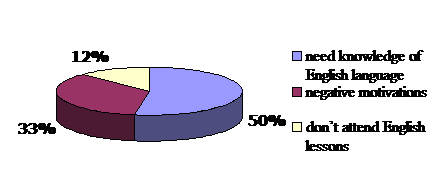
2 Motivation of learning English (experimental group 8 «B»)
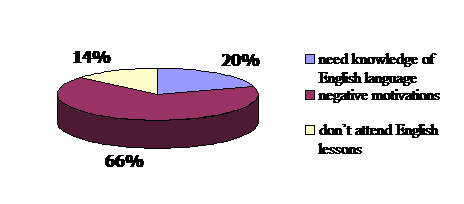
The second purpose of our research is to determine the effectiveness of teaching. It is estimated by us according to 3 indicators: linguistic competence, activity in communication process and during the whole lesson and preparedness with home task. Below we put criteria for these indicators:
1. Linguistic competence.
High level: fluent knowledge (corresponding to the level of the 8th form) of grammatical components of language, correct pronunciation of words, vocabulary allows to express their thoughts rather freely.level: In the grammatical, phonetic and lexical components of language minority of mistakes are acceptable, but only when the material is new or has higher level of complexity for pupils at this age.level: A great number of mistakes in the material, which has been previously studied, the usage of incorrect grammatical structures, poor vocabulary, frequency of incorrect pronunciation of words.
2. Activity in communication process and during the whole lesson
High level: A pupil participates during the lesson, using as much knowledge of English, as possible. He is able to improvise, pays attention to speech of other in order to take part in all discussions.level: A pupil is involved in the work during the lesson, but rather often he can’t continue to be active all the time because of misunderstanding of some phrases and as a result his level of activity gradually goes down.: A pupil can hardly understand teacher and his classmates, he doesn’t follow the situation and that’s why it leads to the minimum of activity and participation during the lesson.