Материал: 2

See discussions, stats, and author profiles for this publication at: https://www.researchgate.net/publication/282939817
Improved DC power distribution with multi-input single-control systems using boost converter
Article in International Journal of Applied Engineering Research · January 2015
CITATIONS |
READS |
3 |
38 |
5 authors, including:
Kuppusamy KarthiKumar
Veltech Multitech Dr. Rangarajan Dr.Sagunthala Engineering College
33 PUBLICATIONS 157 CITATIONS SEE PROFILE
Some of the authors of this publication are also working on these related projects:
Power quality monitoring View project
All content following this page was uploaded by Kuppusamy KarthiKumar on 06 January 2021.
The user has requested enhancement of the downloaded file.

International Journal of Applied Engineering Research
ISSN 0973-4562 Volume 10, Number 3 (2015) pp. 7815-7829 © Research India Publications
http://www.ripublication.com
Improved DC Power Distribution With Multi-Input Single-
Control Systems Using Boost Converter
1M.Karuppiah 2K.Karthikumar 3A.Arunbalaj 4L.Dhineshbabu 5S.Krishnakumar
Assistant Professors
Department of Electrical and Electronics Engineering Vel Tech (owned by RS trust) Engineering College Avadi, Chennai-62, Tamilnadu, India.
1karuppiah2730@gmail.com 2kumarkk1@gmail.com 3aarunbalaj@gmail.com
4dhineshbabu09@gmail.com 5krishna.veltech@gmail.com
Abstract
Environmentally friendly technologies such as photovoltaic’s and fuel cells are DC sources. In the current power infrastructure, this necessitates converting the power supplied by these devices into AC for transmission and distribution which adds losses and complexity. Now-a-days, due to power failure, there is a great used for UPS systems in our homes or in workplaces and also the amount of DC loads in our buildings is ever-increasing with computers, televisions, and other electronics entering our workplaces. This forces another conversion of the AC power to DC, adding further low power ratings, losses and complexity. Due to low power rating of the system, it is very important to reduce number of converter stages and use the generated energy efficiently. Therefore, instead of using different dedicated converters from various uni-directional renewable sources, this paper proposes a single stage boost converter with multiple inputs that can efficiently decimate generated energy. The proposed converter works under various operating modes which are discussed in this paper. This paper proposes the use of a DC distribution system.
Introduction
Increasing demand and environmental concerns have forced engineers to focus on designing power systems with both high efficiency and environmentally friendly. The natural resources such as fossil fuels while reducing the human impact on the environment through a reduction in pollution. The most well-known environmentally friendly is photovoltaic’s and wind turbines [1]. Although fuel cells are not considered an environmental friendly, but fuel cells have low emissions compared to other forms of energy. Unfortunately, the established power system infrastructures are
7816 |
M. Karuppiah |
based on alternating current (AC) while two of the leading environmentally friendly energies, fuel cells and photovoltaics, produce direct current (DC). Currently, power system infrastructures that wish to incorporate fuel cells and photovoltaics must first convert the DC power produced by these energy sources to AC [2]. This adds complexity and reduces efficiency of the power system due to the need of a power converter. Furthermore, a due to power failure, there is a great used for UPS systems in our homes or in workplaces and an increasing number of DC consuming devices such as computers, televisions, and monitors are being incorporated into our buildings. The power supplied to these devices must be converted again from AC back to DC adding further losses and complexity to the power system. Instead of using multiple converters to convert DC to AC and then AC to DC, the power system could only be based on DC. This would eliminate the need for two sets of converters for each DC load, reducing the cost, complexity, and possibly increasing the efficiency. However, a definitive analysis on a DC distribution system is needed to determine the net benefits of eliminating the converters. In the environmentally friendly energies photovoltaic, wind and fuel cells are having some of the drawbacks, likes night time, raining session and low wind there are low power generated in photovoltaic’s and wind, so reduces this drawback using multiple energy source for a distribution this paper, proposes the use of a DC distribution system using multi input single control system.
Problem Background
Since the development of electricity, AC has been describing as the better choice for power transmission and distribution. However, Thomas Edison one of the founders of electricity supported the use of DC. No method at that time existed for boosting and controlling DC voltage at the load, so that transmission of DC power from generation to load resulted in a large amount of losses and voltage variations at the different load locations. To resolve this issue, Westinghouse proposed AC distribution [2]. Tesla showed the practical advantages of alternating current. Transformers made it possible to step up an AC voltage easily, this allowed for efficient transmission of power from one location to another resulting in a complete transformation of the power systems to AC. Although many things have changed since the invention of electricity, AC is still the fundamental power type of our power infrastructure. However, due to the development of power electronics which gives a better utilization of existing transmission corridors with high voltage DC connections. High voltage DC transmission allows more power to be transmitted over a long distance with fewer losses compared to an AC transmission. Power electronics makes efficient and accurate control of electrical power possible. Efficient AC to DC, DC to AC and DC to DC conversion technology are now available on the market, where DC to DC conversion is more efficient than AC to DC conversion. Power converters and DC energy sources, interest in DC has returned. Several studies have investigated the use of a DC distribution system.
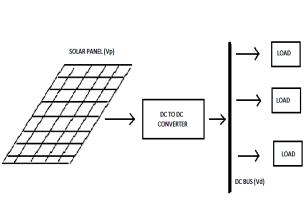
Fig. 1 shows the block diagram of a obtainable system. An input solar source (Vp) is interfaced to a DC distribution bus (Vd) using a DC to DC converter. It uses a DC
Improved DC Power Distribution With Multi-Input Single-Control Systems et.al. 7817
based distribution with various loads connected to it through dedicated point-of-load. The idea is basically inspired from computer power system. The renewable power sources are generally DC. Due to the intermittent nature of renewable sources, even though the generated power is AC or DC (e.g., solar power is DC and wind power is AC), they are converted to a DC and use it further processing. Another factor that improves efficiency is: more the distribution voltage (Vd) less is the current for the same power level. Therefore, a boost stage between the solar panel and distribution bus is advantageous [3]. The choice of voltage level is dependent on the power level of the distribution and available area for renewable installation. Never the less, in most implementations, a boost converter is used to interface the source with the DC bus. This is because, from MPPT point of view, in a smaller installation, the solar panels (generally, with open circuit voltage of 12-36V) are not preferred to be connected in series. They are paralleled as this arrangement has less impact on power generation. So reduce this power generation using conventional system of a single stage boost converter with multiple inputs that can efficiently decimate generated energy.
Figure 1: Existing system block diagram
Proposed System
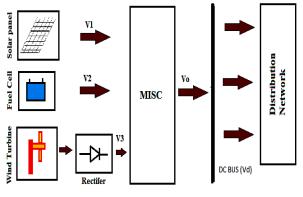
Future DC based system will have various sources interfaced to the DC-distribution bus as shown in Fig. 2. Unidirectional Renewable Sources are interfaced directly to the converter from which power is supplied to the distribution bus. When bidirectional sources are used it is directly interfaced to the distribution bus through a dedicated converter. Renewable Sources have varied characteristics, e.g., a solar array is a current source and a fuel cell is a voltage source. In order to interface all these sources to a single domestic supply grid, a converter has to be interfaced between the respective nodes. The converter takes care of the regulation and protection which arises because of the interfacing a multiport converter is described which uses multiple boost converters with common output as interfaces between various sources and the DC bus. A multi-input series output concept is used to realize this interface which works at ZVS. Most of the researches have addressed the multi-source power utilization problem by using individually controlled converters. That means, the
7818 |
M. Karuppiah |
source and DC bus have a dedicated converter between them. This option is quite good for higher power installations. However, in a DC bus where the power generation is limited and the sources have limited output, these options may not be the most efficient ones as more converters will degrade efficiency and reliability. This paper looks at an alternate circuit to realize a power electronic interface for DC bus, with multiple unidirectional input sources and a single output. The converter structure is realized using a single master control with multiple sources of relatively smaller power rating. The output of the converter is directly connected to a distribution network an additional stages as well as MPPT control.
The organization of paper is as follows Section II gives a problem background and existing system. Section III describes general topology of proposed Converter. Section IV and V describes the possible modes of operation a multi stage converter system with different input sources. Section VI describes the master source control. In Section VII experimental verification of proposed topology is done. Section VII presents conclusion of this paper.
Figure 2: The Proposed system block diagram
Multi-Input Single Control (MISC) Topology
The overall topology is derived from boost Converter as shown in Fig. 3. There is a Master source S1 this source can be voltage or current source and slave sources S2 to Sn are interfaced to the drain of the control switch through dedicated inductors. The converter topology is referred to as Multi Input Single Control due to the fact that the master source is always in control of the duty [4]. The Master Source S1 fixes the duty cycle of switch Ml based on the MPP operating point of the input source, if input is a solar panel. In this case the current is used to supply the loads connected to this bus. In case of a voltage source, the output current of the boost can be controlled. The loads are connected to DC bus directly. As the converter topology is based on boost converter output voltage is always greater than input voltage for the operation of the converter.