Материал: 2177

VII. Work in pairs. Ask each other 6 special questions (to the each part of the text) and answer them.
VIII. 1) Watch video #7 (58:11): a lecture of Stanford University Professor about Introduction to Robotics. 2) Draw up a plan and present the main ideas to your groupmates. 3) Discuss your ideas in your
group. 4) You may write an essay or a summary according to this ma- |
||||||
terial as well. Useful tips how to write a good essay you may find here: |
||||||
https://www.internationalstudent.com/essay_writing/essay_tips/#body |
||||||
и |
|
|
|
|||
С HOME TASK 15 |
|
|
||||
A. Memorize the words from Ex. I and be ready to do a dictation. |
||||||
|
б |
|
|
|||
B. Complete the following sentences with the information from the |
||||||
text “CNC”: |
А |
|
||||
1. |
The title of the text is … |
|
|
|
||
2. |
The main idea of the text is … |
|
|
|
||
3. |
… under analysis… |
Д |
||||
4. |
…taken into consideration … |
|||||
5. |
It is interesting … |
|
||||
6. |
It is important that … |
|||||
|
|
|
||||
7. |
It is known that … |
|
|
|
|
|
8. |
In conclusion … |
|
|
|
|
|
C. Write the summary of the text “CNC (Computer Numerical Con- |
||||||
trol)”. |
|
|
|
|
||
|
|
TEST YOURSELF |
|
|
||
|
CNC is automation of machine tools that are operated by pro- |
|||||
grammed 1) ___ through a computer, as opposed to 2) |
controlled via |
|||||
handwheels or levers. |
|
|
И |
|||
In CNC systems, end-to-end component design is highly automated using 3) ___ programs. All the manufacturing operations are generated and verified in 4) ___. The computer produces a 5) ___ that includes all the commands needed to operate a particular machine. Then this file is loaded into the CNC machine’s computer for 6) ___. The computer on the ma-
111

chine keeps sending the 7) ___ to the machine and the operation continuous same as verified in the computer software.
CNC has touched almost every 8) ___ of manufacturing. Many machining processes have been improved and 9) ___ through the use of CNC. Let’s look at some of the specific fields and place the emphasis on the manufacturing processes 10) ___ by CNC machine usage.
Machining processes that have traditionally been done on 11) ___
|
machine tools that are possible with CNC 12) ___ include all kinds of mill- |
|||||||
|
ing. In similar fashion, all kinds of turning operations are done on CNC 13) |
|||||||
|
|
. There are all kinds of special operations of these two machine types |
||||||
|
including CNC milling machines, CNC drill and tap centers, and CNC |
|||||||
С |
|
|
|
|
|
|||
|
lathes. Grinding operations of all kinds are also being done on CNC 14) |
|||||||
|
___. CNC has even opened up a new 15) ___ when it comes to grinding. |
|||||||
16) |
|
grinding which was previously infeasible due to technology con- |
||||||
|
straints is now possible (almost commonplace) with CNC grinders. |
|||||||
|
и |
|
|
|
||||
|
How many mistakes have you done? What are they? |
|||||||
|
What were the most difficult tasks for you? Why? |
|||||||
|
|
|
б |
|
|
|||
|
Lesson 16 |
|
|
|
|
|
||
|
Refresh the words in Ex. I (Lesson 15) and get ready to have a |
|||||||
|
dictation. |
А |
||||||
|
|
|
|
|||||
|
I. Listen and repeat. Using the dictionary, write in the [træn'skripSn] |
|||||||
|
of the words into the table below. |
|
|
|
||||
|
|
|
|
|
|
|
|
|
1 |
|
material han- |
|
……………… |
система перемещения мате- |
|||
|
|
|
dling system |
|
|
Д |
|
|
|
|
|
|
|
риалов |
|
||
|
2 |
|
raw part |
|
……………… |
заготовка; необработанная де- |
|
|
|
|
|
|
|
|
таль |
|
|
|
3 |
|
assembly |
|
……………… |
сборка |
|
|
|
4 |
|
constraint |
|
……………… |
ограничение |
|
|
|
5 |
|
cart |
|
……………… |
|
И |
|
|
|
|
тележка |
|
||||
|
6 |
|
energize |
|
……………… |
присоединять к источнику пи- |
|
|
|
|
|
|
|
|
тания |
|
|
|
7 |
|
precise |
|
……………… |
точный; определённый |
|
|
|
8 |
|
tolerance |
|
……………… |
допуск |
|
|
|
9 |
|
detect |
|
……………… |
обнаруживать |
|
|
112

|
10 |
embedded |
|
……………… |
встроенный, заделанный |
|
|
|
11 |
tow chain |
|
……………… |
буксирная цепь |
|
|
|
12 |
trough |
|
……………… |
жёлоб |
|
|
|
13 |
drive pin |
|
……………… |
ведущий штырь |
|
|
|
14 |
cam |
|
……………… |
кулачок |
|
|
С |
|
……………… |
вращающийся, крутящийся |
|
|||
15 |
spinning |
|
|
||||
16 |
impart |
|
……………… |
сообщать, передавать |
|
||
17 |
disengagement |
|
……………… |
расцепление; разъединение |
|
||
18 |
asynchronous |
|
……………… |
асинхронный, несинхронный |
|
||
19 |
power-and-free |
|
……………… |
транспортёр с автономным |
|
||
|
|
conveyor |
|
|
|
управлением |
|
20 |
master |
|
……………… |
главный, ведущий, централь- |
|
||
|
|
|
|
|
|
ный |
|
21 |
manoeuvre |
|
……………… |
маневрировать |
|
||
22 |
storage and re- |
|
……………… |
транспортно-складская систе- |
|
||
|
иtrieval system |
|
ма |
|
|||
|
23 |
jig |
|
……………… |
зажимное приспособление |
|
|
|
|
|
А |
||||
|
II. Find the words in the text and translate the word combinations |
||||||
|
with these words.б |
||||||
|
III. Work in pairs. Study the prompts in italics. Think of 2 or 3 ques- |
||||||
|
tions using the words from Ex. I and the Formal Subject. Answer the |
||||||
|
questions of your partner. |
Д |
|||||
|
|
|
|
||||
|
|
Is it necessary to use an antenna to move batter- |
|||||
|
|
powered carts? |
|||||
|
|
Can one manoeuvre heavy parts without cranes? |
|||||
|
|
|
|
|
|
И |
|
* Find the sentences with the Formal Subject in the text below and translate them.
113
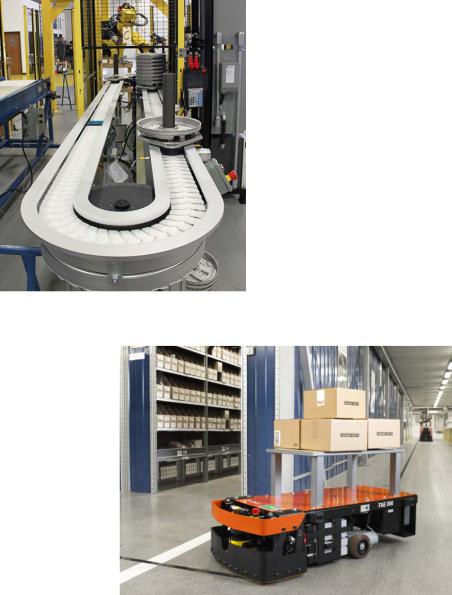
IV. What can you see in the pictures (pic. 30 – 32)? Have you seen such things with your own eyes? How do they work?
Си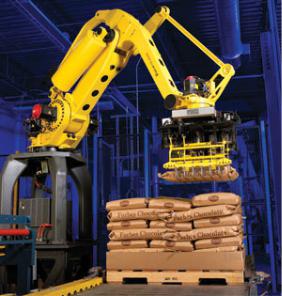 Pic.б30 Pic. 31
А Д И
Pic. 32
V. Read the text, then answer the questions in Ex. IV once again.
MATERIAL HANDLING SYSTEM (MHS)
Material Handling System (MHS) is used to move and store parts, as well as materials used in processing the parts (e.g., tools, coolant, wastes).
There are two principal forms of part transport: parts must be moved from outside the system into it, and they must be conveyed within the sys-
114
tem. Usually it is not convenient to combine these functions because movement into the system involves raw parts while movement within the system involves part, fixture and pallet assemblies.
An FMS is capable of simultaneously processing a wide variety of parts at different work stations. Parts are loaded and unloaded at a particu- Сlar location, and pallets are used to transport parts between machines. Once a part is loaded into the system, it is moved from the station to the other one under the computer control, its path being dependent on its pro-
cessing requirements, machine loads and other constraints of the system. Within the system, there are many possible pallet-movement designs.
Theиthree principal categories are carts, conveyors, and robots. Guidance and control of carts can take different forms. Carts can move along tracks, energized and controlled externally by the central computer. Sensors located at appropriate points along the track identify the precise location of the cart andбcan be used to position it to the required tolerance (typically 0.06 in) to transfer pallets to a machine or unload station. All carts should have dead-man bumpers at each end to help prevent accidents.
Battery-powered carts can be moved along a flat floor, guided by an antenna that detects aАwire embedded below the surface. Position sensors still must be used to control pallet transfer.
Another cart design may use a tow chain in a trough under the floor. The chain moves continuously, and cart movement is controlled by extending a drive pin from the cart downДinto the chain. At specific points along the guideway, computer-operated cam-type stop mechanisms raise the drive pins to cart movement. One advantage of this system is that it can provide some automatic buffering with stationary carts along the track. A variation of this method uses a floor mounted spinning cylinder that imparts motion to the roller drive of individual carts;Иa computer initiates drive disengagement, and the carts can be stopped at selectable locations.
Powered conveyors can be used for basic transportation between flexible machining cells or for positioning parts to interact with robots or other handling devices. Powered roller conveyors are designed to move pallets from the load stations to pallet exchangers located on the machines. Individual sections can have separate drives to control placement of pallets near machines. Special switches can provide feedback to locate pallets along the conveyor.
Asynchronous conveyors based on the principle of rotating tubes are used to place loads precisely for robots, as well as to move loads at high speeds. In machining centres, specialized conveyors us can be designed to
115